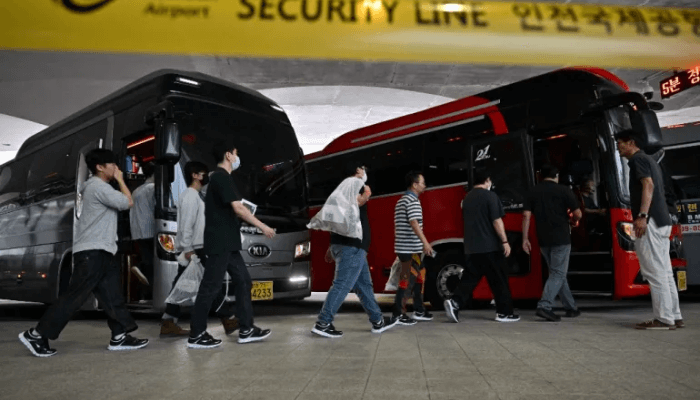
A chartered flight carrying hundreds of South Korean workers arrested in a sweeping United States immigration raid has landed in Incheon, closing a turbulent week that has shaken Seoul and cast uncertainty over ties with its most important ally.
The Korean Air Boeing 747-8I touched down at Incheon International Airport on Friday, bringing home more than 310 South Koreans who were detained in Georgia. They were among 475 people swept up at a Hyundai–LG battery plant construction site, in what US authorities have described as the largest single-site immigration enforcement action since Donald Trump returned to the White House.
Read also: Immigration raid at US Hyundai plant sparks Seoul–Washington tensions
South Korea’s foreign ministry confirmed the operation proceeded without incident. “Everything at Atlanta went smoothly,” an official told AFP, adding that Seoul had closely monitored the deportation process.
But the images of workers in handcuffs and chains triggered fury at home, where many viewed the arrests as humiliating and at odds with the spirit of a decades-long alliance.
Read also: South Korea bans phones in classrooms
At Incheon airport, protesters waved placards mocking Trump in an Immigration and Customs Enforcement (ICE) uniform. “You told us to invest, only to arrest us! Is this how you treat an ally?” read one sign, summing up a sentiment of betrayal that has gained traction in South Korea.
President Lee Jae-myung called the raid “bewildering” and warned that such actions could deter future investment in the United States. “We are pressing Washington to ensure that visa issuance for investment-related purposes operates normally,” he said in remarks on Thursday.
Read also: South Koreas new president Lee Jae-myung vows economic revival, judgment on martial law
The raid comes at a sensitive moment. South Korea has been one of the biggest foreign investors in America’s clean energy and electric vehicle sectors, funnelling billions of dollars into new plants and creating thousands of jobs. That partnership was supposed to underpin both economic cooperation and the climate goals of Washington and Seoul.
Instead, the spectacle of South Korean workers led away in shackles has cast doubt on the security of those investments and raised questions over whether US immigration enforcement is colliding with its own industrial policy.
For now, the deported workers are back on home soil, but the diplomatic fallout is only beginning. Both governments face the difficult task of reassuring industries and workers that investment and cooperation will not be derailed by raids of this scale.

Join BusinessDay whatsapp Channel, to stay up to date
Open In Whatsapp