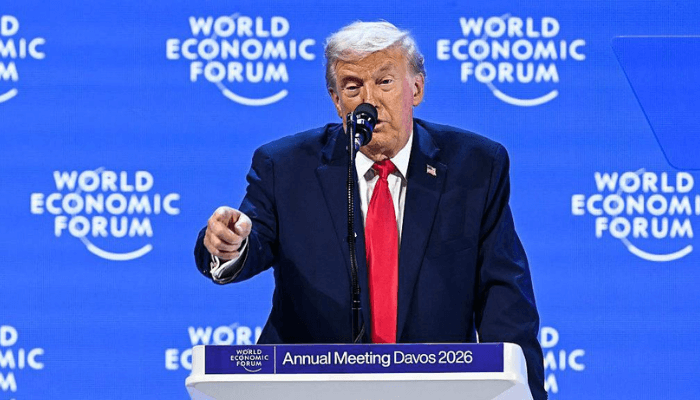
Donald Trump, United States President, used his appearance at the World Economic Forum in Davos to restate hard-line views on global security, alliances, and American power, while insisting he would stop short of military force in pursuing his most controversial ambition.
In a wide-ranging and largely combative speech, Trump defended his demand for control of Greenland, criticised European leaders, weighed in on Venezuela, Canada, and Ukraine, and questioned whether long-standing allies still pull their weight. His remarks underscored a worldview built around leverage, pressure, and what he described as American generosity met with global ingratitude.
Read also: Trump rules out forceful acquisition of Greenland, seeks negotiations
Here are the key takeaways from Trump speech in Davos.
He says he will not take Greenland by force
Trump offered his clearest assurance yet that he would not use military force to seize Greenland, a self governing Danish territory he argues is vital to US security.
“People thought I would use force, but I don’t have to use force,” he told the Davos audience.
While repeating his belief that Greenland should fall under US control, Trump said diplomacy and pressure would be enough. Until now, he had declined to rule out military options.
Despite ruling out force, Trump showed no sign of backing away from his demand. He argued that Denmark is incapable of defending Greenland and that only the United States can secure it.
“We need it for strategic national security and international security,” he said, describing the island as effectively part of North America.
He also accused Denmark of being “ungrateful”, citing US protection during World War II as justification for his claim.
He hints at consequences for allies
Trump suggested that countries opposing his ambitions could face economic or political consequences. Shortly after the speech, he said he had reached a “framework of a future deal” on Greenland after meeting NATO Secretary General Mark Rutte.
He later agreed to lift threatened tariffs on European allies, signalling that trade pressure remains central to his negotiating style.
Venezuela gets praise after pressure
Trump painted an upbeat picture of Venezuela’s future, claiming the country is rebounding after years of socialist rule. He praised cooperation from its interim leadership and said US and international oil companies were returning.
Read also: Venezuela shows how states fall when legitimacy and intelligence fail
Venezuela has been an amazing place for so many years, but then they went bad with their policies,” Trump said.
“Twenty years ago, it was a great country, and now it’s got problems. But we’re helping them. And those 50 million barrels, we’re going to be splitting up with them, and they’ll be making more money than they’ve made in a long time.”
“Venezuela is going to do fantastically well,” Trump said, predicting a rapid economic turnaround driven by oil revenues and foreign investment.
“Venezuela is going to make more money in the next six months than they’ve made in the last 20 years,” he said.
“Every major oil company is coming in with us. It’s amazing. It’s a beautiful thing to see. The leadership of the country has been very good. They’ve been very, very smart.”
“We appreciate all of the cooperation we’ve been given. We’ve been given great cooperation. Once the attack ended, the attack ended, and they said, ‘Let’s make a deal.’ More people should do that.”
Canada and Europe face sharp words
Trump pushed back forcefully against criticism from Canadian Prime Minister Mark Carney, accusing Canada of benefiting from US support without showing gratitude.
“Canada gets a lot of freebies from us, by the way. They should be grateful, but they’re not,” Trump said, taking issue with Carney’s earlier remarks at the conference. “Canada lives because of the United States. Remember that, Mark, the next time you make your statements.” he said.
More broadly, Trump accused European leaders of mismanaging immigration and security, saying parts of the continent were “not even recognisable anymore”.
“Certain places in Europe are not even recognisable, frankly, anymore. They’re not recognisable. And we can argue about it, but there’s no argument,” Trump said
“Without us right now, you’d all be speaking German and a little Japanese,” he said.
Read also: What Canada’s new work licence system means for foreign workers
He claims progress on Ukraine but facts differ
Trump said he was working with Russian President Vladimir Putin and Ukrainian President Volodymyr Zelenskyy to end the war in Ukraine, even claiming he was meeting Zelenskyy in Davos.
Ukrainian officials later confirmed Zelenskyy was in Kyiv, not Switzerland. Still, Trump insisted his goal was to stop what he called needless deaths and stabilise Europe.
A familiar message beneath it all
Running through Trump speech was a consistent theme: that the United States underwrites global security while allies fail to show appreciation.
“Without us, most of the countries don’t even work,” he said.
At Davos, Trump made clear that his foreign policy remains transactional, confrontational and centred on American dominance, even as he tries to reassure the world that he will not push it to war.

Join BusinessDay whatsapp Channel, to stay up to date
Open In Whatsapp