Egypt leads the way as economy stabilizes.
African stock market flotations are on track to reach their highest level since 2010, in dollar terms, according to analysis by Baker & McKenzie, the law firm.
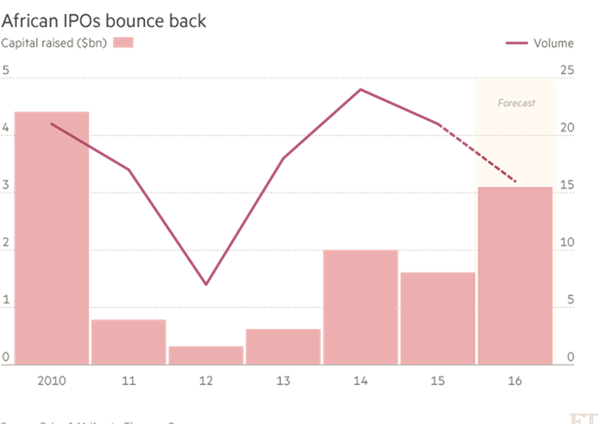
About $3.1bn is likely to be raised from at least 16 initial public offerings this year, the Chicago-based firm forecasts. If so, it would be the strongest year for African IPOs since 2010, when $4.4bn was raised, as the chart shows.
The projected rebound — to virtually twice last year’s figure and almost 10 times the 2012 low of $320m — comes despite a muted start for IPO activity globally amid heightened volatility, and a wave of capital outflows from emerging markets.
“There’s enormous pent up demand among issuers to conduct capital raisings, particularly in Egypt, which is showing strong growth and the emergence of a larger middle class,” said Edward Bibko, head of the Europe, Middle East and Africa capital markets practice at Baker & McKenzie.
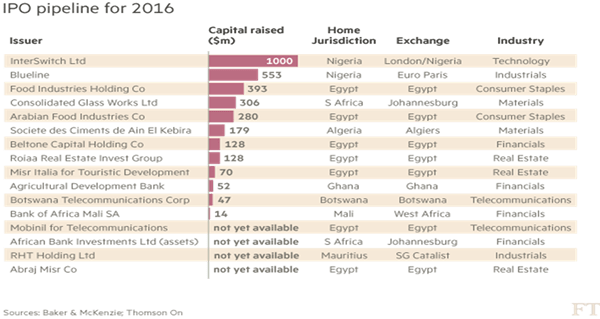
He predicted that the continent could see the first $1bn flotation by a genuinely African company this year if InterSwitch, a Nigerian fintech group that processes payments for banks, decides to list.
Mitchell Elegbe, founder and chief executive of InterSwitch, majority-owned by private equity group Helios Investment Partners, said in June 2015 that he was looking at an IPO in Lagos and London.
Essar Energy, whose headquarters are in Mauritius but is in essence an Indian company, raised $1.9bn, the largest sum by an African company to date, when it listed in London in 2010.
However Dolapo Oni, head of energy research for sub-Saharan Africa at Togo-based Ecobank, said InterSwitch was more likely to wait until the first quarter of 2017 to list, given the difficult funding environment.
Other significant IPOs pencilled in by Baker & McKenzie for 2016 include Blueline, a west African train project that Vincent Bolloré, the French tycoon, plans to list in Paris, and Consolidated Glass Works of South Africa (see the table).
Seven Egyptian companies will also float this year, the law firm believed, as the economy “reboots” following the country’s 2011 revolution and subsequent counter-revolution.
“We have been doing a lot of work with companies that focus on the growing middle-class in Egypt. There is a lightness of mood that you didn’t see before the election [of president Abdel Fattah al-Sisi in 2014],” said Mr Bibko, who sees IPOs in the food, real estate and financial sectors this year.
Egypt could see yet more flotations still this year, amid recent reports that the government is lining up the first privatisations of state-owned enterprises since 2005 to improve public sector finances and bolster Cairo’s capital markets.
 Tarek Amer, governor of the central bank, said earlier this month that it planned to float United Bank of Egypt, a state-owned lender with assets of $3.6bn.
Continent-wide, the number of IPOs could rise further if the East African Securities Exchange Association succeeds in improving liquidity by fast-tracking the integration of the region’s capital markets, said Mr Bibko, who foresaw three IPOs in Rwanda this year if that were to happen.
Sector-wise, activity is increasingly being focused on consumer staple and technology companies, a reversal from the focus on energy and power, real estate and financial services sectors in the past five years.
However, Mr Oni said he did not expect a pick-up in IPOs in sub-Saharan Africa this year as key countries such as Nigeria continued to be hit by the aftershocks of the commodity price rout.
Recent flotations, such as that of Seplat Petroleum Development Company in London and Nigeria and 2014, have also hurt investors in the pocket.
“It will be a major difficulty to push IPOs to market and get them oversubscribed or fully underwritten,” Mr Oni said.
At best, he believed companies would seek to get their documentation in place so they could float towards the end of 2016, if conditions improved.
Mr Bibko believed African-focused mutual funds operated by European and US asset managers still had the appetite to support deals, although he admitted that uncertainty over the level of redemptions could limit the amount they could commit to any given IPO.

Join BusinessDay whatsapp Channel, to stay up to date
Open In Whatsapp