The U.S. and Russia agreed to impose a cease-fire in Syria’s bloody civil war, seeking to ease the country’s deepening humanitarian crisis and begin talks on a political transition that opponents of President Bashar al-Assad hope will lead to his ouster.
U.S. Secretary of State John Kerry announced the deal with Russian Foreign Minister Sergei Lavrov late Friday in Geneva after a day of negotiations. Under the agreement, fighting would be halted at sundown on Sept. 12. If the cease-fire holds for seven days, the U.S. and Russia would then work together to target an al-Qaeda affiliate formerly known as the Nusra Front, which in some cases has mingled with rebels that the U.S. supports.
“If this arrangement holds, we will see a significant reduction of violence across Syria,” Kerry told reporters alongside Lavrov. “After a period of reduced violence, then we will see the United States and Russia taking coordinated steps” to fight terrorists and restart a political process.
Friday’s accord is the latest effort by the U.S. and Russia to stem violence that has killed more than 280,000 people over 5 1/2 years. A February cease-fire began falling apart within weeks, and in the months since, Russia has stepped up its support for Assad by sending its jets to bomb Aleppo and other areas controlled by rebels.
With the Syrian conflict drawing Russian, Iranian, and U.S. forces, along with Islamic State terrorists and armed opposition groups, Lavrov said that “no one can give a 100 percent guarantee” that the deal will hold.
Kerry and Lavrov had met several times in recent weeks to try to pin down the deal. A key concern for Russia was that the Nusra Front — which recently changed its name to Jabhat Fatah al-Sham — has in many cases teamed up with moderate rebels the U.S. supports, particularly in and around Aleppo. Kerry said the U.S. and Russia would work to cut those rebel links with the al-Qaeda fighters. “The warning we give to opposition groups who have until now found it convenient to work with them is it would not be wise to do so,” he said.
Speaking after Kerry, Lavrov said Syria’s government is aware of the agreement and has agreed to abide by it. “We and the U.S. commit to doing everything we can to make sure all sides” fulfill their obligations, he said.
“Getting the Assad regime to comply with the Russian part and the opposition to comply with the U.S. part is going to be a real struggle,” said Andrew Tabler, a fellow at the Washington Institute for Near East Policy. “I think it’s going to be very hard for it to hold.”
Millions Fleeing
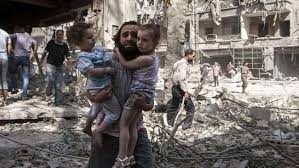
The relentless war in Syria has sent millions fleeing to neighboring countries and Europe. It has also allowed Islamic State to seize territory that it has used as a base to direct and inspire terrorist attacks worldwide.
The biggest impact of the deal may be the U.S. and Russia agreeing to cooperate militarily, something they have not done before, according to Tabler. That idea has faced skepticism from the U.S. Defense Department and other agencies, which are wary of the U.S. entering into any such compact with Russia.
The Russian-U.S plan calls for a joint operations center with intelligence and military officials from both countries. Pentagon spokesman Peter Cook said Russian commitments, including the seven days of cease-fire, must be “fully met before any potential military cooperation can occur,” according to an e-mailed statement.
Under the plan announced Friday night, Syria’s air force would be grounded in parts of the country in an effort to halt the humanitarian crisis and end the bombing of moderate opposition groups that are supported by the U.S. and its allies in their effort to defeat Islamic State terrorists. That would enable the various parties to come to the table for talks on a political settlement. The deal also calls for unimpeded access for aid deliveries.
Assad’s forces, backed by pro-Iranian Hezbollah militia and Russian air power, this week cut off the last rebel supply line to the opposition-held part of Aleppo, restoring a siege that was broken last month, the Syrian Observatory for Human Rights said. Syrian troops and their allies also retook almost all the territory lost since a July 31 offensive by the opposition forces in south and southwestern Aleppo province, according to the group, which monitors the conflict through activists on the ground.
Under the deal, government and opposition forces must pull back from the Castello Road, one of the main routes into Aleppo, Kerry said.
“President Obama has gone the extra mile here in order to try to find a way if possible to end the carnage on the ground in Syria,” Kerry said. He said he hoped that Russian President Vladimir Putin “has made the decision to commit resources of Russia to make sure the Assad regime lives up to its obligations.”

Join BusinessDay whatsapp Channel, to stay up to date
Open In Whatsapp