“When the rain falls, it doesn’t fall on one man’s house alone.” – Bob Marley
The escalating confrontation in the Middle East following the killing of Iran’s Supreme Leader, Ayatollah Khamenei, in a U.S.–Israeli military operation illustrates a recurring pattern in global politics: geopolitical shocks rarely remain confined to where they begin. Oil markets have reacted sharply, and diplomatic tensions have intensified across one of the world’s most critical energy corridors. For Nigeria and other African economies tied to global oil markets, the consequences are never distant.
These developments are not without precedent. History shows that military interventions undertaken in the name of stability, democracy, or security often produce outcomes far more complex than anticipated. What begins as a strategic action frequently evolves into a chain reaction that reshapes regional and global systems. As tensions rise again, the key question is what lessons those experiences offer policymakers navigating an increasingly volatile world.
One example occurred in 1953, when the United States and Britain supported the overthrow of Iran’s democratically elected Prime Minister, Mohammad Mossadegh, after he nationalised the country’s oil industry. The coup restored the Shah but deepened anti-Western sentiment, contributing to the 1979 Iranian Revolution, an event that reshaped global energy politics and continues to influence international relations.
The 2003 invasion of Iraq provides a more recent illustration. Justified partly by claims that Iraq possessed weapons of mass destruction, the intervention led to the collapse of state institutions, prolonged insurgency, and the emergence of extremist groups whose influence extended beyond the region into Europe and global security systems.
Libya in 2011 presents another cautionary case. The removal of Muammar Gaddafi led to state fragmentation, militia conflict, and the spread of arms across the Sahel, contributing to insecurity in parts of West Africa, while disruptions in oil production affected global supply balances. These cases show that external military interventions rarely produce the tidy outcomes imagined by their architects, with consequences that spill across borders and reshape markets, security systems, and economic stability.
The killing of a long-serving head of state is not merely a tactical event; it reshapes the strategic terrain of international politics. Such actions intensify nationalism, strengthen hardline factions, and deepen cycles of retaliation. In the current confrontation between the United States, Israel, and Iran, these dynamics intersect with global energy systems. Iran’s proximity to the Strait of Hormuz, through which nearly 20 percent of global oil traffic passes, gives it significant leverage. As tensions escalate, threats to shipping routes and energy infrastructure are influencing prices and raising risks of wider disruption. The effects travel across the global economy. Rising oil prices increase transportation costs, drive food inflation, and place pressure on currencies. For African economies integrated into global trade and financial systems, these shocks are transmitted rapidly and often disproportionately.
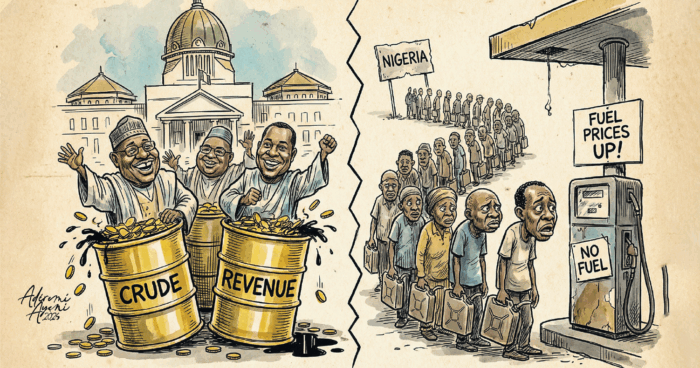
Africa is often described as peripheral to global geopolitics, yet it is deeply embedded in global markets, infrastructure financing, and security arrangements. As great-power competition intensifies, the continent is increasingly affected by decisions made far beyond its borders. Nigeria’s position in this system is both advantageous and precarious. As Africa’s largest crude exporter, the country can benefit from rising oil prices through increased government revenue. In 2025, Nigeria generated approximately $31 billion in oil earnings, underscoring the sector’s continued importance.
Yet this advantage is offset by structural vulnerabilities. Data suggest that Nigeria has experienced one of the sharpest domestic impacts of the current crisis, with fuel prices rising by nearly 40 percent. Higher global oil prices translate into increased transportation costs, inflationary pressure, and rising burdens on households and businesses. This paradox is not new. Oil booms in the 1970s, early 2000s, and 2010s generated significant revenue inflows, but much of this was absorbed through consumption, patronage networks, and inefficient spending, leaving underlying weaknesses intact.
Efforts to reduce vulnerability through domestic refining have made progress, with the emergence of the Dangote Refinery. However, despite its 650,000 barrels-per-day capacity, supply constraints persist. Limited access to crude feedstock has forced partial reliance on imports, reducing its ability to stabilise domestic fuel prices fully. Nigeria remains exposed to global oil shocks not only through prices, but through internal inefficiencies that amplify external volatility.
Moments of global instability also present opportunities, but only for countries capable of disciplined response. Nigerian policymakers must strengthen fiscal buffers by channeling oil windfalls into transparent stabilisation funds and sovereign wealth mechanisms. Domestic refining capacity must be fully operationalised, with all national refineries functioning efficiently through reform, concessioning, or privatisation. Economic diversification must move beyond rhetoric. Expanding agriculture, manufacturing, and digital exports is essential to reducing reliance on crude oil. Nigeria must also pursue balanced diplomacy while strengthening regional cooperation through ECOWAS and the African Union.
It is tempting to interpret distant conflicts through ideological lenses. For policymakers, such positioning offers little value. Nations must pursue their interests with clarity and discipline. Nigeria’s urgent priorities remain unchanged: economic reform, infrastructure development, security stabilisation, and job creation.
The deeper challenge is not the absence of lessons, but the political incentives that discourage acting on them. Repeated oil windfalls and geopolitical shocks have exposed the same structural weaknesses for decades. The persistence of these vulnerabilities suggests that the problem is not knowledge, but the inability, or unwillingness, to translate knowledge into policy.
In the end, the question is not whether history teaches, but whether policymakers are prepared to listen and act.

Join BusinessDay whatsapp Channel, to stay up to date
Open In Whatsapp