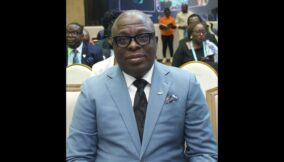
Peter Obi, the former Anambra State governor who rattled Nigeria’s political establishment in the 2023 presidential race, accepted the presidential nomination of the Nigerian Democratic Congress on Saturday, pledging to more than triple the country’s electricity output and pairing with former Kano State Governor Rabiu Kwankwaso as his running mate in what shapes up as an early and aggressive opening to the 2027 campaign season.
Speaking at the NDC convention in Abuja, Obi committed to adding at least 10,000 megawatts to Nigeria’s grid within his first four years in office, a target that would lift national generation and distribution capacity from roughly 4,000MW today to a minimum of 14,000MW.
“We currently generate and distribute a mere 4,000 megawatts of electricity for a population exceeding 200 million,” Obi told delegates. “Over the next four years, I commit to ensuring a minimum of 10,000MW power increase in generation and distribution.”
Nigeria’s electricity crisis is neither new nor abstract. Manufacturers routinely run diesel generators for the bulk of their operating hours, adding layers of cost that hollow out margins and suppress competitiveness.
Small businesses, from cold-storage operators to fintech firms dependent on data centres, absorb billions of naira annually in fuel expenses that their counterparts in peer economies largely avoid. The World Bank and multiple industry groups have for years pegged inadequate power supply as among the single largest constraints on Nigerian economic growth.
Obi, who favors pointed international comparisons in making his case to voters, leaned hard into that rhetorical device on Saturday.
He noted that South Africa and Egypt each generate and distribute more than 40,000MW of electricity despite carrying populations well below half of Nigeria’s 200-plus million.
This means Nigeria is not merely underperforming relative to its own potential, it is being lapped by regional peers operating at roughly ten times its current output per capita terms.
The choice of Kwankwaso as running mate is a calculated political signal. The senator and former Kano governor commands substantial loyalty in the Northwest, a region whose electoral weight has historically been decisive in Nigerian presidential contests. Obi’s own support base skews heavily toward the Southeast and urban professional voters — a coalition that in 2023 proved enthusiastic but ultimately insufficient. Kwankwaso’s addition is an unmistakable attempt to widen the ticket’s geographic and demographic reach before campaigning formally begins.
Beyond electricity, Obi outlined policy ambitions spanning healthcare, education, agriculture, security and governance, describing them collectively as the structural pillars of what he called a productivity-driven administration.
He offered fewer specifics in those areas on Saturday, suggesting the power pledge was deliberately chosen as the headline commitment — a concrete, measurable promise intended to anchor his economic credibility with voters exhausted by decades of vague campaign rhetoric.


Join BusinessDay whatsapp Channel, to stay up to date
Open In Whatsapp