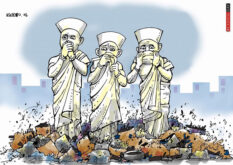
Nigeria’s economy may be under siege as a result of government mismanagement of the various reforms in the oil and Gas industry, according to analysts.
According to industry sources, this is as a result of the inability of government to successfully handle the Petroleum Industry Bill (PIB), which has been stranded at the national assembly for more than seven years with the consequent prevention of investments into the sector.
The sources confirmed that in the last 10 years, there has not been any exploratory activity in the oil and gas sector and because of this, it has become impossible to increase the nation’s crude oil reserve.
There is also the issue of non-payment of the cash call arrears which has reached over $7 billion and still counting for the joint venture operations as well as the issue of contracting circle which are frustrating investors daily.
Oil majors are cutting CAPEX needed to develop deepwater assets on account of low oil prices and tight margins.
Mutiu Sunmonu, chairman, Julius Berger Nigeria Plc, who spoke at the dialogue session organised by the Lagos Chambers of Commerce and Industry (LCCI), said one of the problems of the oil and gas industry is instability in policies, adding that emphasis must be placed on the sanctity of contracts. He said: “Ease of doing business has been on the agenda of successive governments, but at the moment, the indices are not looking well.”
Sunmonu said while Nigeria is targeting economic diversification, it should ensure that the oil and gas sector succeeds in a short term, as its revenue is needed for diversification projects.
Austin Avuru, managing director, Seplat, said that daily consumption of natural gas has grown from 300mscf over the last few years to about 1.7Bcf today, adding that if Nigeria strives to push its gas consumption to 3bcf by 2020, the resource will become engine of economic growth and development and in the process, deliver 15,000MW of electricity and all its multiplier effects.
Some of its multiplier effects include the establishment of production of fertilizer that will ensure food sufficiency and export to neighbouring countries and establishment of petrochemical plants, which will create quantum jobs for the unemployed.
Avuru said that the way to achieve these objectives is to ensure free market economy, invest in infrastructure, and the issue of the great disparity between prices charged by gas producers ($2.50) and the end user price ($7.50) will disappear.
The Seplat chief executive said that in addition to aggressive gas development, Nigeria should strive to meet the target of refining locally 1.2 million barrels of crude oil per day.
“If we strengthen and grow our local refining capacity to at least 1.2 million barrels per barrel a day, Nigeria will become the hub for petroleum products in West Africa and beyond. We can also invest another $300 million to put receiving terminals in different parts of West Africa, the entire region will stop importing petroleum products from Europe,” he said.
The inaction on the side of the government to properly articulate what should be done in the Niger Delta region has also been responsible for the issue of insecurity and militancy, which have crippled the oil and gas production.
About 30 attacks have been recorded since January with over 1000 vandalised points. Transcorp Power plant has joined the list of about a dozen power plants starved of gas and power generation companies that are threatening blackouts over debts by government ministries and departments including the Ministry of Power, Works and Housing.
Industry operators warn that unless proactive measures are taken, the way out of the current recession may be long and torturous, as job losses, weak consumer purchasing power, dearth of gas to power plants, high fuel costs, government’s opulence in the midst of stark national poverty may further worsen the situation.
“The biggest problem is not that the country is in a recession or having problems with militancy,” a source close to the government confided in BusinessDay, “the real issue is that there is no sense of urgency with this government, no intense engagement with the issues.”
Contrasting Barrack Obama’s 2008 foray into the Whitehouse and how the country managed to wade through the 2008 recession, the source said, “We saw engagement with the people, we saw a government with a blueprint, we saw frantic action – bailouts, job creation drives, improving manufacturing, investments in infrastructure – but this is not the same here.”
Closure of terminals for repairs after militant bombings has led to loss of thousands of jobs as local service contractors, vendors, temporary oil workers and ancillary service providers now idle away with grave consequences for the country.
Already, Nigeria’s 2017 budget projections of $42.5 per barrel and 2.4 million barrels per day are at risk as each new day, a different ragtag group of criminals with access to dynamites calling themselves militants, inflict grave damage to the nation’s economy and the ecosystem of the Niger Delta. The 2016 budget has an $11bn hole, which has led the government to make frantic efforts to borrow to plug it.
Jude Amaefule, vice chairman/CEO, Emerald Energy Resources Limited said, “Instead of settling kings and chiefs, thereby creating a never ending cycle of violence and brigandage, the Niger Delta will be best served if a carefully planned agro-based community empowerment initiatives is created for the people.”

Join BusinessDay whatsapp Channel, to stay up to date
Open In Whatsapp