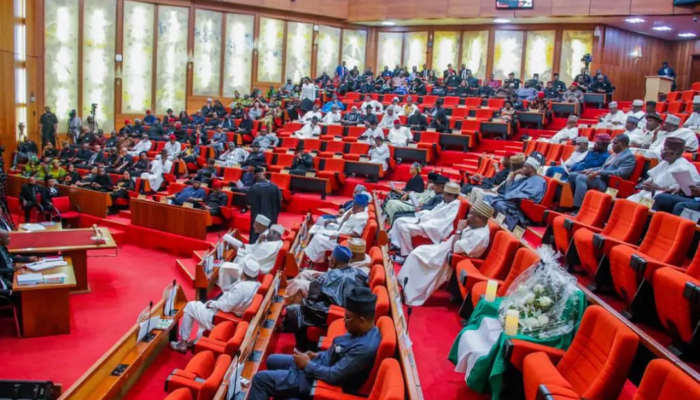
The four senators sworn into the Senate last Wednesday have little time to settle into their new roles.
With barely one year left before the 10th National Assembly winds up in June 2027, Olaka Nwogu (PDP, Rivers South-East), Danladi Halilu Envulu-Anza (APC, Nasarawa North), Ikeje Asogwa (APC, Enugu North) and Dayo Faduyile (APC, Ondo South) must navigate one of the shortest tenures any Nigerian senators have served while carrying the full weight of legislative responsibilities and the political expectations that come with the office.
Their inauguration by Senate President Godswill Akpabio restored representation to four senatorial districts left vacant by the deaths of serving lawmakers and, in one case, the resignation of a senator.
But beyond filling the vacant seats, their arrival comes at a defining moment for both their legislative careers and their political futures.
Unlike senators elected at the beginning of a parliamentary term, the quartet has no luxury of a settling-in period.
They are immediately expected to participate in debates, scrutinise executive policies, sponsor legislation, serve on committees, and represent their constituents, all while preparations for the January 2027 general elections gather momentum.
For three of them, the clock is ticking even faster.
Nwogu, Asogwa, and Faduyile have already secured their parties’ tickets for the January 2027 elections, giving them barely a year to use the advantages of incumbency to convince voters they deserve fresh four-year mandates.
Envulu-Anza, however, is not seeking a return to the Senate, having emerged as a placeholder ahead of the expected bid by the incumbent Nasarawa State governor for the Nasarawa North seat in 2027.
Despite the limited time available, the four lawmakers assume office with the full constitutional powers and privileges of senators.
They can sponsor bills, move motions, scrutinise budgets, oversee ministries and agencies, and influence national policy.
What they cannot do is extend their tenure beyond the life of the current Senate, as lawmakers elected through by-elections serve only the unexpired terms of those they replace.
Their arrival therefore presents a unique political equation.
They have limited time to make legislative impact, yet the office offers them significant visibility, influence and, for three of them, an incumbency advantage as they prepare for another electoral contest.
The vacancies arose following the deaths of serving senators and, in one case, a resignation.
Nwogu won the Rivers South-East by-election conducted after the death of Barry Mpigi.
Envulu-Anza emerged victorious in Nasarawa North following the death of Godiya Akwashiki.
Asogwa replaced Okey Ezea after the Enugu North senator died in office.
Faduyile won the Ondo South by-election following the resignation of Jimoh Ibrahim after his appointment as Nigeria’s representative to the Inter-Parliamentary Union.
Contrary to what some may assume, none of the four lawmakers has begun a fresh four-year tenure.
Nigeria’s Constitution provides that lawmakers elected through by-elections serve only the unexpired portion of the tenure of those they replace.
Consequently, all four senators will remain in office only until the expiration of the current National Assembly in June 2027 unless they secure fresh mandates at the next general elections.
However, their relatively short stay does not diminish the powers attached to their offices.
Having taken the oath of office, they are entitled to the salaries, allowances and privileges accruing to serving senators from the date of their inauguration.
They do not inherit salaries or allowances earned before assuming office, as those remain tied to the tenure of their predecessors and are handled through established administrative procedures.
More importantly, they inherit the constitutional responsibility of representing their senatorial districts.
Like every other senator, they can sponsor bills, move motions, participate in debates, scrutinise executive actions, approve budgets, screen presidential nominees and influence national policymaking.
Another major advantage is committee membership.
Much of the Senate’s oversight work is carried out through committees, where lawmakers examine budget implementation, investigate ministries, departments and agencies, review public expenditure and shape legislation before it reaches the chamber for final consideration.
Even with just about a year left, committee assignments will give the new senators opportunities to build legislative credentials and increase their public visibility.
Politically, the timing of their inauguration may prove even more significant.
Preparations for the January 2027 National Assembly elections are already underway, and three of the four senators have already secured their parties’ tickets to seek full four-year mandates.
For the three senators who have secured tickets, incumbency offers considerable political leverage.
Serving senators enjoy higher visibility within their constituencies and party structures.
They have greater access to stakeholders, government institutions and development agencies, while legislative activities provide opportunities to strengthen political networks, attract constituency projects and build public goodwill before the elections.
Whether that advantage ultimately translates into electoral victory will depend on their performance over the coming months.
Among the four, Olaka Nwogu arrives with the deepest parliamentary experience.
He previously served in the House of Representatives before representing Rivers South-East in the Senate after winning election in 2015.
His return gives him institutional knowledge and familiarity with Senate procedures that could enable him to settle more quickly into legislative business than some of his colleagues who are entering the chamber for the first time.
The by-elections also carried broader political implications.
The APC retained Nasarawa North, captured Enugu North and maintained its hold on Ondo South, while the PDP successfully defended Rivers South-East.
Beyond filling vacant seats, the contests served as an early test of party structures ahead of what is expected to be a fiercely contested 2027 election cycle.
For the four senators, the challenge now is straightforward but significant.
They have roughly one year to demonstrate legislative effectiveness, earn the confidence of their constituents and, for three of them, convert the advantages of incumbency into fresh four-year mandates.
Their tenure may be one of the shortest in the history of the Senate, but the political opportunities before them could shape their careers long after the 10th National Assembly has come to an end.

Join BusinessDay whatsapp Channel, to stay up to date
Open In Whatsapp