….as Shettima asks 26 states to inaugurate their state nutrition councils
The Nutrition 774 Initiative Strategy Board on Wednesday, adopted a domestic financing model as the sustainable foundation for nutrition investment in Nigeria, to close N500 billion financing gap
The gap is seen as likely to increase as foreign donors reduce their support for Nigeria’s nutrition program
The dwindling support has created over N500 billion financing gap which the government now seeks to close.
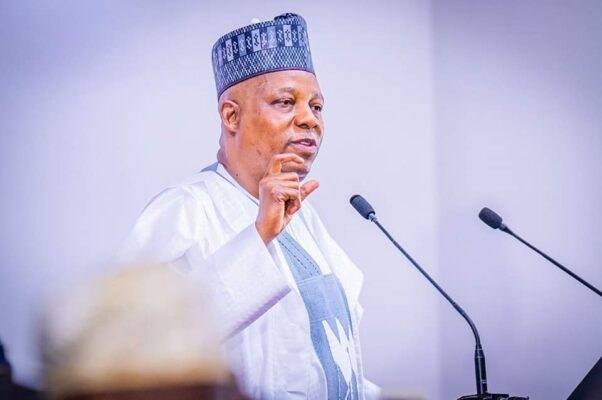
Vice President Kashim Shettima, who Chairs the Board, charged the remaining twenty-seven states that have not inaugurated their State Councils on Nutrition to close the gap by doing so, adding that ” every serious government eventually reaches the point where intentions must face instruments.”
According to him, “The N500 billion financing gap before us must move from a figure in a presentation to a funded programme on the ground. The National Nutrition Bill must move from zero draft to the National Assembly.
Shettima warned that the activation of domestic financing architecture, is necessary as donor financing for nutrition declines across the world, adding that “Nigeria can no longer plan on the assumption of indefinite external support.”
The board also mandated the Federal Ministry of Finance and other critical partners to embark on a robust stakeholder engagement programme in order to activate existing financing instruments, including the Presidential Nutrition Intervention Fund (PNIF), the Sugar-Sweetened Beverage (SSB) levy ring-fence, as funding streams for nutrition and related interventions in Nigeria.
Stanley Nkwocha, senior special assistant to the President on Media and Communications, office of the Vice President announced that the Board took the decisions on Wednesday at the 2nd High-Level Strategic Board meeting of the Nutrition 774 Initiative chaired by the Vice President at the Presidential Villa, Abuja.
The board noted the importance of the Nutrition 774 Initiative as the primary governance vehicle for delivering nutrition outcomes at scale across all 774 Local Government Areas (LGAs) in Nigeria.
Shettima, who doubles as chairman of the N-774 High-Level Strategic Board and Chairman of the National Council on Nutrition, noted that at the subnational level, the state governments and the Nigeria Governors’ Forum (NGF) must help complete the state-level architecture.
He also urged the NGF and the Association of Local Governments of Nigeria (ALGON) to ensure the inauguration of the remaining 26 State Councils on Nutrition and the establishment of the Local Government Committees on Food and Nutrition (LGCFNs) in the remaining 304 Local Government Areas across the country.
On the proposed National Nutrition Bill, Vice President Shettima urged the secretariat to liaise with critical stakeholders in the National Assembly, subnational governments and other partners in the nutrition sector with the view to getting valuable inputs from them before formally transmitting same to the National Assembly.
According to him, “The domestic financing architecture must be activated now, in this administration, within this governance cycle, and under the accountability of this Board. At the same time, the first 1,000 days of a child’s life do not wait for memos, circulars, or budget negotiations. While we deliberate, children across this country are within a window of growth that cannot be recovered once lost.
“This is why every constituency in this room must see its role in precise terms. The Federal Ministries here represented have nutrition obligations beyond the Ministry of Health. Agriculture determines the diversity, quality, and quantity of food available to households.
“Finance, Budget, and Economic Planning hold the appropriation-release-expenditure chain, and funds appropriated for nutrition that are never released do not feed children. Education carries the responsibility of knowledge and behaviour change. WASH, Women Affairs, Humanitarian Affairs, and Social Protection each hold a key to prevention, resilience, and access,” he added.
Shettima also charged legislature to give nutrition the legal backing and enforceability it requires, while development partners “must align investments with the N-774 rail.
“Civil society must hold up the mirror of truth. The private sector must recognise nutrition as an economic issue, because productivity begins with a healthy body and a capable mind,” he stated.
“The remaining State Councils and LGA Committees must be activated. The reports before us are decision-enabling reports, and our duty is to decide.”
He stated that the Nutrition 774 High-level Strategic Board was created to serve as a governance and accountability structure for the N-774 Initiative because every member of the NCN has a defined responsibility in the delivery chain.
According to him, the Renewed Hope Agenda of the Tinubu administration “places human capital development at the centre of Nigeria’s development trajectory, and nutrition is the foundation of that human capital.
“A malnourished child cannot become the engineer who builds our roads, the teacher who shapes our classrooms, the scientist who expands our frontiers, or the leader who carries our national burden. They deserve dignity in their aspiration to be what they desire,” he added.
The meeting was attended by the Chairman of the Nigerian Governors Forum and governor of Kwara State, AbdulRazaq AbdulRahman; Chike Okafor, Chairman of the House of Representatives Committee on Nutrition and Food Security and Mohammed Pate, Coordinating Minister of Health and Social Welfare.
Others are Abubakar Kyari, Minister of Agriculture and Food Security, Imaan Suleiman -Ibrahim, Minister of Women Affairs and Doris Uzoka- Anite, Minister of State for Budget and Economic Planning.
The event was also attended by Tunji Alausa, Ministers of Education, and Joseph Ustev, Water Resources.

Join BusinessDay whatsapp Channel, to stay up to date
Open In Whatsapp