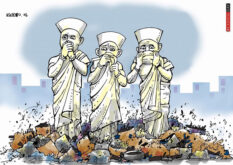
At a time Nigeria is battling severe cash crunch to fund development and pull itself out of recession, as well as a bloated recurrent spending, the Senate is planning to establish over 80 additional federal agencies, commissions and institutes.
If passed and signed into law, this will increase the number of federal agencies, departments, commissions and institutes in Nigeria to 624 from 541 presently.
BusinessDay learns that while most of the proposed agencies are at various stages of legislation at the upper legislative chamber, a few others have passed Third Reading awaiting concurrence from the House of Representatives.
There are also concerns over duplication of functions by some existing federal agencies, as about N2.987 trillion of N7.4 trillion 2017 national budget is allocated to 541 federal agencies, departments, commissions, institutes and other bodies.
Only 30 percent of the budget (N2.177trn) is allocated to capital expenditure.
According to the Abandoned Projects Audit Commission set up by former President Goodluck Jonathan, an estimated 11,886 Federal Government capital projects have been abandoned in over four decades across the country.
Some of the proposed agencies at various stages of legislation in the eighth Senate, according to investigation include: Senior Citizens Centre Bill, Complimentary and Alternative Medicine Practice Regulatory Council of Nigeria (Est., etc) Bill, Chartered Institute of Project Management of Nigeria (Establishment) Bill, Environmental Managers Registration Council of Nigeria (Establishment) Bill, National Poverty Eradication Commission (Est, etc.,) Bill, North East Development Commission (NEDC) (Establishment) Bill, Chartered Institute of Public Management of Nigeria, Chartered Institute of Financial and Investment Analyst of Nigeria (Est, etc.) Bill, National Child Protection and Enforcement Agency Bill, Nigerian Peace Corps (Est, etc.) Bill, Nigerian Institute of Social Work (Est, etc.) Bill, Forestry Research Institute of Nigeria (Est, etc.) Bill and Institute of Nigeria Air Force Technology Bill.
Others are: Nigerians in Diaspora Commission (Establishment) Bill, National Postgraduate College of Medical Laboratory Science Bill, Nigeria Institute of Soil Science (Establishment, etc.) Bill, Defence Space Agency (Establishment, etc) Bill, Federal Capital Territory Hospitals Management Board (Establishment,etc) Bill, Chartered Institute of Human Capital Development of Nigeria Bill, Chattered Institute of Export and Commodity Brokers of Nigeria Bill, Chattered Institute of Public Management of Nigeria Bill, National Commission for Peace, Reconciliation(Establishment etc) Bill and Chattered Institute of Project Managers of Nigeria (Establishment etc) Bill, and numerous others.
Analysts have wondered why the Federal Government should fund these agencies, some of which are professional bodies, at a time most Nigerians are struggling to even feed themselves.
They are also worried that the lawmakers’ proposal clearly contradicts the Steve Oronsaye’s Presidential Committee report on reform of government agencies, which recommended a few years ago, the reduction of statutory agencies of government from 263 to 161.
The panel also recommended for the scrapping of 38 agencies, merger of 52 and conversion of 14 to departments in ministries as well as the removal of all professional bodies/councils from the national budget in order to drastically reduce recurrent expenditure.
The Committee had made that recommendation on the premise that the average cost of governance in Nigeria is believed to rank among the highest in the world, and had even tasked both the legislature and judiciary to reduce their running costs and also restructure the agencies under them since the three arms make up the government.
A White Paper was released by the Jonathan administration on the panel report, though the White Paper Implementation Committee was reconstituted by President Muhammadu Buhari, the report is yet to be implemented.
In an exclusive interview with BusinessDay, Kunle Salami, executive director, Abuja Network of NGOs, expressed concern that the bills would further widen the recurrent expenditure against capital spending.
He also called for the merger of agencies with duplicating functions, saying, “It is not good for the Nigerian economy because we all know that the recurrent expenditure of our yearly budget is 70 percent, while capital hovers around 20 and 30 percent. A country running that type of budget profile cannot develop. And the best way of bridging the gap between recurrent and capital expenditure is to limit channels of making government to spend money on recurrent expenditure.
“So, I am not in support of creation of such agencies. Rather they should look at all the existing agencies, even the moribund ones, on how they can be revived through legislation.
“Just last week at the National Assembly when Senate Committee on Judiciary had public hearing on four new bills, two out of the new bills were kicked against by the Office of the Attorney General and Ministry for Justice, on the ground that the two bills were seeking to create new agencies coming to perform functions already being performed by existing agencies.
“It’s not good for the Nigerian economy and unfortunately here is the Eighth Senate saying that it stands for improvement of the economy via legislation and on the other hand, also bringing problems that will further stiffen the economy.”
But Tijani Kaura, senator representing Zamfara State, defended the action of the Senate, saying: “The recurrent expenditure is divided into two; there is the overhead cost and personnel cost. These two segments make up what you call recurrent expenditure.
“If government is cutting (recurrent expenditure), it should cut on the overhead cost that is the running of government. But salaries must be paid adequately.”
OWEDE AGBAJILEKE, Abuja

Join BusinessDay whatsapp Channel, to stay up to date
Open In Whatsapp