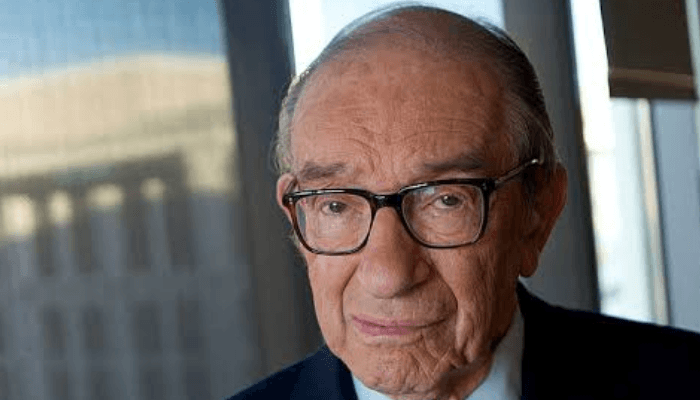
Alan Greenspan, the influential economist who guided United States monetary policy for nearly two decades and became one of the most powerful figures in global finance, has died at the age of 100.
Greenspan died on Monday at his home from complications related to Parkinson’s disease, his wife of 29 years, Andrea Mitchell, the chief Washington correspondent and chief foreign affairs correspondent for NBC News, announced in a statement.
“Alan passed away at our home this morning at the age of 100 from complications of Parkinson’s Disease,” Mitchell said. “He was a giant of a man who helped shape the US economy for decades under presidents of both parties, but was always honest in acknowledging his mistakes.”
Read also: Voters’ privacy critical to public trust in 2027 elections, lawyers warn
She added: “To me he was my husband, who shaped my life from our very first date in 1984. He had irrational exuberance for baseball, the Washington Commanders, tennis, golf and music, especially jazz. He will be remembered for his brilliance and his kindness. Being his life partner was the joy of my life.”
Greenspan led the Federal Reserve from 1987 to 2006 under four American presidents, making him one of the longest serving central bank chiefs in US history. His tenure covered a period of extraordinary economic growth, rapid globalisation and the rise of the internet economy.
Praised by supporters as the steady hand behind one of America’s longest periods of economic expansion, Greenspan earned celebrity status in the financial world and was widely known as “the maestro”.
However, his legacy was also marked by controversy. Critics argued that his support for financial deregulation and his failure to act against risky lending practices contributed to the conditions that led to the 2007 and 2008 global financial crisis.
Read also: Poor policy implementation, lack of export incentives threaten Nigeria’s leather industry
A 2011 report by the Financial Crisis Inquiry Commission concluded that decades of deregulation and reliance on financial institutions to police themselves had removed important safeguards that could have reduced the severity of the crisis.
Born on March 6, 1926, in New York City’s Washington Heights neighbourhood, Greenspan displayed a talent for mathematics at an early age. He also developed a passion for music, attending the Juilliard School and performing jazz saxophone and clarinet before turning his attention to economics.
After studying at New York University and later earning a doctorate in economics from Columbia University, Greenspan built a successful career as an economic consultant. He later entered public service, advising Richard Nixon’s presidential campaign and serving as chairman of the Council of Economic Advisers under Gerald Ford.
President Ronald Reagan appointed him chairman of the Federal Reserve in 1987. Just weeks after taking office, Greenspan faced his first major test when the stock market suffered the devastating Black Monday crash. His swift intervention to ensure liquidity helped calm financial markets and established his reputation as a crisis manager.
Greenspan remained a dominant voice in economic policy throughout the administrations of George H W Bush, Bill Clinton and George W Bush. Despite being a lifelong Republican, he maintained close relationships with leaders from both parties and often praised Clinton’s economic discipline.
Read also: Redefining Pageantry Beauty: ‘I refused to let society’s standards limit me’ — Queen Esther Otuonye
Following his retirement from the Federal Reserve in 2006, Greenspan established a consulting firm in Washington and wrote several books reflecting on economics, politics and the presidents he served.
Over his lifetime, he received numerous honours, including France’s Legion of Honour, an honorary knighthood from Queen Elizabeth II and the Presidential Medal of Freedom, the highest civilian award in the United States.
Remembered as both a celebrated architect of modern economic policy and a figure whose decisions remained heavily debated after the global financial crisis, Greenspan leaves behind a legacy that shaped the American and global economy for generations.

Join BusinessDay whatsapp Channel, to stay up to date
Open In Whatsapp