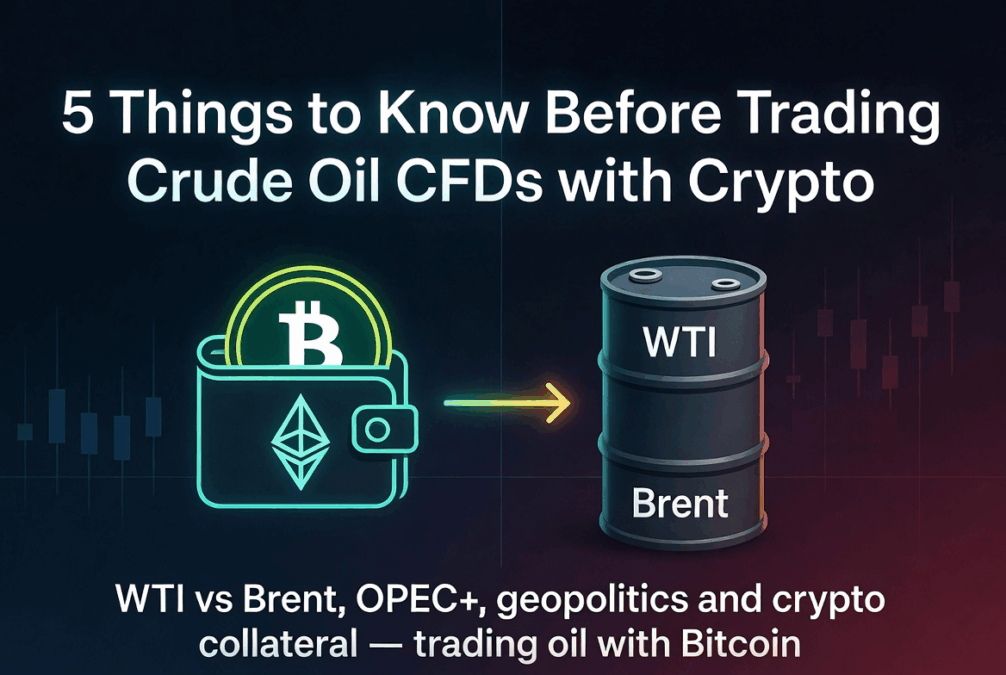
Most crypto traders spend their entire career focused on Bitcoin, Ethereum, and altcoins. The oil market sits in a different mental category – something for traditional commodities traders, hedge funds, and macro investors. That division is increasingly artificial.
Platforms that allow traders to use crypto as collateral for oil CFD positions have eliminated the operational barrier. A trader with a Bitcoin balance can now gain exposure to crude oil price movements without converting to fiat, without opening a separate brokerage account, and without leaving the digital asset ecosystem. The question is not whether it is technically possible – it is whether you understand enough about oil markets to do it intelligently.
These five things are what you need to know before opening the first position.
1. WTI and Brent Are Not the Same Price
Crude oil does not have a single global price. Two major benchmarks dominate international trading, and they trade at different prices with a spread between them that fluctuates based on supply and logistics factors.
West Texas Intermediate, or WTI, is the benchmark for North American crude production. It is priced at Cushing, Oklahoma, a major pipeline hub, and is typically lighter and sweeter than Brent – meaning lower sulphur content and easier to refine into fuels like petrol and diesel. WTI futures trade on the CME’s NYMEX exchange.
Brent crude is extracted from North Sea oil fields and serves as the global benchmark for international petroleum pricing. Approximately two-thirds of the world’s oil is priced relative to Brent. It tends to trade at a premium to WTI during periods of Middle Eastern geopolitical tension because it is more directly exposed to disruption in those supply routes.
The practical implication: when you open a crude oil CFD on any platform, check which benchmark you are trading. The price, spread, and market behaviour can differ meaningfully depending on whether the contract references WTI or Brent.
2. OPEC+ Controls the Single Most Important Supply Variable
Unlike most financial markets where supply is distributed and no single participant has dominant influence, the oil market has a cartel – OPEC and its allies, collectively known as OPEC+ – that controls roughly 40% of global crude production and is explicitly coordinated to manage prices.
OPEC+ meets regularly to set production quotas for member countries. A decision to cut supply by one million barrels per day can move the Brent price by 3-5% on the announcement. A decision to increase supply has the opposite effect. These meetings are scheduled in advance and are among the most directly tradeable macro events in any commodity market.
The comparison that resonates for crypto traders: OPEC+ supply decisions function somewhat like Bitcoin halvings. They are scheduled events with significant supply implications that the market begins pricing ahead of time and reacts to sharply on the day. Unlike halvings, OPEC+ decisions are subject to geopolitical negotiation and can surprise in either direction.
3. Weekly Inventory Data Moves Intraday Price
The US Energy Information Administration releases weekly crude oil inventory data every Wednesday. These reports show how much oil is sitting in US storage facilities, which functions as a proxy for the balance between supply and demand in the world’s largest oil-consuming economy.
When inventory builds unexpectedly – more oil is in storage than traders anticipated – it signals that demand is weaker than expected and supply is ample, which is bearish for price. When inventories draw more than expected, it signals strong demand or tighter supply, and price typically rallies. The release consistently produces sharp 30-minute price moves in WTI.
For crypto traders used to 24/7 markets where no single scheduled event dominates the week, this is a meaningful difference. Oil markets have a weekly rhythm built around this data release that experienced oil traders structure their positions around. Holding an uncovered oil CFD position into a Wednesday EIA release without awareness of the expected number is similar to holding a leveraged crypto position into a surprise Fed announcement.
4. Geopolitics Create Sudden, Sharp Moves
Oil production is concentrated in regions with persistent geopolitical risk. The Middle East – Saudi Arabia, Iraq, UAE, Iran, Kuwait – accounts for a substantial share of global supply. Russia is another major producer whose market access is subject to sanctions and political risk. Nigeria, Libya, and Venezuela have recurring production disruptions.
Any credible threat to supply in these regions produces immediate price spikes. The Strait of Hormuz, through which approximately 20% of global oil passes, is the single most consequential shipping chokepoint for energy markets. Concerns about its closure were a live market factor as recently as early 2026, contributing to oil price volatility alongside gold and other risk assets.
The geopolitical risk premium embedded in oil prices is not constant. It rises and falls based on the perceived probability of supply disruption, which means oil can gap sharply on unscheduled news in a way that even crypto occasionally does not.
The table below summarises what every crypto trader should understand before entering oil CFD positions:
| Factor | What to know | Trading implication |
| WTI vs Brent | Two benchmarks, different prices | Know which you are trading |
| OPEC+ meetings | Scheduled supply decisions | High volatility around announcement dates |
| EIA weekly data | Wednesday inventory report | Sharp moves on release, respect the number |
| Geopolitical risk | Middle East, Russia supply exposure | Sudden gap risk, monitor news flow |
| Oil-crypto correlation | Generally low, improves diversification | Portfolio benefit when combined |
5. Oil and Crypto Have Different – and Useful – Correlations
The final thing to understand is why oil belongs in a crypto trader’s toolkit at all. The answer is diversification through low correlation.
Bitcoin and Ethereum are risk assets. When global equity markets fall sharply in a risk-off move, crypto typically falls alongside them. Gold holds value as a safe haven. Oil is different again: it responds primarily to supply-demand dynamics, OPEC+ decisions, and global industrial activity – a completely different set of drivers from those that move crypto.
This means oil and crypto can be moving in opposite directions simultaneously – or moving together during specific macro regimes when energy inflation drives both risk appetite and commodity prices simultaneously. The correlation is not reliably inverse, but it is reliably low, which is exactly what diversification requires.
For a crypto trader who wants to maintain exposure to digital assets while generating returns from a different market that is moving differently, the combination of crypto capital and oil CFD exposure is genuinely useful. The infrastructure to trade oil for Bitcoin already exists on platforms that accept crypto margin – the remaining requirement is understanding the market you are entering.
Conclusion
Crude oil is not a simple market, but it is a learnable one. The five things covered here – benchmark differences, OPEC+ dynamics, weekly inventory data, geopolitical risk exposure, and the diversification case – provide a foundation for approaching oil CFD trading with realistic expectations and appropriate preparation.
The traders who combine crypto capital with oil exposure most effectively are those who treat it as a distinct market requiring distinct knowledge, not as another price chart to apply the same technical patterns to. The price action looks similar; the underlying drivers are completely different.

Join BusinessDay whatsapp Channel, to stay up to date
Open In Whatsapp