African leaders and CEOs have been told to reject siloed leadership mindset as this may not be productive in the present era of polycrisis.
The admonition came from an international leadership development expert, Caroline Lucas, who is the Director, Special Projects at TEXEM UK, the United Kingdom based leadership development organisation.
In her statement on TEXEM website, www.texem.co.uk, Lucas said the harshest truth of the polycrisis ravaging Africa is that siloed thinking actively aggravates harm.
“The challenges we face today, including spiraling inflation, currency volatility, climate-induced agricultural disruption, institutional fragility, and complex security threats; are not a series of unfortunate, independent events.
“They do not wait their turn in a neat, orderly queue. We are living in the age of the polycrisis: a state where disparate crises interact such that the whole overwhelming mess is far more dangerous than the sum of its parts.
“In Nigeria and across the broader African landscape, these pressures combine, collide, and amplify one another.
“A climate shock in the Sahel is not just an environmental issue; it instantly mutates into an agricultural deficit, which triggers economic inflation, which exacerbates resource scarcity, which ultimately ignites a security crisis,” she explained.
Lucas added that in spite of this, looking at the current corporate and governance structures, a dangerous flaw persists, which is the fact that the leadership in many African countries leadership remains stubbornly siloed.
She asserted that when institutions, ministries, and corporate boards treat interconnected risks as separate line items, the responses they deploy are not just ineffective, they are often counter productive.
Citing cases, she spoke of the Governance Trap, a trap which she said should be avoided by all means but it is still catching many CEOs.
“A central bank adjusting monetary policy to fight inflation without coordinating with ministries of agriculture or trade can inadvertently crush local production,” Lucas said.
While talking about another case of siloed leadership which she called The Corporate Blindspot, Lucas said that a CEO addressing a supply chain crisis by cutting costs, while ignoring the social and economic pressures facing their workforce, simply trades a logistics problem for a crippling labor and institutional crisis.
“When we treat real-world effects as isolated variables, our solutions become band aids on systemic fractures. We solve a problem in Department A, only to inadvertently detonate a crisis in Department B. In a polycrisis, a silo is not a shield; it is a blindfold,” she said.
Lucas said the mandate for African leaders is to have a systemic vision.
“To lead effectively in this era, African leaders and CEOs must fundamentally shift from linear thinking to systems leadership.
“They should map the connections, not just the risks. The leaders must design institutional frameworks that mirror the messy reality of the world. Corporate and state strategies must be built on cross-functional intelligence.
“Risk management can no longer live in a single department; it must be the fabric that connects operations, finance, human capital, and sustainability,” the TEXEM director said.
Lucas urged the leaders to break the institutional ego explaining that bureaucratic turf wars and corporate empire building are luxuries of a stable past.
“Today, public-private partnerships and cross sector collaboration are survival mechanisms. If your institution is not actively sharing data, resources, and insights across traditional boundaries, you are vulnerable,” she said.
Lucas advised leaders to build adaptive, connected resilience, noting that true resilience is not about bouncing back to an outdated status quo.
“It is about building agile systems where a signal of distress in one sector immediately triggers a coordinated, multi-pronged response across all sectors.
“The real world does not operate in silos. The crises facing Africa are deeply connected, and our leadership must be equally integrated.
“As the captains of African industry and the stewards of its governance, your mandate is clear: tear down the internal walls before the external crises breach them.
“We must learn to see the whole system, lead across boundaries, and match the complexity of our challenges with the unity of our response,” she said.
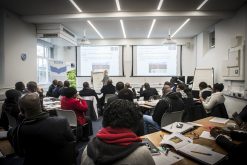
The statement also announced that TEXEM will be hosting African leaders and CEOs to a programme in Newcastle, United Kingdom on leadership in a polycrisis.
Speaking on the coming Newcastle leadership development programme, “Leading in an Age of Polycrisis”, Lucas said three reputable TEXEM faculty will handle them from 14th to 18th June.
The faculty are, Lord Jonny Oates, Prof. Roger Delves and John Peters.
Lord Jonny Oates is a Member of the UK House of Lords, and former Chief of Staff to the UK Deputy Prime Minister.
He chairs and serves on parliamentary groups with strong Africa and international development focus.
He is an experienced communicator on governance, public policy and international affairs.
Prof. Roger Delves is a Professor of Leadership Practice and served as Dean of Qualifications at Ashridge Business School, part of Hult International Business School.
He is a world-renowned, transformational leadership, EQ at work, authenticity in leadership, purpose, values and the role of integrity expert.
John Peters is a former Chair of Association of MBAs (Accreditors of top Business Schools such as Harvard, London Business School, Stanford and IMD).
He is a world-renowned Resilience expert and documentary on his life won Independent Documentary of the Year and was also nominated for a BAFTA award.
Interested participants in the June programme are expected to click on the link, https://texem.co.uk/leading-in-an-age-of-polycrisis/
The statement also shared testimonials from past delegates of TEXEM programmes.
“I regard the These Executive Minds (TEXEM) Executive Education programme as the best I have attended in recent times. Not one of them, but the very best as it was humanly perfect.
“My favourite thing about the programme would be … drawing our attention again to … change, which has been a constant in life experiences, you know, change in our lives, change, you know, in businesses … the evolution of businesses and the way we do things … discussions, for example, on cyber security and mental health, which is not just equipping us to know what is happening around us, even equipping us personally, our mental health, paying attention to also the ever evolving cybersecurity… Those are things I would say that made it very, very interesting”.
-Previous TEXEM delegate, Ifeanyi Ani CEO Total Pension CPFA
“TEXEM is a good platform for advancing leadership training, and I would recommend them for any organizations or institutions that are, desirous of improving their workforce in leadership and strategic policy making”. – Previous TEXEM delegate, Prof. Olatunde Julius Otusanya, Hon. Commissioner, Tax Appeal Tribunal
“The program has been very interesting, exciting, facilitated knowledge sharing and it has actually brought about a greater insight into what leadership is. – Previous TEXEM delegate, Akinwunmi Lawal, former MD/CEO of NPF Microfinance Bank

Join BusinessDay whatsapp Channel, to stay up to date
Open In Whatsapp