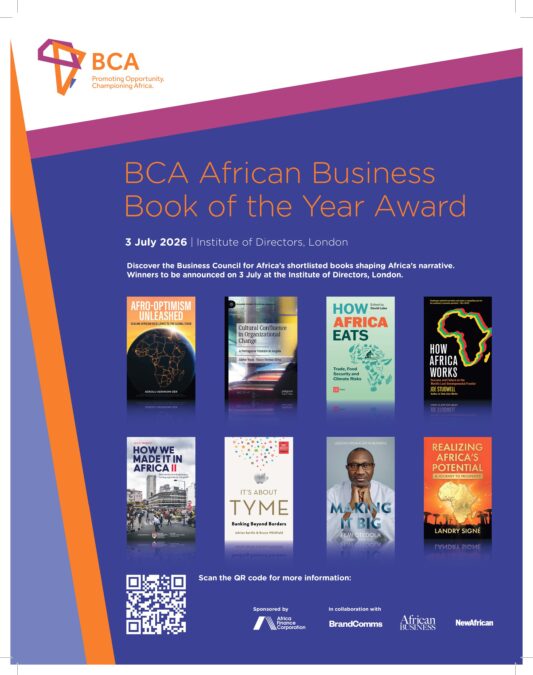
The Business Council for Africa African Business Book of the Year Award is more than a literary prize. It is a strategic intervention in how Africa is understood, governed, financed and led. Convened by BCA at the Institute of Directors, London, the Award recognises books that move Africa’s business story beyond slogans into evidence, experience, discipline and possibility.
Arnold Ekpe, Chair of BCA, captures the purpose with clarity:
“The annual African business book awards seek to elevate the discourse on African businesses and business leaders. It champions real stories of successful African businesses and business leaders.”
That mission matters because narratives are not soft assets. They shape investment decisions, policy priorities, institutional confidence and public expectations. A continent repeatedly framed through fragility will be treated as a risk to be managed. A continent understood through enterprise, resilience, innovation and execution will attract the partnerships, capital and governance seriousness needed to accelerate sustainable development.
This is why the shortlisted works are significant. Books such as Afro-Optimism Unleashed, How Africa Works, How Africa Eats, How We Made It in Africa II, It’s About Tyme, Making It Big and Realizing Africa’s Potential do not merely celebrate success. They examine the conditions that produce it: leadership, culture, markets, institutions, food security, banking, entrepreneurship and the ability to turn constraints into competitive advantage.
Arunma Oteh OON’s reflection on Moniepoint brings this vividly to life:
“Who understands Africa’s fragmented payments landscape better than those who have successfully transformed it?
Consider Moniepoint, one of Nigeria’s most remarkable fintech success stories. What began as a bold vision to solve financial access challenges for small and micro-enterprises has grown into a platform that now processes billions of dollars in transactions annually, serving more than two million businesses across Nigeria.
During the cash crunch of 2023, Moniepoint’s extensive network of point-of-sale terminals became a critical lifeline for millions of Nigerians, demonstrating not only the resilience of African innovation but also its capacity to solve real-world challenges at scale.
Today, Moniepoint stands as the backbone of much of Nigeria’s informal economy, empowering merchants, traders, and entrepreneurs—many of them women—with the financial tools needed to grow and prosper. Its success offers a powerful lesson: financial inclusion is not simply a social imperative; it is an exceptional business opportunity.
The broader story across Africa is equally compelling. Mobile money transactions on the continent exceeded US$1 trillion in value in 2024, underscoring the scale of Africa’s digital transformation. Africa is no longer catching up; in many areas, it is setting the pace for the rest of the world.
Innovative African payment platforms are enabling seamless transactions across more than 35 countries, supporting over 150 currencies and connecting African businesses to global markets. These solutions are helping to unlock trade, drive financial inclusion, and accelerate economic integration across the continent.
For investors, entrepreneurs, and policymakers alike, the message is clear: Africa’s greatest opportunities lie in businesses that solve fundamental challenges at scale. The continent’s fintech revolution demonstrates that doing good and doing well are not competing objectives—they are mutually reinforcing.
When we invest in innovation that expands opportunity, strengthens financial inclusion, and connects markets, we are not merely investing in Africa’s future—we are investing in one of the most significant growth stories of the 21st century.”
This is precisely where business literature contributes to good governance. Good governance is not only about regulation, transparency and accountability, although these remain essential. It is also about learning from what works, scaling solutions responsibly, improving institutional imagination and grounding policy in the lived realities of markets.
Africa’s most urgent governance challenge is execution. Governments, regulators, investors and entrepreneurs must understand how businesses operate in fragmented markets, how trust is built where institutions are uneven, how technology can expand inclusion, and how leadership cultures shape performance. Serious books help convert scattered experience into shared intelligence.
Dr Alim Abubakre, Founder of TEXEM, UK, and Board Member of the Business Council for Africa, rightly links narrative to destiny:
“Stories shape perceptions, perceptions shape decisions, and decisions shape destinies. For too long, Africa’s narrative has been written through the lens of limitation rather than possibility. The leaders, authors, and entrepreneurs who will define this century are those courageous enough to replace outdated assumptions with evidence, ambition, and achievement. When the world sees Africa more clearly, it will discover not a continent waiting for opportunity, but a continent creating it.”
The value of the BCA Awards lies in this rebalancing. It does not deny Africa’s difficulties. Rather, it insists that the continent must be analysed with equal seriousness when it succeeds. That is a governance act in itself, because institutions improve when societies study performance as rigorously as they study failure.
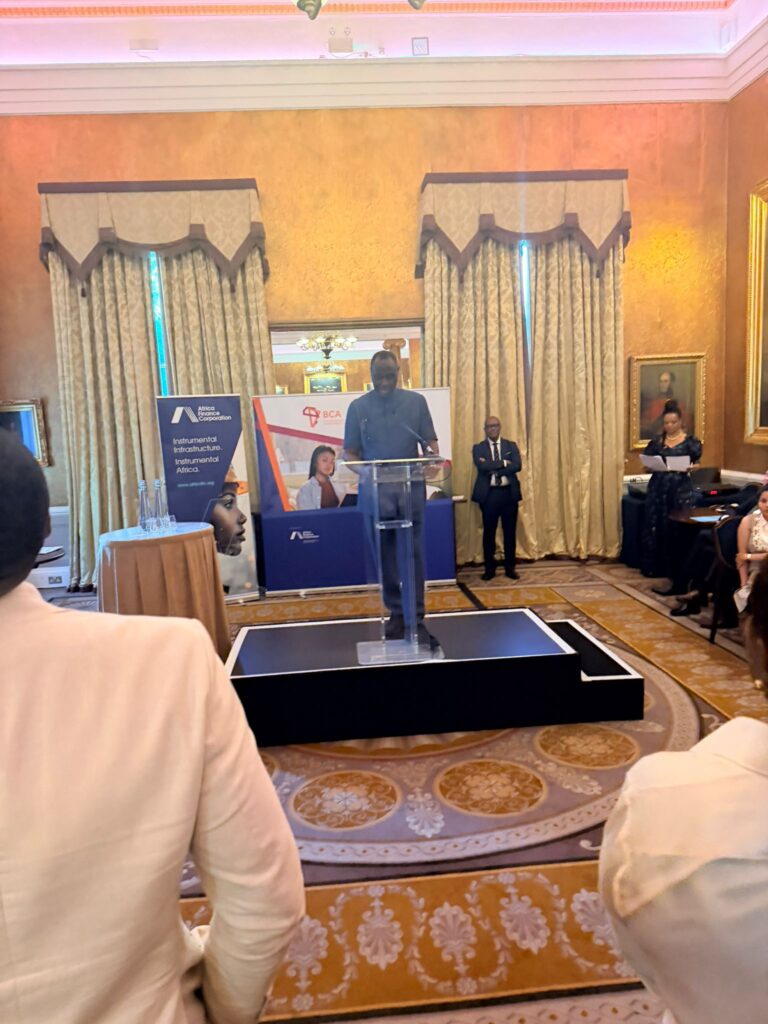
Samaila Zubairu, President and Chief Executive Officer of Africa Finance Corporation, deepens the argument by placing conviction at the centre of transformation:
“Books matter because they do more than record ideas; they shape convictions. And conviction is the most valuable asset any nation, institution, or individual can possess. Throughout history, every great transformation began when people saw possibilities where others saw limitations.
If I could change one thing about Africa, it would be neither our resources nor our demographics. It would be the strength of our collective conviction in the future we are capable of building. For too long, many have looked outward for validation, for permission, or for solutions. Yet the future of Africa will not be imported. It will be imagined, financed, and built by Africans who have the confidence to act before certainty arrives.
At Africa Finance Corporation, we have learned that capital follows conviction. Investors do not fund geography; they fund belief translated into vision, strategy, and execution. The nations that prosper are not necessarily those with the greatest endowments, but those with the greatest confidence in their ability to create value from what they possess.
Africa’s defining challenge is therefore not a shortage of potential. It is the urgency of converting potential into performance, ambition into infrastructure, and aspiration into globally competitive institutions. When Africans fully embrace ownership of Africa’s future, capital will follow, partnerships will multiply, and prosperity will accelerate.
The most important investment we can make today is not merely in roads, ports, power plants, or digital networks. It is in a mindset that refuses to mortgage tomorrow to the doubts of yesterday. Because the Africa we seek will ultimately be built by the confidence we have today in what Africa can become tomorrow.”
This is the intellectual foundation of sustainable governance: conviction disciplined by evidence. Optimism without rigour becomes rhetoric. Rigour without ambition becomes paralysis. Africa needs both. It needs leaders who can read complexity, design institutions, build businesses, mobilise capital and govern for long-term value.
The BCA Book Awards therefore performs three strategic functions. First, it curates knowledge that improves the quality of decision-making about Africa. Second, it elevates African agency by foregrounding entrepreneurs, executives, investors and institutions solving real problems. Third, it creates a bridge between business, policy and public imagination.
The future of Africa will not be secured by narrative alone. It will require infrastructure, education, energy, industrial capacity, accountable institutions and patient capital. But without a stronger narrative rooted in proof, many of those investments will arrive too slowly, too cautiously or too narrowly.
Books matter because they lengthen attention. Awards matter because they signal what a serious society chooses to honour. BCA’s African Business Book of the Year Award matters because it recognises that Africa’s future will be built not only in boardrooms, ministries and markets, but also in the ideas that shape what leaders believe is possible before they act.

Join BusinessDay whatsapp Channel, to stay up to date
Open In Whatsapp