Osun state government is increasingly turning to digital learning and Artificial Intelligence (AI) as it battles a lingering out-of-school children crisis affecting an estimated 297,000 children.
According to the official Multiple Indicator Cluster Survey (MICS-6) conducted by the National Bureau of Statistics (NBS) in collaboration with the United Nations Children’s Fund (UNICEF), Osun state has an out-of-school children rate of 13 percent, the highest in the South-West geopolitical zone. The figure translates to nearly 297,000 children, mostly between the ages of six and 11, who are not receiving basic primary education.
The data also reveals a gender gap, with 14.88 percent of male children out of school compared to 11.50 percent of female children. Although the rate is significantly lower than the 26.9 percent recorded in previous survey rounds, population growth means that the actual number of affected children remains alarmingly high.
Read also: The Shea Lesson: Are women squeezed out of value capture?
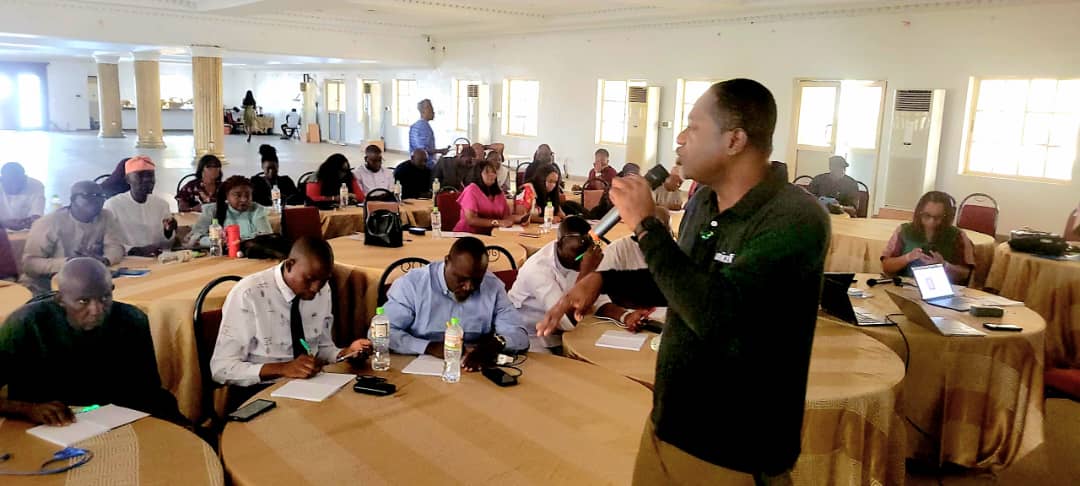
It was against this backdrop that stakeholders gathered in Osogbo for a two-day media dialogue on Digital Learning, Artificial Intelligence and Skill Development for Out-of-School Children, organised by the Osun State Ministry of Education in collaboration with UNICEF.
UNICEF’s out-of-school children and digital learning programmes are implemented through partnerships with the Federal Ministry of Education, the Universal Basic Education Commission (UBEC), the National Commission for Almajiri and Out-of-School Children Education (NCAOOSE), State Ministries of Education, State Universal Basic Education Boards (SUBEBs), Local Government Education Authorities (LGEAs), with support from international organisations including the World Bank, Education Cannot Wait (ECW), GPE, Microsoft, Airtel, IHS Towers, TECNO and SONY.
Speaking at the event, Murtala Adekilekun Kehinde Jimoh, the permanent secretary of the Osun State Ministry of Education, described out-of-school children as one of the most pressing educational challenges facing Nigeria and Osun state.
Jimoh said the state government was leveraging partnerships, technology and community engagement to tackle the problem.
“Education remains the most powerful tool for human development, social transformation and economic growth. However, many children remain excluded from formal education due to socio-economic, cultural, geographical and security-related challenges,” he said.
According to him, digital technology and artificial intelligence now offer opportunities to bridge educational gaps and reach vulnerable children who would otherwise remain outside the education system.
Jimoh noted that digital learning platforms can personalise education, identify learning gaps, support teachers and provide innovative solutions for children who are difficult to reach through conventional classroom systems.
He stressed that the state’s collaboration with UNICEF has been particularly impactful through programmes such as the Nigeria Learning Passport.
The permanent secretary disclosed that out-of-school children remain concentrated in major towns including Ede, Osogbo, Ile-Ife and Ilesa, but said targeted interventions have helped reduce the number of children found on the streets.
“We have established learning centres and schools specifically designed to accommodate these children and help them reintegrate into the education system. Through these combined efforts, we are making steady progress towards reducing the number of out-of-school children,” he said.
While Osun seeks technological solutions, UNICEF officials warned that the challenge extends far beyond access to classrooms.
Celine Lafoucriere, chief of UNICEF’s Lagos field office, painted a troubling picture of learning poverty among Nigerian children.
She told participants that only one in four Nigerian children who attend school can read properly and perform basic mathematics by the age of 14.
“Think about that for one second. Of all the children in Nigeria who actually go to school, only one in four can read properly and do basic math at age 14. And we are only talking about the children who make it to school,” she said.
According to her, millions more children never get the opportunity to attend school at all, leaving them vulnerable in a world increasingly shaped by digital technology and artificial intelligence.
“The children who know how to use these technologies will have a chance. The ones who don’t will be left out. Right now, out-of-school children in Nigeria are the ones being left out,” she added.
Lafoucriere challenged journalists to keep the issue in public focus, arguing that sustained media attention can influence policy decisions and drive action.
“A story that does not go away is a story that gets acted upon,” she said.
Further insight into the scale of the crisis was provided by Harold Kpojime, UNICEF education specialist, who disclosed that recent national data now places Nigeria’s out-of-school children population at nearly 20 million, making it the largest in the world.
He explained that the figure emerged from a nationwide survey involving 9,632 households and assessments of 22,143 children between the ages of five and 17.
According to Kpojime, one out of every three primary school-age children in Nigeria is currently out of school. He stressed that reliable data remains critical to solving the problem.
“If you do not know how many children are out of school, it becomes difficult to solve the problem. You cannot claim success if you do not know exactly who these children are,” he said.
Kpojime noted that the challenge goes beyond enrolment. School attendance, he said, declines steadily as children move up the education ladder.
While approximately 68 percent of primary school-age children attend school, completion rates fall to about 73 percent at primary level, 68 percent at junior secondary level and only 54 percent at senior secondary level.
“This means that only about half of those who begin the education journey successfully complete senior secondary education,” he said.
Read also: Nigeria targets youth unemployment with agribusiness land fund
He identified poverty, insecurity, culture, religion, gender disparities and location as major factors driving school exclusion.
According to him, wealth, place and gender remain the three strongest determinants of whether a Nigerian child will receive quality education.
Education experts at the dialogue observed that while technology alone cannot solve Nigeria’s education crisis, digital learning platforms are increasingly becoming important tools for reaching excluded children, particularly those in remote communities and informal settlements.
For Osun state, the challenge is both encouraging and urgent. Although the out-of-school rate has fallen significantly from previous levels, the state still records the highest proportion of out-of-school children in the South-West.
The emergence of AI-powered learning platforms and digital skills programmes may offer new opportunities, but stakeholders insist that technology must be supported by stronger investments in schools, teacher training, poverty reduction and community engagement.
As governments and development partners search for solutions, the figures serve as a reminder that behind every percentage point are thousands of children whose futures depend on whether they can gain access not just to classrooms, but to meaningful learning and skills needed for the digital economy.


Join BusinessDay whatsapp Channel, to stay up to date
Open In Whatsapp