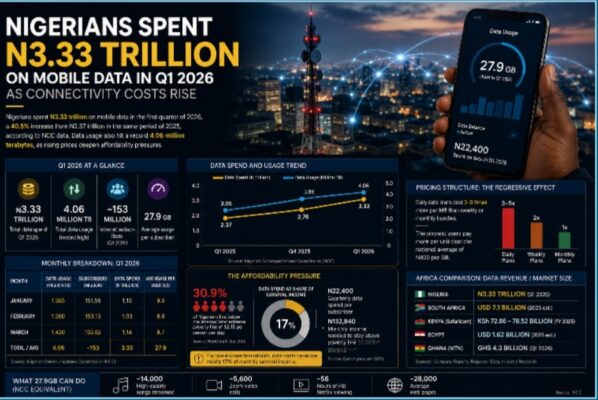
Nigerians spent nearly one-fifth of the income required to stay above the poverty line on mobile internet data in the first quarter of 2026, highlighting the growing financial pressure of staying connected in Africa’s largest digital market.
New data from the Nigerian Communications Commission (NCC) showed that consumers spent about N3.33 trillion on mobile data between January and March 2026, up sharply from N2.37 trillion in the same period last year, as internet use and data prices continued to rise.
The increase reflects both higher consumption volumes and elevated prices per gigabyte. Total data usage reached a record 4.06 million terabytes between January and March 2026, more than 4 billion gigabytes, exceeding the previous quarterly high of 3.86 million terabytes in Q4 2025.
An average internet subscriber used 27.9 gigabytes over the three months, at an effective rate of around N800 per GB. This translated to roughly N22,400 spent per user on data during the quarter.
That national average, however, conceals a sharp divide rooted in income. According to the World Bank’s Nigeria Poverty and Equity Brief published in October 2025, 30.9 percent of Nigerians live below the international extreme poverty line of $2.15 per person per day.
At the naira exchange rate prevailing in late 2025, a Nigerian household needed at least N4,428 per day, approximately N132,840 per month, simply to stay above that poverty threshold, according to Dataphyte.
Read also: NCC demands $1bn investments, consumer payback, tightens QoS enforcement
For families living around that level, spending about N22,400 every three months on internet data is a major financial burden. It would take nearly one-fifth of their monthly income, even before paying for essentials such as food, rent, transport, healthcare, or school expenses.
The pricing structure compounds that burden regressively. Daily data plans, the only entry point accessible to the lowest-income subscribers, cost between three and five times more per megabyte than weekly or monthly bundles, according to an analysis of operator pricing.
A subscriber buying data in daily fragments pays a significantly higher effective rate per gigabyte than the N800 per GB national average cited by the NCC, meaning the poorest users are in practice paying more per unit than the headline figure suggests.
Monthly performance
January opened the year strongly with 1.385 million terabytes consumed by 151.56 million internet subscribers, generating about N1.13 trillion in spending. Average usage was 9.6 GB per subscriber.
February saw a seasonal dip to 1.26 million terabytes used by 153.13 million subscribers, resulting in N1.03 trillion in spending and 8.6 GB per user. Industry observers linked the slowdown to post-holiday effects.
March delivered the strongest month on record, with 1.42 million terabytes consumed by 153.82 million subscribers. Spending reached N1.14 trillion, with average usage rising to 9.7 GB per person. Subscriber numbers grew steadily throughout the quarter.
Year-on-year growth
The Q1 2026 figures represent roughly a 40 percent increase in spending compared to Q1 2025. Full-year 2025 data consumption across Nigeria reached about 13.2 million terabytes, underlining sustained digital expansion driven by streaming, social media, fintech, and remote work.
Africa comparison
Nigeria’s N3.33 trillion quarterly data spend significantly outpaces other major African markets in absolute terms, reflecting its large population and subscriber base of over 150 million. Comparable national consumer data spend figures are not publicly reported in the same aggregated format for other countries.
However, operator-level data shows strong growth elsewhere but at much smaller absolute scales. In South Africa, the overall mobile services market was estimated at around $7.1 billion for 2025, with data and internet services accounting for a major share of between 50 and 55 percent. While South Africa has higher average revenue per user and more advanced infrastructure, its total data economy remains substantially smaller than Nigeria’s in absolute value. Kenya’s Safaricom recorded mobile data revenue of approximately KShs 72.86 billion to KShs 78.52 billion for its full financial year ended March 2025. Telecom Egypt reported a 46 percent rise in data revenue for full-year 2025 as part of total revenue of EGP 106.7 billion, with the wider Egypt telecom market for data and internet services estimated at around USD 1.62 billion. In Ghana, MTN Ghana posted data revenue of GHS 4.3 billion in Q1 2026, up 52.3 percent, and GHS 13.4 billion for full-year 2025. Despite rapid percentage gains, absolute figures across all four markets remain significantly smaller than Nigeria’s.
The NCC equates the average 27.9 GB quarterly usage to roughly 14,000 high-quality songs streamed, 5,600 Zoom video calls, 56 hours of standard HD Netflix viewing, or 28,000 average web pages.
Rising smartphone penetration, urbanisation, and a youthful population continue to drive demand. Telecom operators have expanded networks to cope, though capacity constraints persist in some areas.
NCC boss reacts
Aminu Maida, the executive vice chairman of the NCC, acknowledged the growing public frustration over network performance, but said the sector is only beginning to recover from years of underinvestment that weakened service quality across the country. According to him, the industry is now witnessing one of its biggest infrastructure expansion phases in years.
He explained that operators deployed just over 300 new or upgraded telecom sites last year, but have now committed to approximately 12,000 site upgrades in 2026 alone. Already, about 2,800 upgrades have been completed this year, including new base stations, capacity expansion projects, and upgrades from older 2G and 3G systems to more efficient 4G and emerging 5G infrastructure.
Maida said the pace of deployment reflects renewed investor confidence in the Nigerian telecom sector after a prolonged period of financial strain.
He noted that quality-of-service indicators are beginning to improve gradually, especially around data speeds, even though consumers still experience latency and congestion in many areas. According to him, the NCC’s quarterly monitoring reports show measurable progress, but he cautioned that improvements will take time because rising data demand is expanding faster than network capacity.
“As networks improve, people consume even more data,” he explained, noting that video streaming and social media traffic are rapidly increasing bandwidth demand nationwide.
A major part of the recent improvement in network capacity, he said, has come from spectrum expansion and redistribution.
The NCC recently facilitated the reallocation and trading of about 100 megahertz of previously underutilised spectrum resources to operators. Maida described spectrum as the “digital highways” that carry telecom traffic across networks.
According to him, lower-frequency spectrum bands improve rural coverage, while higher-frequency bands increase capacity in dense urban locations where internet demand is highest.
The additional spectrum assignments have enabled operators to improve speeds and coverage more efficiently, contributing to noticeable improvements in data performance during the first quarter of the year.
Still, affordability remains a growing concern. Recent telecom tariff increases have pushed data costs higher across networks, adding pressure on households already battling inflation and declining purchasing power.
Defending the pricing adjustments, Maida said the industry required cost-reflective tariffs to sustain investment and prevent further deterioration in service quality.
He argued that without improved revenue generation, operators would struggle to finance network expansion and infrastructure upgrades needed to meet Nigeria’s rising digital demand.
According to him, telecom companies remain heavily exposed to foreign exchange volatility because most equipment used in the industry is imported from global suppliers such as Ericsson and Nokia.
The cost of importing network equipment, powering telecom sites with diesel generators, and maintaining infrastructure has risen sharply in recent years due to naira depreciation and inflationary pressures.
Maida disclosed that one major telecom operator alone is investing more than $1 billion this year, surpassing total industry investment recorded in the previous year.
He described the scale of current investment as encouraging, though he warned that sustainable improvement would depend heavily on forex stability and supportive government policies.
Beyond network expansion, the NCC boss also addressed consumer complaints around poor service quality and announced that compensation for affected subscribers would begin immediately.
Importantly, the NCC has changed the way service quality is measured. Instead of relying on broad state-level assessments, the Commission now evaluates performance at the local government level to capture user experience more accurately. This allows regulators to identify service failures in specific locations and determine compensation more precisely.
Subscribers will receive notifications explaining the value and reason for compensation, with payouts varying depending on usage patterns and the severity of disruption experienced.
According to him, operators are now required to invest beyond their existing capital expenditure plans for 2026 rather than merely reallocating already approved budgets.
Independent auditors will verify the investments to ensure compliance and prevent operators from overstating infrastructure spending.
The NCC leadership believes stronger regulation and stricter monitoring will improve both consumer protection and long-term service quality.
Maida also highlighted the importance of fibre infrastructure in solving Nigeria’s long-term broadband affordability problem.
He argued that mobile networks alone cannot sustainably provide affordable unlimited internet access because telecom towers rely heavily on expensive diesel-powered generators.
According to him, fibre-based broadband supported by Wi-Fi networks in homes, schools, offices, and public spaces offers a more economically sustainable path for mass connectivity.
He pointed out that in more advanced economies, most data traffic is carried through fibre networks rather than mobile infrastructure.
The NCC boss also acknowledged that the rollout of 5G services remains relatively slow compared to 4G expansion.
However, he described the trend as normal, noting that earlier generations of telecom technology experienced similar adoption patterns during their early years.
Factors such as high device costs, infrastructure requirements, and limited compatible smartphones continue to slow mass 5G adoption in Nigeria.
Nevertheless, Maida expressed confidence that uptake would accelerate gradually as device affordability improves and network deployment expands.
Read also: NCC to transform youth creativity into economic power, Asein says
Outlook
The strong Q1 performance signals a maturing digital economy in Nigeria. Sustained growth in 2026 will depend on continued network investment, tariff stability, and broader economic conditions affecting consumer affordability.
Across Africa, data services remain a major engine of digital inclusion and economic contribution, but wide differences in market size, infrastructure maturity, and spending power persist.


Join BusinessDay whatsapp Channel, to stay up to date
Open In Whatsapp