
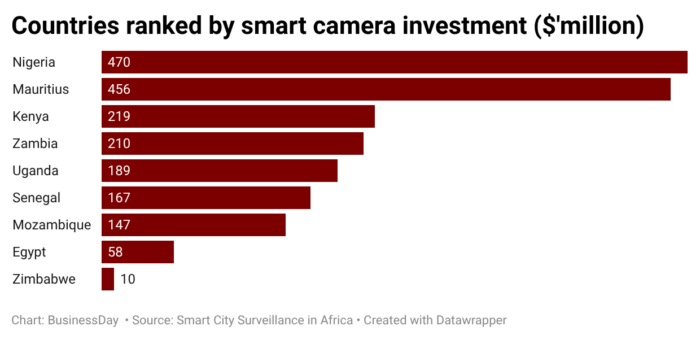
Nigeria has emerged as the largest investor in artificial intelligence (AI)-powered surveillance technologies in Africa, accounting for over $470 million of the estimated $2.1 billion spent across the continent.
This is according to a March 2026 report by the Institute of Development Studies titled ‘Smart City Surveillance in Africa: Mapping Chinese AI Surveillance Across 11 Countries.’ The study examined surveillance deployments in 11 African countries, including Kenya, Egypt, Rwanda, and South Africa.
The report found that Nigeria’s investment is primarily focused on AI-enabled facial recognition systems and automatic number plate recognition (ANPR) technologies, positioning the country as Africa’s largest buyer of smart city surveillance infrastructure.
Across the countries studied, at least 35,000 smart cameras have been deployed, with Nigeria alone accounting for about 10,000 more cameras than any other nation in the group.
Mauritius followed Nigeria with $456 million in spending, while Kenya, Zambia, and Uganda also made significant investments in surveillance infrastructure.
The report further revealed that much of Africa’s surveillance technology is supplied by Chinese firms and financed through loans from Chinese banks. Other contributors include companies from South Korea, Russia, the United Arab Emirates, and Western countries.
Despite the scale of investment, the study raises concerns about effectiveness as the researchers found little evidence that expanded digital surveillance has significantly reduced crime or improved prosecution rates across the countries reviewed.
The findings also highlight regulatory gaps, noting that none of the countries studied has a comprehensive legal framework to balance surveillance activities with data protection and human rights obligations.
However, the report recommends stricter laws, judicial oversight, and independent monitoring bodies to ensure accountability.
In Nigeria, the growing reliance on AI surveillance comes amid persistent security challenges, including kidnappings and violent attacks. While technologies such as NIN-SIM linkage and digital tracking systems have been introduced to enhance security, authorities acknowledge that criminals continue to exploit technological loopholes to evade detection.


Join BusinessDay whatsapp Channel, to stay up to date
Open In Whatsapp