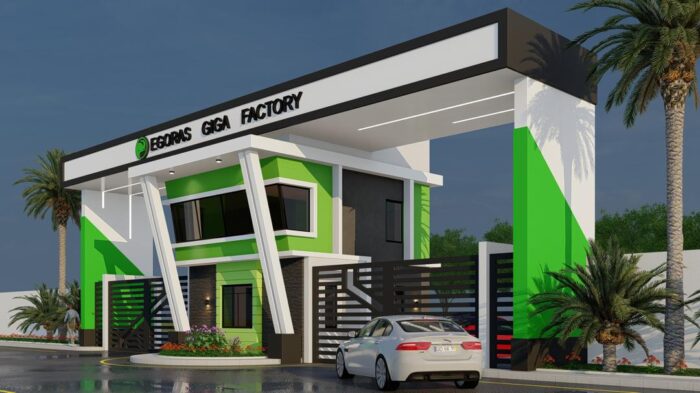
Egoras Technologies Ltd. is partnering with Airtel Nigeria to launch an artificial intelligence-powered smartphone designed to turn millions of informal merchants into digital businesses, in a move that could reshape how small firms access payments, data and enterprise tools in Africa’s largest economy.
The device, called the Cube Phone, bundles free internet access for business use, a built-in contactless payment terminal, and a suite of AI-driven business tools into a single Android handset priced at N240,000 ($150). The product is scheduled for launch on April 28, with nationwide distribution planned through Egoras showrooms.
The push comes as Nigeria struggles to digitize its vast informal economy. Of an estimated 40 million micro and small businesses, fewer than eight percent accept digital payments, according to company data. High device costs, expensive mobile data and concerns over data privacy have slowed adoption, leaving most transactions cash-based despite rapid fintech growth.
Read also: PoS growth slows as Nigeria’s payments market enters new phase
Ugoji Harry, Egoras chief executive officer said the company’s goal was not to compete in the crowded smartphone market but to eliminate the structural barriers preventing merchants from making their first digital sale.
“We removed the cost of data, simplified payments, and embedded intelligence into the device itself. The phone is simply the delivery mechanism,” Harry said.
At the core of the offering is a zero-rated connectivity agreement with Airtel, allowing all activity on the phone’s CubeOS platform, payments, applications and AI interactions, to run without data charges. Unlike typical telecom fair usage models, the company said there are no caps or throttling, effectively reducing a key operating expense for small businesses that often spend N5,000 to N10,000 monthly on mobile data.
That pricing structure could prove disruptive in a market where cost remains a major barrier to digital adoption. Eliminating recurring data expenses may accelerate merchant onboarding faster than traditional fintech incentives.
The Cube Phone also doubles as a payment acceptance device. Each unit ships with 100 contactless Cube Cards, battery-free NFC cards with a projected lifespan of up to 10 years, that merchants can distribute to customers. Transactions require only a password, removing the need for smartphones or apps on the customer side.
Egoras is betting on a network effect. Each phone effectively seeds a micro payment ecosystem of 100 users. As adoption grows, more participants are expected to purchase their own devices, expanding the network organically. The company projects one million phones and 100 million cards in circulation within the first year.
The device further integrates an AI Business Suite, offering tools typically out of reach for micro enterprises. Functions include contract drafting and compliance support, financial tracking and reporting, workflow automation, and basic human resource management. The tools support multiple Nigerian languages including Yoruba, Igbo, Hausa and Pidgin, a feature aimed at improving accessibility in underserved markets.
In a notable departure from mainstream cloud-based models, Egoras said, adding that all data and AI interactions are encrypted and stored on-device using a blockchain-based architecture. Transactions and records are processed without centralized intermediaries, with Airtel acting only as a transport layer.
The approach addresses growing concerns around data sovereignty and privacy, particularly among small business owners wary of sharing sensitive financial information with large platforms.
The Cube Phone enters a competitive but fragmented landscape. Companies such as Moniepoint and OPay dominate merchant payments, while hardware makers like Tecno Mobile and Itel Mobile focus on affordability. Mobile money platforms provide transaction services but rely on paid data and centralized infrastructure.
Egoras is positioning the Cube Phone as a full-stack alternative, combining hardware, connectivity, payments, AI tools and privacy into one device. If successful, the model could challenge the multi-service approach that forces small businesses to juggle separate tools and subscriptions.
The company said discussions are ongoing with other telecom operators, including MTN Nigeria and Globacom, to expand zero-rated access beyond Airtel’s network.
For Airtel, the partnership offers a potential pathway to deepen enterprise usage and defend market share in a price-sensitive environment. For Egoras, the stakes are higher: proving that bundling connectivity, payments and AI into a single device can unlock Nigeria’s largely untapped digital commerce base.
Whether merchants adopt the model at scale will depend on execution, trust and the durability of its zero-cost promise. But if it works, the Cube Phone could compress years of gradual fintech adoption into a single hardware cycle, turning a basic smartphone into the operating system of Nigeria’s informal economy.


Join BusinessDay whatsapp Channel, to stay up to date
Open In Whatsapp