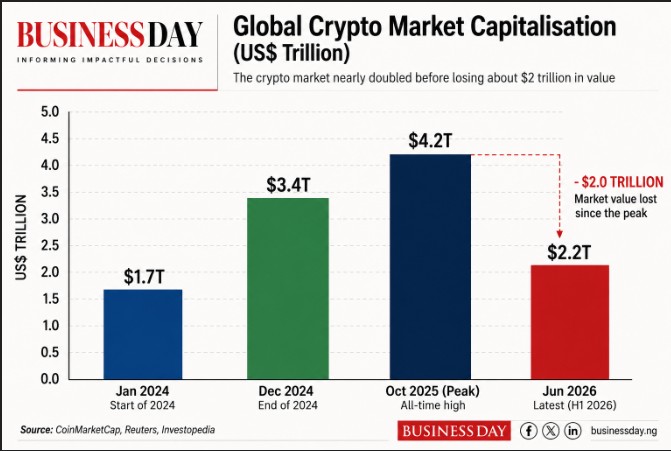
The first half of 2026 has turned into one of the toughest periods for the cryptocurrency market since the collapse of the FTX exchange in 2022.
After reaching record highs last year, Bitcoin, Ethereum and most major digital assets have suffered steep losses, wiping more than $2 trillion off the global crypto market and forcing investors to question whether the industry’s long-running boom-and-bust cycle is changing or simply repeating itself.
Unlike many commentaries circulating online, however, the available market data suggests the downturn is not driven by a single event. Instead, it reflects the combined impact of weakening institutional demand, persistent outflows from Bitcoin exchange-traded funds (ETFs), rising global economic uncertainty, geopolitical tensions in the Middle East, higher interest rates and a shift in investor appetite towards artificial intelligence (AI) companies and high-profile technology listings.
One of the clearest signs of the market’s weakness is Bitcoin itself. According to CoinDesk data, Bitcoin was trading around $58,000 on July 1, (though, it increased to around $62,000 on July 3), its weakest level since September 2024 and more than 50 percent below its all-time high of $126,223 reached in October 2025. Ethereum also fell sharply to about $1,586, its lowest level since April 2025.
The sharp correction has prompted Citigroup to cut its 12-month outlook for the two largest cryptocurrencies. The bank lowered its Bitcoin target from $112,000 to $82,000, while reducing its Ethereum forecast from $3,175 to $2,240, citing weakening investor appetite, continued ETF outflows and the slow pace of digital asset legislation in the United States.
The retreat marks a dramatic change from 2024 and 2025, when institutional adoption helped drive one of crypto’s strongest rallies. The approval of spot Bitcoin ETFs in the United States in early 2024 attracted billions of dollars from institutional investors and contributed to Bitcoin breaking successive record highs.
That momentum has reversed. Recall U.S. spot Bitcoin ETFs have recorded approximately $3.3 billion in net outflows this year, prompting Citi to abandon its earlier expectation of $10 billion in annual ETF inflows. Without fresh institutional demand, analysts say it has become difficult for Bitcoin to sustain higher prices.
Other market trackers have reported even larger redemption figures during periods of sustained selling. CoinDesk, using SoSoValue data, estimated that U.S. spot Bitcoin ETFs experienced about $4.4 billion in cumulative outflows over a 13-session stretch in late May and early June, illustrating the depth of institutional withdrawals during the market decline.
Market analysts also point to changing investor preferences, as many investors who poured money into cryptocurrencies over the past two years are now rotating into AI-related companies, semiconductor stocks and anticipated technology initial public offerings (IPOs), reducing speculative demand for digital assets.
Macroeconomic conditions have compounded the pressure. Expectations that U.S. interest rates could remain higher for longer have strengthened the dollar and reduced demand for riskier assets, including cryptocurrencies. At the same time, renewed conflict involving Iran and broader geopolitical uncertainty have encouraged investors to move towards safer investments such as gold and government bonds.
While Bitcoin has endured heavy losses, many alternative cryptocurrencies have suffered even more.
Ethereum has underperformed Bitcoin throughout much of the year, while tokens such as Solana and XRP have also experienced significant declines as investors reduced exposure to higher-risk digital assets. MarketWatch noted that the broader altcoin market has generally fallen more sharply than Bitcoin during the current correction.
The overall impact on the crypto ecosystem has been substantial. Investopedia reported that more than $2 trillion in cryptocurrency market value has disappeared since the market peaked in late 2025, leaving digital assets among the weakest-performing major investment classes of 2026. The publication noted that cryptocurrencies have lagged behind U.S. equities, gold and even crude oil during the period.
Despite the sell-off, analysts caution against assuming that the industry’s long-term growth story has ended.
One reason is Bitcoin’s well-known four-year halving cycle. Every four years, the reward paid to Bitcoin miners is reduced by half, slowing the creation of new coins. Previous market cycles have often seen prices rise after a halving before entering a prolonged correction.
However, experts stress that this historical pattern should not be treated as a prediction.
While some market participants believe the current downturn resembles previous post-halving corrections, no major research institution has concluded that Bitcoin follows a fixed calendar. Instead, analysts argue that broader economic conditions, institutional investment flows, regulation and market sentiment now play a much larger role than in earlier cycles.
The current downturn also challenges the belief that institutional participation would permanently reduce Bitcoin’s notorious volatility.
When U.S. regulators approved spot Bitcoin ETFs in 2024, many investors expected that large institutional ownership would make future corrections less severe. Instead, MarketWatch observed that the current decline has shown ETFs can also become channels for large-scale selling when investor sentiment turns negative.
Another closely watched indicator is corporate demand for Bitcoin.
Strategy, formerly MicroStrategy and the world’s largest corporate Bitcoin holder, has seen its market valuation come under increasing pressure as crypto prices weakened. The company’s enterprise value recently fell below the value of its Bitcoin holdings for the first time, reflecting growing investor concern over its aggressive cryptocurrency strategy.
Read also: Nigeria’s $59bn crypto inflows raise new risks for monetary policy, says IMF
For now, analysts say the next phase of the market will largely depend on whether institutional investors return to Bitcoin ETFs, whether U.S. lawmakers make progress on digital asset regulation, and whether global economic conditions improve.
Citi believes meaningful recovery may require fresh catalysts beyond the Bitcoin halving narrative, including renewed ETF demand and greater regulatory certainty. Without those developments, the bank expects cryptocurrency prices to remain under pressure in the months ahead.
Although the first half of 2026 has erased much of the optimism that followed Bitcoin’s record-breaking rally last year, market observers argue that the industry’s future will ultimately depend less on historical price cycles and more on whether digital assets can continue attracting long-term institutional capital in an increasingly competitive global investment landscape.


Join BusinessDay whatsapp Channel, to stay up to date
Open In Whatsapp