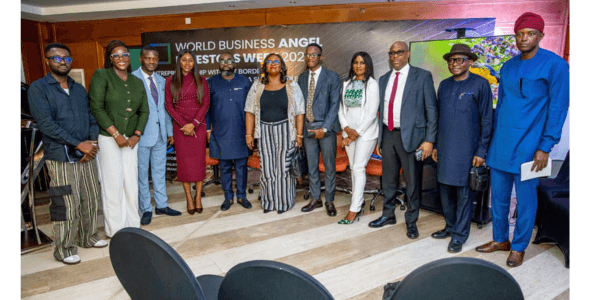
Angel investors are intensifying efforts to connect Nigerian startups with global capital and markets as declining venture funding raises concerns over the ability of the country’s innovation ecosystem to scale beyond domestic boundaries.
Stakeholders at the World Business Angels Investment Forum (WBAF) Investors Week in Lagos said cross-border investment networks, alternative financing structures, and partnerships among investors, governments, and entrepreneurs are becoming critical to sustaining startup growth and expanding financial inclusion.
The discussions come as startup financing in Nigeria fell 17 percent to $343 million in 2025, according to BusinessDay analysis. The figure represents the lowest level since 2019 and reduced Nigeria’s share of African venture capital funding to 11 percent. Despite the decline, Nigeria retained its position as Africa’s most active startup market by deal volume, with 85 startups raising at least $100,000.
Goodness Alabi, head of programmes and trade missions at the World Trade Center Abuja, said the shrinking size of venture capital deals has increased the importance of angel investors in supporting startups seeking growth capital.
“We are generating more startups than anyone else in Africa, but the checks are shrinking. The average deal size is falling, and this is the very gap that angel investors must fill,” Alabi said.
She noted that cross-border angel deals involving African startups rose by 37 percent in 2025, allowing investors from North America, Europe, Asia, and Africa to pool capital and expertise.
“Angel investors are not just early-stage funders. They are ecosystem builders, knowledge brokers, and international connectors,” she said.
According to her, research by the Organisation for Economic Co-operation and Development (OECD) showed that startups backed by international angel investors are 2.2 times more likely to export within their first three years.
Rosaline Adedoyin-Amangbo, country chair of WBAF Nigeria, said Nigeria is positioned to benefit from the global shift towards deep technology, digital infrastructure and sustainable development, but stronger financing mechanisms are needed to convert local innovations into global businesses.
“The world is entering a new economic and technology era defined by rapid innovation, and Nigeria, with its talent pool and dynamic markets, is uniquely positioned to harness these forces for national and global prosperity,” she said.
Adedoyin-Amangbo said Nigerian startups have played key roles in financial inclusion, digital health, and agricultural technology, but scaling these innovations requires the convergence of public policy, technology and investment capital.
“Global investors assist in scaling local startups and entrepreneurs to the global level,” she said.
She called on investors to embrace new financing structures, including blended finance, tokenised funds, and decentralised finance, adding that they could improve access to capital for entrepreneurs and underserved communities.
Speaking virtually from Turkey, Baybars Altuntas, global chair of WBAF and affiliated partner of the G20 Global Partnership for Financial Inclusion, said inclusive entrepreneurship has become an economic imperative.
“Diversity is not simply a social aspiration; it is an economic necessity. When we empower women entrepreneurs, support youth and innovation, and enable underserved communities to participate in the startup economy, we unlock new sources of creativity and growth,” Altuntas said.
He added that while capital remains important, entrepreneurs also need mentorship, education, market access, and supportive policies.
“Financial inclusion remains the cornerstone of this mission. Access to finance, particularly early-stage equity capital, enables entrepreneurs to transform ideas into scalable ventures,” he said.
Also Opeyemi Oriniowo, senior policy adviser on economic affairs at the Consulate General of the Kingdom of the Netherlands in Lagos, during his keynote presentation said Africa’s challenge is not the absence of ideas but the absence of ecosystems that enable businesses to scale.
“The challenge is not a lack of ideas. The challenge is creating ecosystems for growth and development,” he said.
Oriniowo noted that with Africa projected to account for one in every four people globally by 2050, stronger regional integration and collaboration are necessary for sustainable development.
“The future belongs to connected ecosystems, not isolated actors,” he said, adding that the African Continental Free Trade Area offers an opportunity to create a market of over 1.4 billion people if accompanied by deeper ecosystem integration.
He also pointed to opportunities in sustainable finance and environmental, social, and governance (ESG) investments, saying African financial institutions have yet to fully tap into the growing pool of global capital targeting climate financing and carbon markets.
Wofai Samuel, director of the WBAF Nigeria event, said connecting investors, policymakers, and entrepreneurs on one platform creates opportunities that would otherwise take years to materialise.
“Every investment secured, every partnership formed, every business expanded, and every entrepreneur empowered has a multiplier effect on the economy,” Samuel said.


Join BusinessDay whatsapp Channel, to stay up to date
Open In Whatsapp