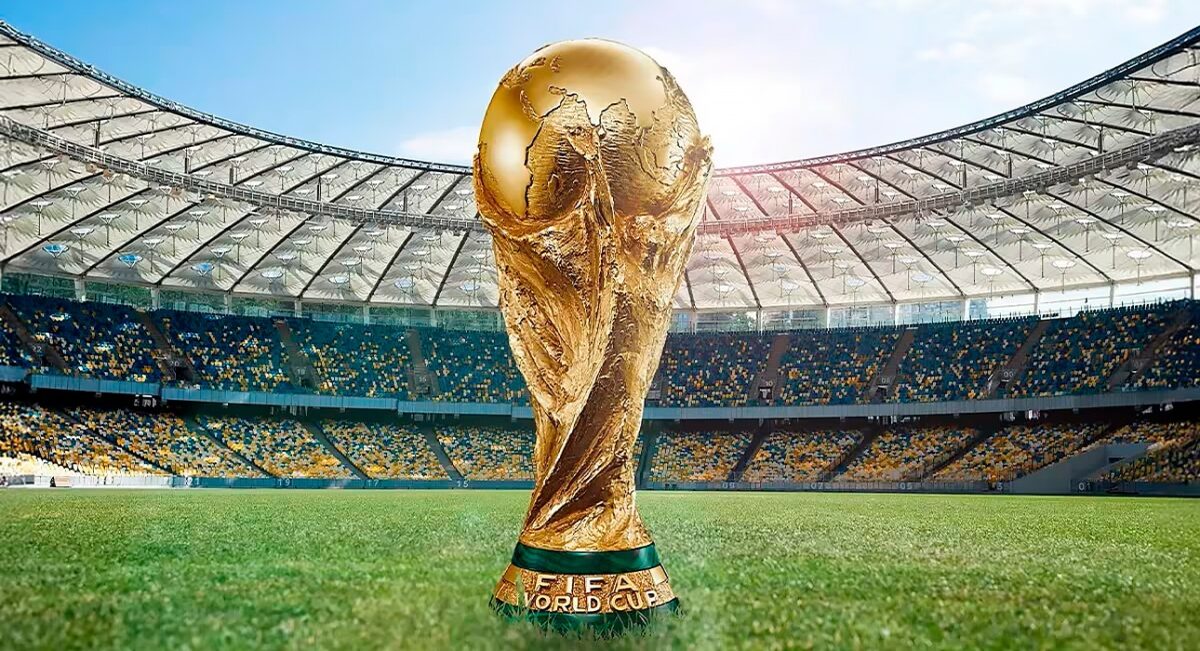
The next World Cup host will make football history long before the first whistle.
Rather than being staged in a single country, the 2030 FIFA World Cup will unfold across six nations on three continents, creating the most geographically expansive tournament in the competition’s 100-year history.
FIFA’s centenary edition will begin where the World Cup started in 1930, South America, before shifting to its main hosts in Europe and Africa, a format designed to commemorate the inaugural tournament while showcasing football’s increasingly global reach.
When is the next FIFA World Cup?
The next FIFA World Cup will take place in 2030, with FIFA proposing a tournament running from June 8 to July 21, 2030.
The opening centenary fixtures are scheduled for June 8 and 9 in South America, while the main tournament is expected to kick off in Morocco, Portugal and Spain on June 13 and 14.
The final is provisionally slated for July 21, although FIFA has yet to publish the complete fixture list.
Who is the next World Cup host?
The next World Cup host is a partnership between Spain, Portugal, and Morocco, which will stage the vast majority of the 2030 tournament.
In a break from tradition, Uruguay, Argentina, and Paraguay will each host one opening-round match before the competition moves permanently to the three principal host nations.
The arrangement makes the 2030 edition the first men’s World Cup to be played across six countries and three continents.
For FIFA, the format is symbolic as much as logistical.
Uruguay, the venue for the inaugural 1930 World Cup, will stage the opening centenary match in recognition of hosting football’s first global tournament. Argentina, runners-up in that competition, will also host a commemorative fixture, while Paraguay’s inclusion recognises its status as home to CONMEBOL, South America’s football governing body.
Which countries have qualified?
Six nations have already secured automatic qualification by virtue of hosting the tournament:
Spain
Portugal
Morocco
Uruguay
Argentina
Paraguay
The remaining 42 places will be determined through continental qualifying competitions over the next several years.
Why is the 2030 tournament different?
The tournament represents one of FIFA’s boldest organisational experiments.
Teams involved in the South American centenary matches will receive additional recovery and travel time before rejoining the rest of the tournament in Europe and North Africa.
The unusual structure reflects FIFA’s attempt to balance historical symbolism with the realities of staging an expanded global competition.
For broadcasters, sponsors, and, travelling supporters, however, the logistics will be unprecedented, with matches spread across thousands of kilometres and multiple time zones.
Will there be 48 or 64 teams?
As it stands, the 2030 FIFA World Cup will feature 48 teams, maintaining the expanded format introduced at the 2026 tournament in the United States, Canada and Mexico.
That may not be the final word.
FIFA President Gianni Infantino has confirmed that football’s governing body will study proposals to further increase the competition to 64 teams, arguing that expansion creates more opportunities for emerging football nations and strengthens the sport’s global appeal.
No decision has yet been taken.
A tournament built around history
The 2030 competition carries greater historical significance than any World Cup in recent decades.
The first FIFA World Cup was held in Uruguay in 1930, when 13 teams travelled, many by ship, to compete in the inaugural tournament. Uruguay defeated Argentina 4-2 in the final at Montevideo’s Estadio Centenario to become football’s first world champions.
A century later, FIFA is returning to those origins before handing the tournament over to its modern co-hosts.
The World Cup has since evolved from a 13-team competition into a global sporting event featuring 48 nations, reflecting football’s expanding commercial reach and international popularity.
What comes after 2030?
Attention will quickly turn to the 2034 FIFA World Cup, which will be hosted by Saudi Arabia.
Unlike the centenary edition, the 2034 tournament will return to a single-host format after FIFA confirmed Saudi Arabia as the sole successful bidder.
The governing body has not yet announced the tournament schedule or match calendar
The next World Cup host is unlike any before it. By stretching the 2030 FIFA World Cup across six countries and three continents, FIFA is using football’s centenary to celebrate its origins while signalling a future in which the game’s biggest tournament is becoming larger, more global and increasingly ambitious.

Join BusinessDay whatsapp Channel, to stay up to date
Open In Whatsapp