Nigeria’s Safe Schools Initiative captures a painful contradiction between fiscal ambition and lived insecurity. Despite a ₦144.77 billion (2023–2026) federal commitment to secure learning spaces, classrooms remain under siege. In May 2026, gunmen abducted dozens of students in Borno State and attacked schools in Oyo’s Oriire LGA, exposing how billions in Abuja fail to reach the frontlines.
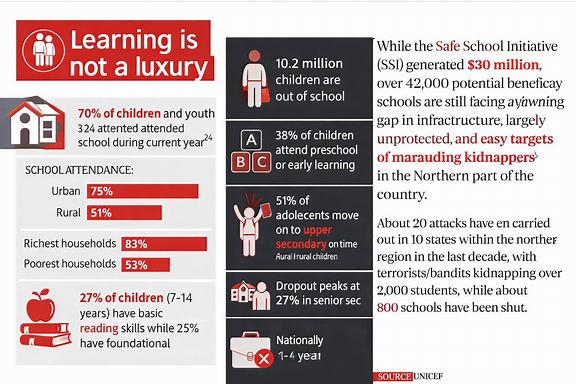
The crisis is not new. UNICEF data show 10.2 million children out of school, with only 27 % possessing basic reading skills and 25 % foundational numeracy. While the government recently sought an additional ₦5 billion boost, accountability questions persist over the larger fund. The earlier $30 million Safe Schools Plan left more than 42,000 schools vulnerable, and over 800 schools have been shut following 20 attacks across 10 northern states, where 2,000 students were kidnapped.
Oyo’s ₦3.5 billion local grant for armed forest guards underscores the fiscal disconnect—local improvisation replacing federal protection. The result is a widening black hole: money allocated but not delivered. Fixing it demands decentralised disbursement, transparent tracking, and direct investment in school level security. Without this, Nigeria risks spending billions while leaving its children unprotected and its classrooms empty.
Oyo’s deployment of a ₦3.5 billion local grant for armed forest guards highlights the fiscal disconnect: local improvisation fills gaps left by federal inertia.
The result is a widening black hole- money allocated but not delivered. Fixing it requires decentralising disbursement, enforcing transparency, and tying funds directly to frontline security and infrastructure. Without this, Nigeria risks spending billions while leaving classrooms empty and children unprotected.
Safe School Initiative (SSI) Mandate
More than a decade has passed since the abduction of nearly 300 girls from their school in Chibok, Borno State, a moment that jolted the world and forced Nigeria to confront the dangers facing its learners. That tragedy gave rise to the Safe Schools Initiative, a pledge to strengthen classroom security and reassure families that education would not come at the risk of their children’s lives.
Twelve years later, the nightmare hasn’t ended. The May 2026 attack in Askira, Borno State and Oriire, Oyo state where close to 100 students and teachers were taken, continues to echo across the country.
Recent data show that only about 37% of schools in 10 high-risk states have basic early-warning systems, and just 14% meet safe-infrastructure standards. For many parents, these numbers raise a difficult question: how secure are the places meant to shape their children’s future?
Meanwhile, the country’s school-security budget: a once-promising ₦144.7 billion plan for 2023-2026 remains largely unspent or perhaps unaccounted for. When the Safe School Initiative (SSI) was launched in 2014 with a $30 million fund and global praise, it was billed as the turning point that would finally protect Nigerian children from terror. Years later, the gap between promise and protection remains obvious.
From Paper Budgets to Soft Targets
Nigeria’s SSI starkly illustrates the gulf between fiscal ambition and lived insecurity. On paper, Abuja allocated humongous to secure classrooms, alongside an earlier $30 million Safe Schools Plan. Yet UNICEF reports that 42,000 schools remain vulnerable, while Social Voices notes that the programme has failed to shield children from daily threats of banditry and insurgency.
The Punch timeline underscores the human toll: since March 2024, over 600 pupils and teachers have been abducted in seven mass incidents. These include 137 children in Kuriga, Kaduna (March 2024), 303 students and 12 teachers in Niger (Nov 2025), and the 46 pupils and staff kidnapped in Oyo’s Oriire LGA (May 2026)—the first large scale abduction in southern Nigeria. In Borno’s Askira area, dozens were taken the same day, highlighting the spread of insecurity across regions.
Quantifying the Cost of Fear
To reveal the fiscal paradox of the Safe School Initiative (SSI), the additional ₦5 billion boost requested by the Federal Government exposed glaring cracks: states like Oyo report receiving no direct disbursement, forcing them to improvise with ₦3.5 billion in local grants for armed forest guards. At its centre lies a ₦144.77 billion National Plan for Financing Safe Schools (2023–2026), hailed as one of Africa’s boldest education security interventions. Yet insecurity continues to devastate classrooms. According to Punch, more than 600 pupils and teachers have been abducted since 2023, despite the scheme’s existence. The attached timeline shows at least nine major incidents across Katsina, Zamfara, Kaduna, Niger, Kebbi, Sokoto, Borno, and Oyo States, with the crisis spreading southward in May 2026 when 46 pupils and staff were kidnapped in Oyo’s Oriire LGA—the first large scale abduction in southern Nigeria.
The disconnect highlights a deeper structural problem in Nigeria’s public finance architecture. Rather than functioning as a rapid-response mechanism for vulnerable schools, the programme has become trapped within a centralised procurement and administrative framework that prioritises processes over outcomes. As a result, states are increasingly compelled to finance school security from already-stretched budgets, turning what should be a nationally coordinated preventive investment into a reactive, fragmented expenditure burden.
The outcome is both economically inefficient and socially costly: while funds accumulate at the centre, insecurity escalates at the periphery, exposing the widening gap between budgetary allocation and real-world protection.
Reclaiming the Schools
To truly secure Nigerian schools, safety must shift from defensive walls to proactive protection. First, rapid-response security squads should be deployed around school clusters to cut response time during attacks.
Second, community intelligence networks and early-warning systems must be formalised to detect threats before they materialise.
Third, school security funding requires transparent, ring-fenced budgeting to prevent diversion.
Finally, absolute protection depends on coordinated operations among the critical stakeholders, police, NSCDC, and vetted state vigilante groups.
Only a holistic, multi-layered security ecosystem, not fear-driven fortification like that in Niger State, can reclaim the classroom and restore learning as a safe public good.
Join BusinessDay whatsapp Channel, to stay up to date
Open In Whatsapp