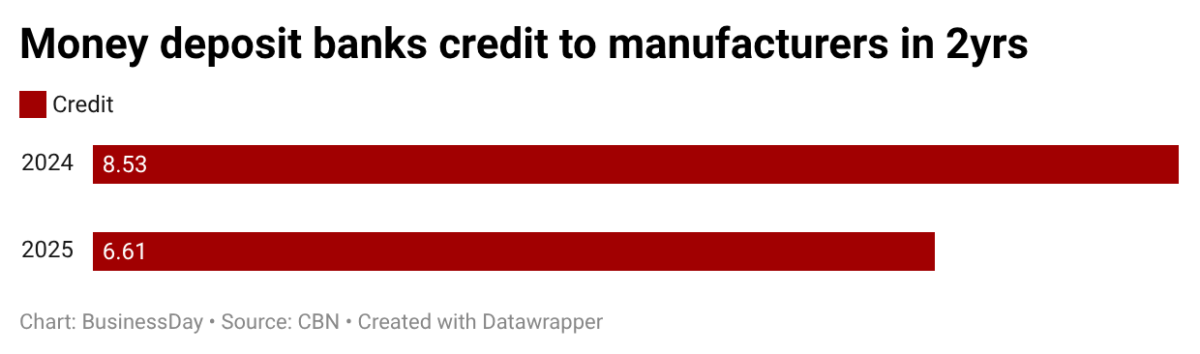
Nigeria’s manufacturing sector is facing a severe credit crunch, with banks’ loans plunging 22.5 percent to N6.6 trillion in 2025, according to data from the Manufacturers’ Association of Nigeria (MAN).
According to the data, commercial bank credit allocation to manufacturing contracted by N1.92 trillion from N8.53 trillion in December 2024 to N6.61 trillion in December 2025.
This represents a significant year-on-year contraction of 22.5 percent which MAN described as particularly disturbing, given that manufacturing recorded one of the largest credit contractions among the top sectors, surpassed only by the general services sector at 25 percent.
The significant contraction has left manufacturing lagging behind other sectors, such as oil and gas and finance, highlighting a systemic preference for speculative activities over productive sectors.
The credit squeeze is particularly concerning given the sector’s potential for job creation and economic diversification.
Segun Ajayi-Kadir, director-general of MAN, noted that the reduction in credit access could limit capacity utilization, stall technological upgrades, and hinder job creation, ultimately slowing down vital diversification efforts and leaving the nation vulnerable to external shocks.
According to him, this comes as global peers such as India and Vietnam are aggressively expanding credit to their manufacturing sectors.
Kadir attributed the contracted credit distribution to a combination of prohibitive interest rates, structural bureaucracy, and policy misalignment. With Nigeria’s manufacturing sector struggling to access credit, the country’s economic growth prospects are increasingly uncertain.
“The Nigerian manufacturing sector cannot thrive without sustainable and growing financial foundations,” he emphasized.
Kadir noted that the high cost of borrowing is a major barrier to credit access, with commercial lending rates averaging 27 percent prime lending and 35.6 percent maximum lending.
He also stressed that the Central Bank of Nigeria’s (CBN) stringent Cash Reserve Ratio of up to 45 percent has also constrained loanable banking liquidity. Also, commercial banks’ systemic risk aversion has led to stringent collateral requirements, making it difficult for manufacturers to access credit.
According to him, the non-implementation of the N1 trillion Manufacturing Stabilization Fund has also worsened the credit crunch.
The fund, announced in 2024, was meant to cushion the impact of currency devaluation and high energy costs on manufacturers. The CBN’s policy shift to halt direct development financing has also starved manufacturers of vital concessionary capital, forcing them to rely on expensive commercial loans.
The credit contraction has severe implications for the sector, including suppression of manufacturing capacity utilization, structural stagnation of sectoral contribution to national GDP, escalation of workforce downsizing, and structural unemployment, MAN DG said.
The sector’s contribution to GDP remains below 10 percent; the credit squeeze also exacerbates supply-side inflation and foreign exchange strain, making it difficult for the nation to achieve economic diversification, he explained.
He stated that the situation threatens to paralyze the 2025 Nigeria Industrial Policy (NIP), which aims to boost industrial productivity and drive job creation.
“Without accessible credit, manufacturers cannot execute capital expenditures and modernize operations, making the NIP’s targets unrealizable.”
Ajayi-Kadir emphasized the need for policymakers to address these challenges and create an enabling environment for manufacturers to access affordable credit and drive growth.

Join BusinessDay whatsapp Channel, to stay up to date
Open In Whatsapp