Nigeria’s consumer goods sector is facing a paradox. While companies are posting impressive profits, their warehouses are filling up with unsold goods, a sign that consumers are buying less.
According to the Manufacturers Association of Nigeria (MAN), unsold goods fell to N1.04 trillion in the first half of 2025, a 16.05 percent increase from the N896.2 billion recorded in the second half of 2024, underscoring the toll of Nigeria’s economic hardship on household spending.
During the release of the Q3 2025 Manufacturers’ CEO Confidence Index report, Segun Ajayi-Kadir, director-general of the MAN, cautioned that the increase in unsold goods was a result of both poor implementation of the government’s local content policies and weak consumer demand.
“Low patronage by government agencies remains one of the top challenges facing manufacturers,” Ajayi-Kadir said.
“Despite our persistent advocacy for public institutions to lead by example in buying made-in-Nigeria products, implementation remains weak, and this has left local industries struggling with rising inventories,” he said.
Read also: FMCG makers seen posting stronger Q3 on easing inflation, stable naira
He explained that other major challenges identified by manufacturers in the quarter included inadequate power supply, high exchange rates and forex scarcity, high electricity tariffs and alternative energy costs, multiple taxation, and poor road infrastructure.
Profits up, sales down
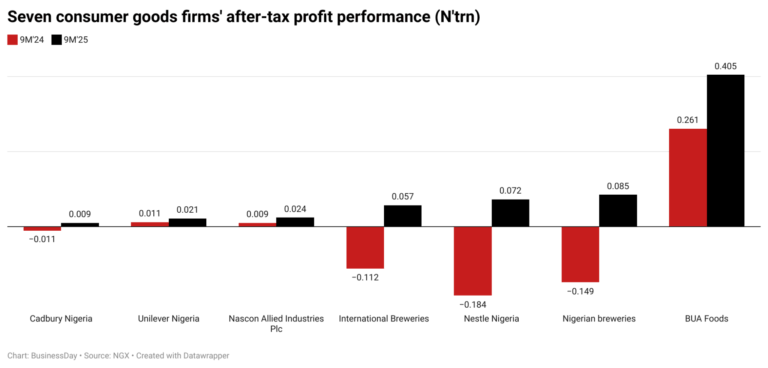
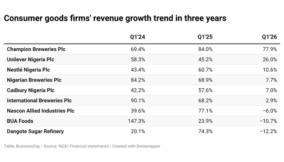
At first glance, the numbers suggest recovery. BUA Foods, for instance, posted a 101 percent surge in after-tax profit to N405 billion, cementing its position as the most profitable consumer goods firm on the Nigerian Exchange. Yet across the sector, inventories tell a different story.
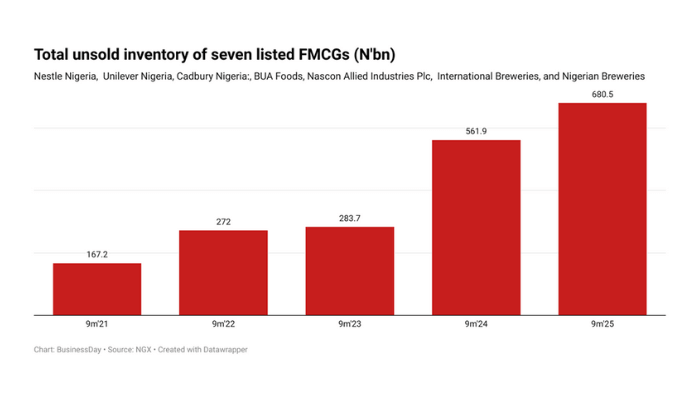
According to data reviewed by BusinessDay, seven listed companies reported unsold goods worth N680.5 billion in the nine months of 2025, up from N561.5 billion reported at the start of the year, compared to N167.2 billion reported in the same period of 2021.
Among the companies reviewed, international breweries’ unsold goods inventory rose the highest, by 355.7 percent in the last five years, followed by Nigerian Breweries (289.7 percent), Nestle Nigeria (267.3 percent), and Nascon Allied Industries Plc (256.6 percent).
Others include Cadbury Nigeria (210.4 percent), BUA Foods (131.4 percent), and Unilever Nigeria (81.4 percent).
This highlights that many companies are becoming more profitable not because they are selling more products, but because they are charging higher prices to offset inflation, managing costs aggressively, or benefiting from accounting adjustments tied to currency devaluation.
Read also: Inflation to innovation: FMCGs’ resilience playbook
As a result, their profit growth conceals the reality of weak demand and consumer resistance in a price-fatigued economy.
Data shows that these seven listed consumer goods firms disclosed a combined after-tax profit of N673 billion in the nine months of this year, compared to an after-tax loss of N175 billion last year.
“This rebound is a positive signal for investors and reflects the resilience of Nigeria’s FMCG sector amid tough macroeconomic conditions,” said Adewale Johnson, a consumer market analyst in Lagos.
“If the current momentum is sustained and policy reforms continue, we could see consistent profitability through the rest of the year,” he said.
Similarly, Uchenna Uzo, professor of Marketing at Lagos Business School, noted that many consumer goods companies are better positioned to navigate macroeconomic headwinds, as market conditions have become relatively more stable than last year.
“It’s not that consumers are buying significantly more,” he explained, “but firms have implemented price increases, which have, in some cases, led to a doubling of profits.”
Demand erosion and economic strain
Beyond company performance, the rising tide of unsold goods exposes deeper structural issues within Nigeria’s economy.
Weak consumer demand not only affects manufacturers but also threatens broader economic growth. Household consumption, which drives a large share of GDP, has stagnated, and unemployment remains high.
According to the Nigerian Gross Domestic Product Report (Expenditure and Income Approach), household consumption expenditure in Q1 and Q2 of 2024 fell by 42.28 percent and 61.18 percent in real terms, year-on-year.
Despite growth in national disposable income to 12.91 percent and 17.44 percent in Q1 and Q2 of 2024, which has been impacted by the rising inflation, although now slowing down, it reflects deeply on consumer spending.
The National Bureau of Statistics (NBS) has disclosed that inflation has been taking a back seat, slowing for the sixth straight month to 18.02 percent in September 2025, the lowest it’s been in three years.
According to investment and research firm CardinalStone, in a note, a stronger naira and declining inflation are helping to reduce raw material and packaging costs, leading to a moderation in the cost-to-sales ratio and improved profitability.
The naira has, for most of 2025, maintained rare stability, climbing to a nine-month high buoyed by portfolio inflows, stronger FX reserves, and coordinated policies that have seen the currency decouple from fluctuation in oil prices.
The naira has for weeks traded below the “psychological” 1500/$ to close the market on Friday at 1,421.73 per dollar as confidence continues to build in Africa’s most populous nation’s economy.
“The stronger macroeconomic conditions are expected to boost the earnings of consumer goods firms,” the CardinalStone report disclosed.
Manufacturers, on their part, are trapped between cost pressures and the need to sustain operations. Many have spent heavily on alternative energy sources and imported raw materials, rising to N676.6 billion and N1.72 trillion in the first half of the year, MAN disclosed in its Q3 manufacturing confidence index report.
”The manufacturing overall performance remains fragile. Real output growth slowed from 1.69 percent in the first quarter to 1.6 percent in the second quarter, contributing 7.81 percent to Nigeria’s Gross Domestic Product, down from 9.62 percent in the preceding period,” the report disclosed.


Join BusinessDay whatsapp Channel, to stay up to date
Open In Whatsapp