
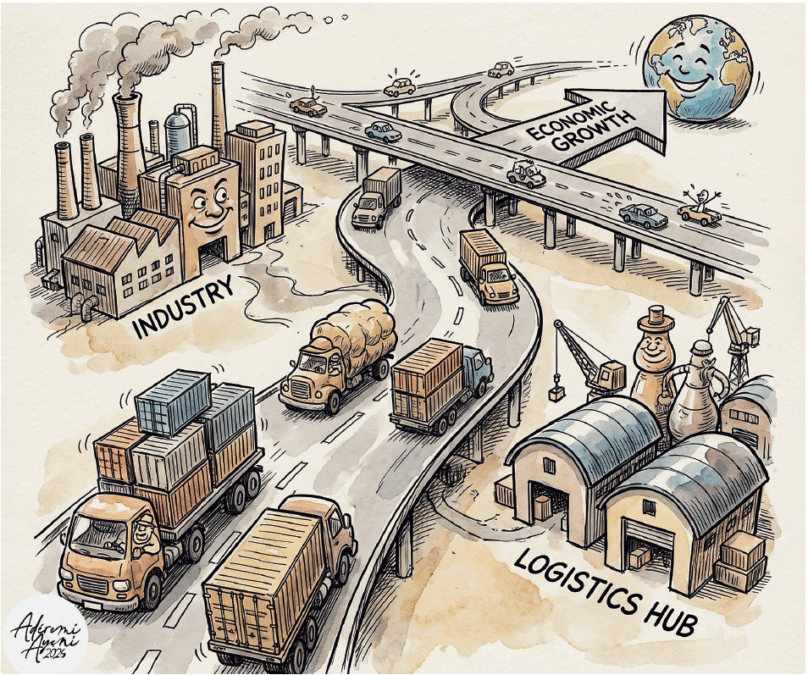
For much of the past three years, Nigeria’s economic debate has centred on a few key prices: petrol, foreign exchange, electricity, and the cost of borrowing. Since 2023, government reforms have altered each of them significantly. Fuel subsidies were removed, the exchange rate was liberalised, electricity tariffs for some consumers increased, and the Central Bank pursued one of its most aggressive monetary tightening cycles in decades.
These reforms sought to correct long-standing distortions and restore market signals. They changed how resources are priced across the economy. But changing prices is only the first stage of economic reform. On its own, it cannot transform an economy whose deeper constraints lie in weak productivity and limited productive capacity.
This explains why many of Nigeria’s longstanding challenges remain. Prices have changed. The real test is whether those changes are translating into higher production, stronger investment and sustained productivity growth. Businesses still struggle with unreliable electricity. Agricultural productivity remains low. Manufacturing continues to face high production costs. Non-oil exports have expanded only modestly, while productive job creation has remained slow.
Prices perform an important economic function. They signal scarcity, encourage efficiency and influence investment decisions. They help producers and consumers respond to changing market conditions. But prices do not build factories, generate electricity, modernise farms, construct transport infrastructure, or train skilled workers. Those outcomes depend on investment, institutions and productive capacity.
This distinction is often overlooked in public debate. Much of Nigeria’s recent reform programme has focused on correcting prices. Subsidy removal changed the price of fuel. Exchange-rate liberalisation altered the price of foreign exchange. Monetary tightening increased the cost of borrowing. Electricity tariff reforms moved parts of the sector towards cost-reflective pricing.
Many of these measures were necessary. Artificial prices had become fiscally expensive and economically distortive. But price reforms should not be mistaken for structural transformation.
A higher fuel price does not automatically create domestic refining capacity. A weaker naira does not automatically produce competitive exporters. Higher interest rates do not raise productivity by themselves. Cost-reflective electricity tariffs do not automatically increase electricity supply.
What price reforms do is improve incentives. They encourage businesses and households to make different decisions, reduce waste and allocate resources more efficiently. Businesses also need reliable infrastructure, policy stability, access to finance, skilled labour and confidence that investments will generate sustainable returns. Manufacturers will not expand production simply because the exchange rate has been liberalised. Farmers will not invest more because fuel prices have increased. Investors respond when they can see dependable electricity, efficient logistics, predictable regulation and markets capable of supporting long-term returns. Price reforms may encourage investment, but productive investment depends on the wider business environment.
Experience from Asia’s fastest-growing economies points in the same direction. China, Vietnam and Indonesia all liberalised prices and relied more on market signals, but they matched those reforms with sustained investment in infrastructure, manufacturing, education and export capacity. Markets improved incentives, while deliberate public and private investment expanded productive capacity. Together, these changes drove productivity, employment and income growth over several decades.
Nigeria now faces a similar task.
The country’s most important economic constraint may no longer be distorted prices but weak productivity. Productivity determines how much value workers, farms and businesses generate from available resources. Over time, rising productivity, not price adjustments, is what raises incomes and improves living standards.
Recent data illustrate the challenge. According to the International Labour Organisation, ILO, the average Nigerian worker generated about US$5.60 of output per hour in 2025. Comparable figures were US$8.30 in Côte d’Ivoire, US$11.60 in Ghana, US$15.90 in Namibia and more than US$20 in both China and Botswana. These differences reflect stronger productive capacity rather than simply different price levels.
Higher productivity changes almost every economic outcome. A worker who produces more value per hour can earn higher wages. Farms that produce more from the same hectare increase incomes without requiring additional land. More efficient firms compete more successfully in domestic and export markets. Over time, productivity growth enables an economy to generate more output with existing resources while supporting rising living standards.
Price adjustments without corresponding improvements in production usually lead economies back to familiar difficulties: inflationary pressures, foreign exchange shortages and recurring fiscal stress. Price reforms improve incentives and resource allocation, but they cannot replace investments that expand output.
This is why the next phase of Nigeria’s reforms will matter even more than the first. The priority should now shift towards policies that strengthen productive capacity: improving electricity supply, expanding transport infrastructure, supporting competitive manufacturing, modernising agriculture, investing in skills, deepening access to long-term finance and creating a more predictable business environment.
Price reforms should therefore be seen as a beginning rather than the destination. Their success ultimately depends on whether they stimulate higher investment, stronger exports, more productive firms and sustained productivity growth.
The true measure of economic reform is not simply that petrol costs more, the exchange rate is market-determined or electricity tariffs are more cost-reflective. It is whether Nigeria produces more, exports more, creates more productive jobs and steadily improves living standards. Without that second phase of reform, the gains from price adjustments will remain limited, and the economy will continue to fall short of its productive potentials are never realised.

Join BusinessDay whatsapp Channel, to stay up to date
Open In Whatsapp