One of the biggest visions of the early Pan-Africanist movement after the independence struggles of the 1950s and 1960s was the idea of a politically and socially united Africa where Africans could move, cooperate, and coexist beyond colonial borders. Kwame Nkrumah imagined a United States of Africa. Muammar Gaddafi spent years campaigning for a single African currency and stronger continental institutions. Nelson Mandela often spoke about an Africa connected by shared struggle rather than divided by artificial boundaries. However, more than six decades later, that vision remains largely in the discussion phase, with recurring violence against fellow Africans increasingly exposing how fragile African unity remains in practice.
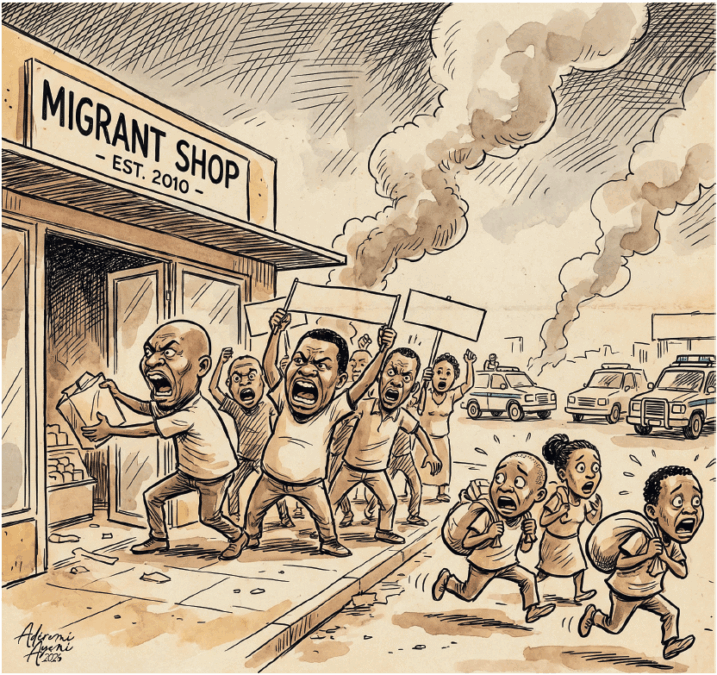
South Africa has become one of the clearest examples of this contradiction. In recent months, anti-immigrant protests and marches in parts of South Africa again placed African migrants at the centre of public hostility, with demonstrators accusing foreigners of contributing to crime, unemployment, and economic hardship. The tensions are not new. Since 2008, South Africa has experienced repeated outbreaks of violence targeting African migrants, particularly Nigerians, Zimbabweans, Somalis, Ethiopians, and Mozambicans. According to Human Rights Watch, more than 60 people were killed and tens of thousands displaced during the 2008 attacks alone. Similar violence resurfaced in 2015 and again in 2019, when foreign-owned businesses were looted across parts of Johannesburg and Pretoria. Nigeria temporarily recalled its ambassador to South Africa after the 2019 attacks, while some African governments issued travel advisories for citizens. Although South African authorities have repeatedly denied that the attacks reflect xenophobia, the repeated targeting of African migrants over nearly two decades has reinforced that perception across the continent.
According to the World Bank, South Africa remains one of the most unequal societies globally, while unemployment has remained above 30 percent in recent years. In many poor communities, frustration is shaped by poverty, crime, weak service delivery, and economic exclusion. Migrants often become easy targets during periods of hardship because they are visible, vulnerable, and politically convenient to blame. Economic hardship explains part of the anger, but it does not fully explain why fellow Africans repeatedly become the focus of hostility.
South Africa hosts major Chinese, Indian, Lebanese, and European business interests across several sectors of its economy. Public anger, however, is often directed more aggressively at black African migrants involved in small businesses, transport operations, and informal trade. That contradiction reveals something deeper about African solidarity and identity. Africa sometimes appears more comfortable accommodating foreign capital than accommodating fellow Africans trying to survive within the continent.
The contradiction extends beyond South Africa. In 1983, Nigeria expelled more than one million undocumented West African migrants, many of them Ghanaians, during an economic crisis. The Ghanaians do not seem to have forgotten that episode because just recently, as has happened in the past, Nigerians and Nigerian businesses became targets of attacks in Ghana, with protesters calling for Nigerians to leave their country. Tunisia also faced international criticism in 2023 after President Kais Saied’s remarks about sub-Saharan African migrants triggered panic, violence, and mass arrests. Across several African countries, anti-immigrant rhetoric often resurfaces whenever economies weaken or political tensions rise.
These tensions persist despite decades of Pan-African commitments. The African Union promotes continental integration, ECOWAS guarantees free movement across West Africa, and the African Continental Free Trade Area promises deeper economic cooperation. However, movement across much of the continent remains heavily restricted. The African Development Bank’s Visa Openness Index continues to show that many African countries maintain strict visa systems against fellow Africans despite years of integration promises. Aliko Dangote once revealed that he still requires about 38 visas to travel across Africa despite being one of the continent’s biggest investors and industrialists. If one of Africa’s leading economic figures faces such barriers, the limitations confronting ordinary Africans are even greater.
Africa’s integration problem is not only political. It is also psychological. Many African states inherited colonial borders that created fragile national identities and regional distrust. After independence, governments focused heavily on sovereignty and domestic control, while Pan-Africanism often remained symbolic. Africans frequently grow up learning more about Europe, America, and Asia than about neighbouring African societies and liberation movements. As a result, many Africans still see fellow Africans first as outsiders before seeing them as partners.
Africa cannot continue treating integration as a ceremonial project discussed mainly at diplomatic summits while ordinary Africans remain trapped behind hostile borders and political suspicion. Pan-Africanism must become visible in policy and everyday life. African governments should reduce unnecessary visa restrictions, simplify residency systems for Africans, and improve recognition of professional qualifications across regional blocs. Education systems should also teach African history as a connected continental experience rather than isolated national struggles.
The African Union also needs stronger enforcement mechanisms. Repeated xenophobic violence against African migrants should trigger coordinated continental responses, including investigations, mediation structures and diplomatic consequences for governments that fail to protect residents. Integration cannot survive if African states enjoy the language of unity without accepting the responsibilities that come with it.
Africa should be far beyond this cycle in 2026. Xenophobia continues exposing the distance between the Africa leaders describe and the Africa many ordinary Africans experience. A continent that cannot consistently protect Africans within Africa will struggle to build the political and economic unity it repeatedly promises. Pan-Africanism cannot survive on speeches alone. It must become visible in borders, institutions, labour systems, and public behaviour, otherwise violence against fellow Africans will continue revealing how fragile Africa’s unity project truly remains.

Join BusinessDay whatsapp Channel, to stay up to date
Open In Whatsapp