Oil markets have a long history of reacting sharply to geopolitical shocks. Their deeper significance, however, lies in how they redistribute opportunity across producing economies. For oil-dependent states like Nigeria, price surges are not merely market events; they are moments of fiscal possibility that can either reinforce structural weakness or enable meaningful economic recalibration.
The latest Middle East crisis has once again triggered a similar response in global oil markets. Brent crude briefly surged above $100 per barrel, far exceeding Nigeria’s 2026 budget benchmark of roughly $60. For a country whose public finances remain closely tied to crude exports, such a gap immediately raises the prospect of another oil windfall. Oil markets, however, remain highly volatile. Prices have since fluctuated as geopolitical expectations shift, including signals from figures such as Donald Trump on the possible duration of the conflict. Even so, prices may remain comfortably above Nigeria’s fiscal assumptions, sustaining the possibility of higher-than-expected oil revenues.
The arithmetic illustrates the scale of this potential windfall. Nigeria currently produces around 1.3 to 1.5 million barrels of crude oil per day. When global prices exceed the budget benchmark, every additional dollar translates into millions in extra daily revenue. At sustained price levels of $80 to $100 per barrel, the resulting gains could amount to several billion dollars annually. Such an outcome could materially improve Nigeria’s fiscal position. Higher oil earnings could narrow budget deficits, strengthen external reserves, ease exchange rate pressures, and reduce reliance on borrowing. In the short term, this can create breathing space for macroeconomic management. However, Nigeria’s experience with oil windfalls suggests that the reality is rarely straightforward.
The first limitation is production. Nigeria can only benefit from higher prices if it produces and exports sufficient volumes of crude. In recent years, output has been constrained by crude theft, pipeline vandalism, operational disruptions, and underinvestment in upstream infrastructure. Production has at times fallen close to 1.2 million barrels per day, well below Nigeria’s OPEC quota and far below historical levels. When volumes are weak, price gains cannot fully translate into revenue gains. More importantly, persistent instability in production undermines investor confidence and limits the sector’s long-term viability.
The second constraint lies in the country’s fiscal structure. Oil revenues are distributed through the federation account and shared across the three tiers of government. Significant portions are also absorbed by operational costs, joint venture obligations, and debt servicing commitments. Nigeria’s debt service burden has risen sharply, with a growing share of government revenue now devoted to repayments. As a result, higher oil income does not automatically translate into greater fiscal flexibility, but often dissipates across competing obligations before it can be strategically deployed.
Nigeria’s economic history offers important context. During the commodity supercycle of the 2000s, oil prices climbed to record levels, briefly exceeding $140 per barrel in 2008. Government revenues expanded significantly, yet much of the spending was directed towards recurrent expenditure rather than long-term investment. A similar pattern emerged between 2011 and 2014, when prices remained above $100 for extended periods. More recently, global supply disruptions following Russia’s invasion of Ukraine in 2022 pushed prices above $120 at one point.
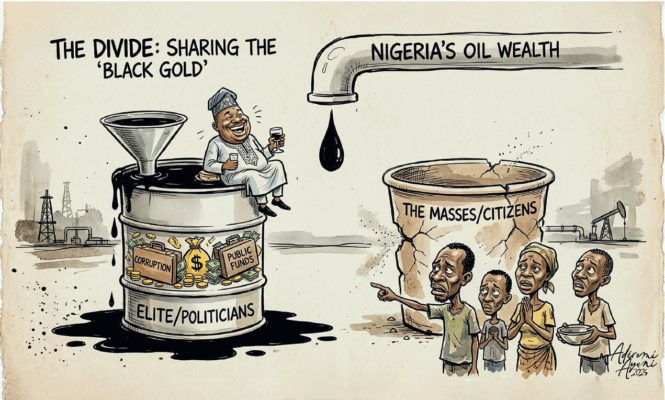
Each of these episodes temporarily improved fiscal balances. Yet none fundamentally reduced Nigeria’s dependence on crude exports or transformed the structure of the economy. Infrastructure deficits persisted, manufacturing capacity remained limited, and non-oil exports continued to account for a relatively small share of foreign exchange earnings. The pattern is clear: windfalls have historically provided relief, but not reform. This historical pattern makes the current moment particularly significant. If oil prices remain elevated, Nigeria could receive another substantial windfall. But whether this translates into lasting economic benefit will depend less on oil markets than on policy choices and institutional discipline.
Three issues are likely to be decisive. The first is production stability. Without sustained improvements in output, Nigeria will struggle to capture the full value of higher prices. Addressing crude theft, securing pipeline infrastructure, improving regulatory clarity, and incentivising upstream investment are not just operational priorities but strategic imperatives for revenue certainty.
The second is fiscal discipline. Oil windfalls can either strengthen public finances or reinforce cycles of volatility. Experience shows how quickly temporary gains can translate into permanent spending commitments. A disciplined approach would prioritise deficit reduction, debt stabilisation, and the rebuilding of fiscal buffers such as sovereign savings mechanisms. Without this, the cycle of boom and fiscal stress will persist.
The third is structural investment. The most successful resource-rich economies have used commodity windfalls to finance long-term transformation by investing in infrastructure, human capital, and productive sectors that reduce dependence on extractive revenues. For Nigeria, this means directing windfall gains into sectors that expand the non-oil economy, improve productivity, and generate sustainable employment. Without such deliberate allocation, windfalls risk being absorbed into consumption rather than transformation.
The current surge in oil prices, therefore, presents both an opportunity and a test. Nigeria has experienced many windfalls over the decades. What has been rare is using them to permanently strengthen the economy.Whether this moment leads to a different outcome will depend on whether policy discipline can finally match fiscal opportunity.


Join BusinessDay whatsapp Channel, to stay up to date
Open In Whatsapp