
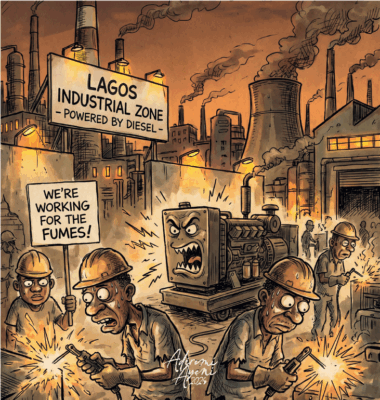
Nigeria’s industrial future cannot continue to depend on factories and businesses generating their own electricity through diesel generators and private power systems. That is the uncomfortable truth at the heart of the country’s electricity crisis. For too long, the national conversation around power has focused mainly on household supply, how many homes receive electricity, how many hours of light people enjoy, and how often the grid collapses. These are important concerns, but they often miss the larger economic question: who powers production?
The deeper issue has always been electricity as the foundation of manufacturing, industrial clustering, and economic agglomeration. No serious industrial economy develops sustainably when businesses must first solve their own electricity problems before they can produce competitively. Agglomeration is one of the oldest laws of industrial development. Businesses do not grow strongest in isolation; they grow by clustering together, sharing infrastructure, labour, suppliers, and logistics. Stable power is the first condition for that concentration to happen. Without dependable power, agglomeration weakens.
When a factory must generate its own electricity, it is not merely a business inconvenience; it is evidence of institutional failure. Every industrialist running multiple generators is effectively operating a private power company inside a manufacturing firm. That is not development. It is survival.
The recently announced Mini-Grid Regulations 2026 by the Nigerian Electricity Regulatory Commission offer a rare opportunity to rethink this structure. The regulations propose a framework for isolated mini-grids of up to 5MW and interconnected mini-grids of up to 10MW, alongside streamlined permitting and investment protections. The regulations may appear technical, but their real promise is not merely household electrification; it is industrial geography.
Nigeria’s industrialisation problem has never been only about insufficient generation capacity. It is about unreliable distribution and the crippling uncertainty that follows. Businesses do not plan around installed megawatts on national spreadsheets; they plan around whether power will be available at 2 p.m. when machines must run. Predictability matters because investors avoid environments where production can halt without warning.
That uncertainty has shaped the structure of Nigerian production. Manufacturers self-generate, while medium-scale factories spend heavily on diesel. Operating costs rise, product prices rise, and competitiveness falls as imports become cheaper than local production. Private generators have become a suffocating tax on industrial ambition.
This burden extends beyond large factories. Across Nigeria’s cities and semi-urban centres, welders, cold-room operators, rice millers, mechanics, tailors, and agro-processors spend significant portions of their earnings powering small generators simply to remain operational. Many small and medium enterprises close early, reduce production, or abandon expansion plans because electricity costs are unpredictable.
This is why mini-grids matter, because if properly deployed, they create shared power infrastructure. Instead of two hundred small and medium enterprises each buying and maintaining two hundred generators, one properly financed mini grid can provide stable electricity for all of them. It lowers costs, improves planning, reduces downtime, and increases investor confidence. It allows firms to think beyond survival and towards expansion. This is where industrial clusters begin.
The arrival of Geometric Power has fundamentally altered that equation. Commissioned in February 2024, the $800 million Aba Integrated Power Project is Nigeria’s first fully integrated private generation and distribution power project. It comprises a 188MW gas-fired plant and an embedded distribution company serving nine local government areas in Abia State.
The Geometric model demonstrates what becomes possible when power follows a production strategy. The plant was deliberately sited in the Osisioma Industrial Layout, with more than 100 kilometres of industry-centred distribution lines constructed to deliver reliable electricity directly to manufacturing clusters.
The Aba experience is not an isolated case; it is a replicable model. Nnewi’s manufacturing base, Kano’s textile traditions, Ogun’s industrial corridors, Kebbi’s rice mills, and Benue’s agro-processing potential all reflect the same logic. Businesses stay close because clustering makes production cheaper and markets stronger. Mini-grids can strengthen this agglomeration effect across Nigeria’s productive zones. A leather cluster in Aba becomes more competitive when workshops share reliable electricity instead of relying on individual generators. Agro-processing belts in Benue and Kebbi can scale when cold storage and milling operations are powered predictably.
Nigeria has often made the mistake of separating infrastructure from production strategy. This explains why roads are built without freight logic, housing estates emerge without transport planning, and power projects are announced without industrial mapping. The result is infrastructure without economic transformation. Mini-grids could repeat that mistake if they are pursued mainly as isolated welfare projects, solar systems for villages, or ribbon-cutting ceremonies for political visibility.
This requires deliberate state coordination. The Ministries of industry, trade, agriculture, and power cannot continue to operate like unrelated departments. Industrial mapping must guide energy deployment. State governments should identify productive zones where mini-grid investments can unlock immediate economic gains.
None of this suggests that mini-grids should replace national grid reform, transmission upgrades, or large-scale generation investments. But they can provide something the larger system has consistently failed to deliver – predictable local power where production happens. For many manufacturers and small businesses alike, 24-hour certainty from a local mini-grid is more valuable than repeated promises of national megawatts that never reach the factory gate.
The success of the Mini-Grid Regulations 2026 will therefore not be measured by how many communities receive electricity connections. It will be measured by whether firms expand, factories reopen, industrial clusters deepen, and agglomeration economies begin to emerge across Nigeria’s productive zones. The real test is whether Nigeria finally begins to power production instead of merely supplying electricity.


Join BusinessDay whatsapp Channel, to stay up to date
Open In Whatsapp