


In 2018, a dramatic event captured global attention when 12 schoolboys and their football coach became trapped deep inside a flooded cave in Thailand during the monsoon season. Over the next two weeks, one of the most complex rescue operations in modern history unfolded. Combining technology, expertise, international cooperation and meticulous planning, rescuers overcame what initially appeared impossible. On 10 July 2018, after eighteen days underground, all 12 boys and their coach emerged alive.
The story captivated the world because it revealed a profound truth about rescue in the modern age. Beyond bravery, rescue is an expression of capability. It is a system built on information, surveillance, communications, logistics, planning, coordination and trained personnel. It raises a difficult question: what would happen if Nigerian schoolchildren disappeared today — into a cave, a forest, a floodplain, or the hands of kidnappers? Would the Nigerian state be capable of locating them quickly, tracking their movement, coordinating a multi-agency response and bringing them home safely?
Nigeria’s recent history already supplies uncomfortable answers. From the abduction of 276 schoolgirls in Chibok in 2014 to repeated mass kidnappings in Katsina, Niger, Kaduna and Zamfara States, a familiar pattern has emerged. Victims disappear. Panic follows. Negotiations begin. Communities mobilise. Intermediaries appear. Months pass, sometimes years. Some victims return. Others do not. What is consistently missing is the defining feature of a capable rescue system – the demonstrated ability to rapidly locate, isolate and recover citizens in distress.
It must be clarified that security and rescue are not the same thing. A state may possess soldiers, police officers and security agencies, yet still lack the integrated intelligence, surveillance, communications and operational systems required for effective rescue missions. Rescue is not merely about force; it is about tracing and finding. Before a state can save those who are lost, it must first be capable of seeing them.
This is where the real perplexity begins. Why would a country that has spent decades confronting insurgency, kidnapping, oil theft, illegal mining and recurring disasters allow its strategic surveillance capabilities to weaken or stagnate? Common sense suggests the opposite trajectory. Such a country should continuously strengthen systems that improve situational awareness, intelligence gathering and the ability to locate threats and victims across vast terrain.
There was a time when Nigeria appeared to understand this logic. Following the establishment of the National Space Research and Development Agency (NASRDA) in 1999, the country invested in Earth observation, remote sensing and geospatial intelligence capabilities designed to give the state a clearer view of its territory and the challenges unfolding within it. NigeriaSat-1, launched in 2003, provided independent earth observation capability and placed Nigeria within the international Disaster Monitoring Constellation. This was expanded in 2011 with NigeriaSat-2 and NigeriaSat-X, satellites designed to enhance environmental monitoring, disaster response, security operations and geospatial intelligence while also building indigenous technical expertise.
Together, these investments represented more than technological ambition. They reflected a deliberate attempt to acquire one of the defining capabilities of modern statehood: the ability to see territory, understand events as they unfold and coordinate informed responses. Earth observation satellites are not prestige projects. They are instruments of state capability, enabling governments to monitor environmental change, track floods, map vulnerable populations, detect illegal activity and support security operations across large and complex territories.
So why would a country confronted by insurgency, expanding kidnapping networks, oil theft, illegal mining and climate-related disasters allow such capabilities to decline after investing heavily in them? Even to the most indifferent observer, the value of persistent geospatial intelligence should be obvious. Still, national urgency around these systems gradually diminished. Strategic surveillance slipped from the centre of policy attention. Investment slowed. Continuity weakened. Public debate faded.
The consequences are increasingly difficult to ignore. The recent abduction of 46 pupils, teachers and a school principal in Ogbomoso, Oyo State, has once again brought the question of rescue capability into sharp focus. More than two weeks after the incident, families and communities were still waiting anxiously for news. Too often, Nigerians are left hoping, praying, negotiating and fundraising while criminal groups move through difficult terrain with relative freedom. The pattern suggests a state that has become more accustomed to responding after abductions than preventing them, more experienced in negotiation than in the execution of rescue operations.
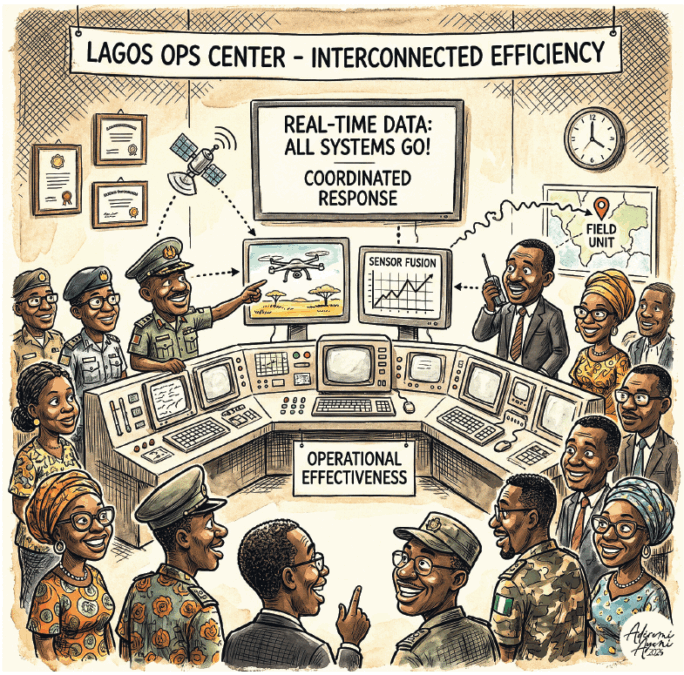
Nigeria is not starting from zero. It still retains a space agency, trained engineers, ground infrastructure and institutional memory. But recovery requires more than replacing satellites. It demands a hard reckoning with how and why these capabilities weakened in the first place. A renewed earth observation system is essential, combining high-resolution optical satellites, radar systems capable of seeing through cloud and darkness, and smaller constellations that provide continuous coverage. Satellite intelligence must also be integrated into security and emergency response systems so that information flows directly into anti-kidnapping operations, border security, disaster management and rescue missions. Equally important is restoring indigenous engineering capacity and reviving the philosophy behind NigeriaSat-X, where national expertise was developed rather than outsourced.
Any meaningful technological renewal, however, must begin with an honest appraisal of the political and institutional choices that weakened the nation’s strategic surveillance capacity, and of the interests those choices ultimately served. In the modern world, the ability to observe is not a luxury; it is the foundation of protection. A state that cannot see its territory will always struggle to secure it. More importantly, a state that cannot see will almost always arrive too late to rescue.


Join BusinessDay whatsapp Channel, to stay up to date
Open In Whatsapp


