

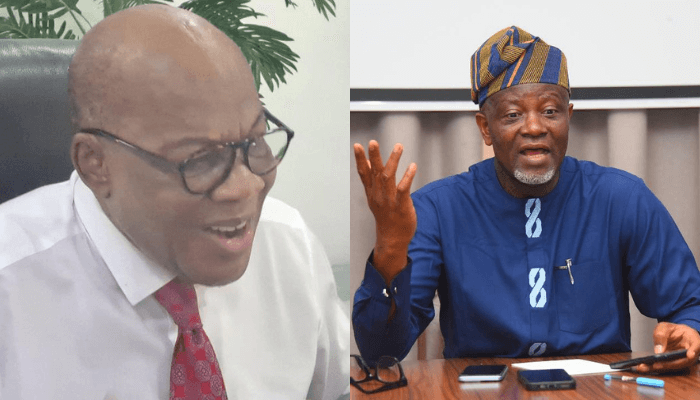
…An insider gives account of how Tinubu emerged in 2022 as APC candidate
Politics is an exciting game where everyone masquerades as a master. But there is a group of powerful and influential individuals who pull the strings in the right places to alter or influence decisions in the corridors of power purely for selfish reasons.
All through the history of Nigeria, they have been there. As the older members die or fade away, younger ones continue the trade. Through the ages, the real essence of the manipulations is for selfish reasons that are always couched in good rhetoric as if in the interest of the masses. Whether in the military of civilian regime, this group has always existed.
Since the return of Nigeria to civil rule, there are few individuals that have continued to be recognised as power brokers and kingmakers. Although some of these people are today not healthy enough to move about as they used to do, their opinions are always sought on who become what in political cycles, and their residences are always a “mecca of sort” for politicians, particularly those seeking presidential position.
As Nigeria inches closer to the next round of general election scheduled for next year, there will be plenty of wheeling and dealing all over the place, particularly in the corridors of power. There will be high level consultations too.
There will be too many nocturnal meetings where important and decisive decisions will be taken. This is in line with the words of Russell Wayne Baker, a former American columnist, that, “The dirty work at political conventions is almost always done in the grim hours between midnight and dawn. Hangmen and politicians work best when the human spirit is at its lowest ebb.”
With the next round of general election approaching, political activities are peaking. Politicians have again begun to sell their “wares.”
Joseph Story, 1779-1845, American Judge, captured the scenario thus: “A new race of men is springing up to govern the nation; they are the hunters after popularity, men ambitious, not of the honour so much as of the profits of office- the demagogues, whose principles hang laxly upon them, and who follow not so much what is right as what leads to a temporary vulgar applause.”
In June 2019, Bolanle Austen-Peters, founder and CEO, Terra Kulture, an art and entertainment outfit in Lagos, broke her record when she premiered ‘The Bling Lagosian’, a movie that broke cinema box office ticket sales and was streamed more than her previous movies and musicals.
The movie caught the eyes of many because of the exposure of the ‘one percent of the one percent’, the elites, who run the country, its economy, its politics, its life and everything. They have their fingers in every pie!
Tope Musowo, public policy analyst, said there was the need for policy change from the government to bridge the gap.
According to Musowo, “Elite consensus has not taken us anywhere; it is part of our problem.
The system is structured to favour the few people that are the elite in the society; there is no doubt about that.”
In a recent interview with Bolaji Rilwan Raji, chairman/ CEO of Blackwell Petroleum Ltd and Blackwell Productions Ltd, highlighted the activities of the cabal in the Nigeria political space.
“A cabal, defined as a small, secretive group plotting for political power or private interests, inherently undermines democracy, which is government by and for the people,” Raji noted.
According to him, “While I’ve heard talk about a cabal in this administration, I commend the president’s ability to identify and dismantle such groups. Ideally, we should have disciples who emulate the president’s positive actions rather than pursue selfish interests. However, the failure of some in power to replicate the President’s good deeds fuels the perception of a cabal. I urge the President to re-evaluate the performance of certain key assistants.”
Raji, who also is founder, New Dawn for Women & Community Intervention Initiative, and convener of Game Changer Group, further said: “The formation of a cabal hinges on a leader’s understanding of power dynamics, specifically the distinction between sharing and controlled delegation. Olusegun Obasanjo, for example, favoured controlled delegation, preventing any potential cabal leaders from gaining significant influence. Yar’Adua’s tenure was cut short by ill health and death, but figures like Bukola Saraki and James Ibori were prominent. In contrast, Goodluck Jonathan, despite his patriotism, entrusted significant power to aides who sometimes abused it, leading to the rise of competing power blocs and a formidable cabal.
“Under President Buhari, this phenomenon reached unprecedented levels, with a cabal becoming the de facto ruler. As someone married into the Buhari family, I have witnessed this firsthand. Initially, the cabal consisted of two individuals, but President Buhari’s ill health and the death of Chief of Staff Abba Kyari led to the emergence of multiple cabals, the primary one being “G5+1” with various subsets. Similar cabals also formed within the National Assembly, including a ‘Yoruba cabal.’”
Raji told BusinessDay that the intrigues that attended the selection process of Buhari’s successor in 2022 was very intense.
“Internal power struggles and conflicting agendas plagued the lead-up to the election. The G5 + 1 faction initially favoured Atiku Abubakar or former President Goodluck Jonathan, while a cabal within the National Assembly and party leadership pushed for Ahmed Lawan. The Yoruba cabal supported Yemi Osinbajo. A member of the G5 + 1, secretly vying for the vice presidency, attempted to bring Jonathan into the race. When this failed, he rejoined the G5+1 in supporting the PDP candidate. The other +1 to make G5+1 +1, which was meant to include a top security official (+1), ultimately faltered, perhaps due to the official’s awareness of President Buhari’s preferences.
“The Yoruba cabal, misled by the G5, encouraged Osinbajo to contest against the eventual winner, believing Buhari would not support Asiwaju – a ploy to weaken Yoruba chances. Despite the cabals’ machinations, President Buhari remained steadfast in his integrity and commitment. Sensing the situation, I contacted the President’s son, Seyi Tinubu and took him to a close confidante of President Buhari, his sister, Hajia Rakiya, to appeal to the President. Evidence supports this account.”
He also disclosed that President Bola Ahmed Tinubu was not the favourite of the leaders of the APC as some cabals had rooted for different people instead.
“Despite not being favoured by key power brokers who respectively preferred Atiku or Goodluck Jonathan, Ahmed Lawan, and Yemi Osinbajo, Asiwaju’s success was due to divine intervention, President Buhari’s support, the influence of Hajia Rakia (Buhari’s sister), and his own political acumen. Hajia Rakia’s role should be acknowledged with a kind gesture. Appreciation is also due to the Emir of Katsina. Asiwaju’s ability to positively engage even those who betrayed him is remarkable, and his legacy of uplifting others despite their disloyalty is unmatched,” he said.
Olisa Agbakoba, senior advocate of Nigeria, SAN, believes that elite consensus and the existence of selfish cabals may have frustrated the push for Nigeria’s return to federalism and even national development.
In one of the interviews he granted BusinessDay, Agbakoba was asked why the federal system was not working again in Nigeria?
In his response, he said: “That question is absolutely reflective of the civil society today. Whenever I go out of this country and see how vibrant civil society groups are, I ask myself the question, ‘how come we can’t get people to critique it, ask questions about what is going on in the country or to agitate?’ That’s what you have just said. The civil society is fractured. The traditional society is also fractured. The religious society is fractured. The only society that is intact is the political elite and they understand this.
“Wherever you find them, whenever they meet, they speak one language- the language of power. They don’t speak Igbo or Hausa or Yoruba. Whether the person is from PDP, APC, no matter whatever party, it doesn’t matter what party, they speak the same language. That person speaks that language to sustain his interest. That obviously could affect the response of the civil society to be influential, but that’s not to say they should not keep trying. “Second point is Federalism. There’s a book, ‘Federalism: An Introduction’ by George Anderson; There is no one sign fit-all for federalism. The best place where you can apply federalism is where you have diverse views; where you have multi-lingual, multi-ethnic and multi-cultural views. We are perfect for that.
“We have six federal sub-zones. Federalism will suit Nigeria, but the problem is can you point to any of sub-zones in which the federal process has been applied? The only period when federalism applied in its best form was the First Republic, when you had regional governments with their own constitution; self-authority, etc. So, we are looking for a federal system that is fully genuine and that can deliver Nigeria from its present morass.”

Join BusinessDay whatsapp Channel, to stay up to date
Open In Whatsapp


