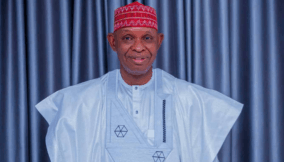
…Ganduje acknowledges Sanusi as Emir of Kano
A wave of political realignments triggered by the defection of Kano State Governor Abba Kabir Yusuf to the All Progressives Congress (APC) is beginning to yield a rare sense of unity among the State’s deeply divided political class, with Tuesday’s swearing-in of Murtala Sule Garo as Deputy Governor serving as a symbolic and practical turning point.
The ceremony, held at the Government House in Kano, brought together an unusual coalition of political heavyweights whose interactions signaled a softening of long-standing rivalries.
Most notably, former Governor Abdullahi Umar Ganduje publicly acknowledged Muhammadu Sanusi II as the Emir of Kano; an unprecedented gesture since his Administration dethroned the monarch in 2020.
That moment, subtle yet politically charged, underscored the broader reconciliation underway in Kano’s power circles. Sanusi was reinstated by the Yusuf’s Administration amid ongoing legal disputes with the matter currently before the Supreme Court and a final judgment expected in April 2027.
Ganduje’s public recognition of the Emir at the event is widely interpreted as a conciliatory move, reflecting the new political reality shaped by Yusuf’s alignment with the APC.
The governor’s defection has effectively reunited him with Ganduje, his erstwhile political rival, under the same party platform – an alliance observers say is already reshaping Kano’s governance and political dynamics.
Tuesday’s event also drew an array of influential figures, including former governor Ibrahim Shekarau and Deputy Senate President Barau Jibrin, alongside traditional rulers, lawmakers, and party stakeholders. Their presence reinforced the growing consensus within the APC ranks in Kano and hinted at a broader effort to consolidate political influence ahead of future contests.
Administering the oath of office, the Chief Judge of Kano State, Justice Dije Abdu Aboki, formally ushered Garo into Office as Deputy Governor, marking a significant shift in the State’s leadership structure.
In his address, Governor Yusuf charged his new deputy with the responsibility of loyalty and collaboration, emphasizing the need for a united front in delivering what he described as a “new Kano.”
“This administration is committed to rebuilding and repositioning Kano State,” Yusuf said. “The task before us requires unity, dedication, and a shared vision for progress.”
While the indoor ceremony was marked by high-level political symbolism, it was the massive turnout of young supporters outside the Government House that defined the day’s atmosphere.
Hundreds of youths flooded the streets leading to the venue, creating a carnival-like scene with music, drumming, and chants. Trucks packed with supporters lined major roads in Nassarawa GRA, effectively halting vehicular movement and transforming the area into a vibrant display of political enthusiasm.
Observers described the crowd as a “sea of heads,” reflecting not only the popularity of the new deputy governor but also the growing political energy among Kano’s youth population.
Many of the attendees who spoke with reporters expressed strong support for Garo, citing his grassroots engagement and accessibility as key reasons for their loyalty. For them, his emergence as deputy governor represents an opportunity for greater inclusion and responsiveness in governance.
“He is someone we can relate to,” one supporter said. “He listens to the people and understands our struggles.”
The scale of youth participation is being interpreted by analysts as an indication of Garo’s rising political profile and his potential influence in future electoral cycles. His journey to the deputy governorship, often described as a product of persistence and strategic alignment, has earned him a reputation as a grassroots mobilizer.
Security Agencies maintained a strong presence throughout the event, ensuring order despite the overwhelming crowd. While traffic disruptions were reported around the Government House, authorities managed the situation without major incidents.
Beyond the spectacle, the swearing-in ceremony highlighted a deeper transformation in Kano’s political landscape—one driven by shifting alliances, reconciliatory gestures, and a renewed emphasis on unity within the ruling party.
For a state long characterized by factional rivalries and political tension, the convergence of key actors under the APC umbrella signals a potential turning point. The coming months will test whether this newfound unity can translate into effective governance and sustained political stability.
As Kano navigates this evolving landscape, the Yusuf-Garo partnership, backed by a seemingly united APC structure, may well define the next chapter in the state’s political history.

Join BusinessDay whatsapp Channel, to stay up to date
Open In Whatsapp