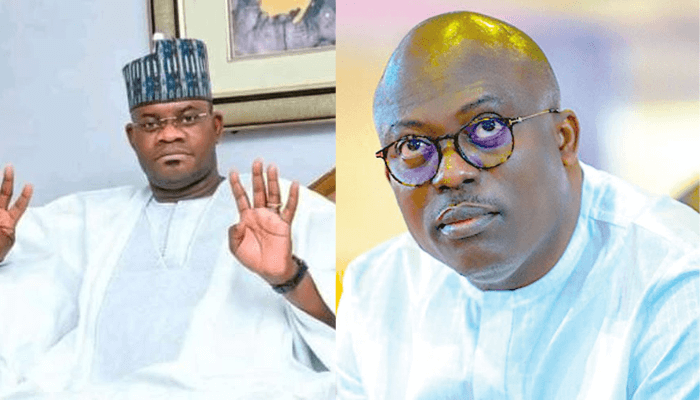
As preparations for the 2027 general election intensify, the ruling All Progressives Congress (APC) is steadily consolidating power around President Bola Ahmed Tinubu, drawing into its fold political actors who were once rivals, outsiders or politically estranged from his presidential project.
The recalibration underscores a familiar pattern in Nigerian politics: as elections approach, past hostilities give way to pragmatic alliances, often blurring ideological lines and raising questions about accountability within the ruling elite.
Among the most striking examples of this evolving alignment are Yahaya Bello, former Kogi State governor and Siminalayi Fubara, the Rivers State governor, whose growing proximity to the APC power structure highlights the party’s “all hands on deck” approach ahead of 2027.
Read also: The last seven governors still resisting APC’s political gravity
President Tinubu, last week in Lagos, inaugurated a Committee on Strategy, Conflict Resolution and Mobilisation to resolve conflicts within the All Progressives Congress as it approaches the 2027 general elections.
Worthy of note amongst the committee members were Fubara and Bello.
Bello’s renewed prominence within the APC has drawn significant public attention, particularly given his political history with President Tinubu.
During the build-up to the 2023 general election, Bello contested the APC presidential primaries against Tinubu, projecting himself as a generational alternative within the party.
Although his ambition failed to gain widespread support, it placed him firmly among those who challenged Tinubu’s ascendancy at the time.
Beyond intra-party rivalry, Bello’s political trajectory has been overshadowed by allegations of large-scale financial impropriety during his tenure as governor of Kogi State.
The Economic and Financial Crimes Commission (EFCC) had invited Bello for questioning after determining that he had a case to answer.
For months, however, the former governor failed to honour the agency’s invitations, prompting the EFCC to declare him wanted.
Following a series of dramatic encounters with law enforcement, Bello was eventually arraigned in court on charges bordering on alleged fraud involving sums reportedly running into over N200 billion.
He has denied the allegations, insisting that the charges are politically motivated, and the matter remains before the courts.
Despite these unresolved legal challenges, the APC which famously wrested power from the People’s Democratic Party (PDP) in 2015 on an anti-corruption platform went on to appoint Bello as a member of a high-powered party committee, a move that sparked criticism from opposition figures.
Bello has since maintained a high public profile, speaking openly about his political future and even hinting at a possible senatorial ambition, a posture that critics say reflects the confidence conferred by his renewed relevance within the ruling party.
Bello’s reintegration illustrates how proximity to power, rather than political history or legal baggage, increasingly determines influence within the APC as 2027 approaches.
Equally significant is the political repositioning of Rivers State governor Fubara, whose relationship with the APC has evolved dramatically amid his protracted feud with his predecessor, Nyesom Wike, now Minister of the Federal Capital Territory (FCT) and a central figure in President Tinubu’s political coalition.
Fubara, who was elected on the platform of the PDP, became embroiled in a bitter power struggle with Wike shortly after assuming office, plunging Rivers State into months of political instability marked by legislative crises, parallel party structures and legal battles.
In a decisive shift, Fubara has now formally defected to the APC, effectively aligning himself with the same political machinery anchored by Tinubu, a move widely interpreted as a survival strategy in a state where federal power has become increasingly decisive.
The Fubara–Wike–Tinubu triangle reflects the complex nature of elite bargaining within the ruling coalition.
While Wike remains one of Tinubu’s most influential allies, Fubara’s accommodation by the APC suggests that electoral value and strategic control of Rivers State may outweigh lingering loyalties or internal resentments.
Read also: Ex-APC guber candidate empowers 230,000 youths in Rivers
For Tinubu, Rivers represents a critical political prize in the South-South, and the absorption of Fubara into the APC significantly weakens the opposition PDP’s grip on the oil-rich state ahead of 2027.
The emerging pattern points to President Tinubu’s preference for political consolidation over confrontation, neutralising potential threats by absorbing them into the ruling structure rather than leaving them outside to regroup.
“With 2027 in view, the APC is not taking chances,” said a top member of the party who pleaded anonymity.
“Former rivals, controversial figures, and politically vulnerable actors are all being pulled in. The priority is control, not moral consistency.”
The APC’s growing numerical dominance in the National Assembly, fuelled by waves of defections, has further emboldened the party’s leadership to tighten its grip across the political landscape.
As the countdown to 2027 begins, the ruling party’s message is unmistakable: Tinubu is the centre of gravity, and alignment, regardless of past opposition or unresolved controversies, is fast becoming the currency of political relevance.
Whether this strategy strengthens democratic governance or merely entrenches elite consensus remains an open question.
What is clear, however, is that within the APC, the battle lines for 2027 are already being drawn and loyalty is being carefully rearranged.

Join BusinessDay whatsapp Channel, to stay up to date
Open In Whatsapp