Mr. President, last month, the United States Embassy in Abuja issued a security alert warning American citizens of credible, specific threats. The warning emanated from an internal memo by the Nigeria Customs Service obtained by The Associated Press of coordinated attacks targeting the Abuja airport, prison facilities in the capital, and a military detention centre in neighbouring Niger State. The alert cited this intelligence suggesting organised attempts to free detained terrorists and damage critical infrastructure. It was addressed to Americans in Nigeria.
Not to Nigerians
The government of a foreign country warned its citizens about an imminent threat on Nigerian soil before Nigeria’s own security architecture communicated that threat to Nigerian citizens. Let that register. The intelligence existed. It was specific enough to name targets. It was credible enough to trigger a formal diplomatic alert. And the channel through which most Nigerians learnt of it was not a DSS public advisory, not an NSA briefing, not a Ministry of Defence statement — it was a United States Embassy notice. This is not a criticism of the American government for doing its job. It is an indictment of a Nigerian intelligence architecture that cannot do its own.
This is the problem, Mr. President. And it is not a security problem. It is an intelligence problem.
Four years ago, on March 28, 2022, gunmen detonated an explosive on the Abuja–Kaduna railway line and abducted one hundred and sixty-eight (168) passengers. In the eighteen months before that attack, there had been over twenty (20) documented highway ambushes on the same corridor — each one a warning that was available but not acted upon (SBM Intelligence, North-West Security Brief, Q1 2022). Today, the threat has moved from the corridor to the capital itself — to the airport, to detention facilities, to military infrastructure in Niger State. The geography has changed. The failure has not.
THE PROBLEM, PRECISELY
Nigeria currently operates three core federal intelligence agencies under the Office of the National Security Adviser: the Department of State Services, the National Intelligence Agency, and the Defence Intelligence Agency, and many others, including the Naval Intelligence, Air Force Intelligence, the Nigerian Police Force Intelligence Response Team, and the Nigerian Financial Intelligence Unit, among others. Each has its own database. Each has its own reporting chain. None has a statutory obligation to share real-time intelligence with the others. The National Security Adviser chairs a coordinating committee, but that committee is a secretariat — it has no operational authority, no joint database, and no mandate to compel data fusion between agencies.
The result is that the same threat can be known to one agency and invisible to another — or known to all of them and still produce no coordinated response to the public. Last month’s US Embassy alert is the clearest proof: a foreign government knew of specific targets in Nigeria’s capital with sufficient confidence to issue a formal warning. Nigeria’s own agencies produced nothing equivalent for Nigerian citizens. Either the intelligence was not shared across agencies in time, or it was shared and the response architecture still failed to act publicly. Either scenario is a structural indictment.
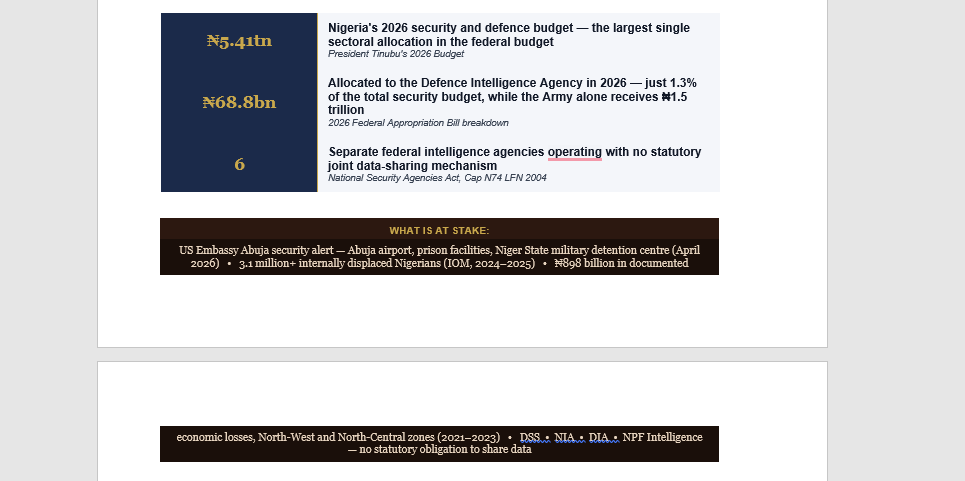
The numbers in President Tinubu’s own 2026 budget confirm the root cause. Nigeria’s proposed 2026 security budget stands at ₦5.41 trillion — the largest sectoral allocation in the entire federal budget. Of that, the Intelligence arms under the ONSA receive ₦664 billion. That is roughly 12% of the total. For every ₦1 Nigeria allocates to its primary defence intelligence agency, it spends ₦22 on the Army. The Office of the National Security Adviser receives approximately ₦690 billion — but that budget funds coordination and administration, not field intelligence operations. Nigeria is not underfunding security. It is systematically underfunding the part of security that prevents attacks before they happen.
WHY IT PERSISTS
Intelligence failures in Nigeria are structurally invisible in ways that kinetic failures are not. When a military operation fails, there is a body count and a headline. When intelligence fails, that is an attack that was not prevented — and the connection between the absence of good intelligence and the presence of that attack is rarely made in public. No agency has ever been publicly sanctioned for a preventable breach. No budget line has ever been reduced because intelligence outputs were inadequate. The agencies continue to grow, their appropriations continue to increase, and the attacks continue.
There is also an institutional incentive problem that goes deeper than funding. Intelligence agencies in Nigeria — as in many post-colonial states — were historically designed not to protect citizens from external threats but to monitor political opponents of the government in power. That orientation shapes what is measured, what is reported upward, and what is considered a success. Reforming this requires more than a budget reallocation. It requires a structural redesign of mandate, reporting lines, and accountability.
And at the community level, the first tier of any functional intelligence system — the traditional institutions of district heads, ward councillors, and community leaders who know exactly who is moving through their area and why — has been systematically eroded. In Kaduna State alone, over three hundred traditional rulers were displaced from their communities between 2020 and 2023 as a direct consequence of the same insecurity the government is trying to address (Kaduna State Peace Commission, 2023). Nigeria has, in effect, dismantled its own early-warning infrastructure through the violence it has failed to prevent.
THE ASK
Mr. President, your own 2026 budget tells the story more clearly than any critic could. Nigeria wants to spend ₦5.41 trillion on security this year. Of that, ₦1.5 trillion goes to the Army, ₦1.3 trillion to the Police, ₦443 billion to the Navy, ₦407 billion to the Air Force — and ₦68.8 billion to the agency responsible for knowing what the enemy is planning before they act. That is the arithmetic of a country that responds to threats rather than prevents them.
Last month, the United States government told its citizens in Nigeria to stay away from certain areas. The threat was specific. The targets were named. The warning was issued. To Americans.
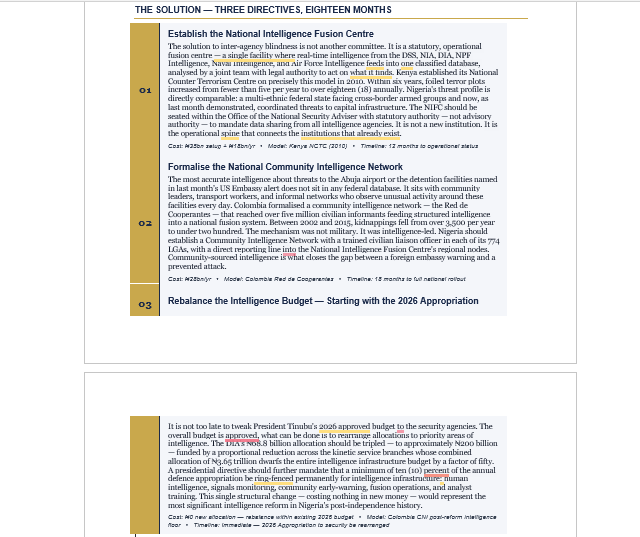
Nigeria deserves the same warning — issued by its own institutions, to its own citizens, before the next attack rather than after it. The intelligence architecture that makes that possible requires not new money, but a decision about where the existing money goes. That decision sits on your desk.
You cannot protect what you cannot see. And right now, for ₦68.8 billion — 1.3% of your own security budget — Nigeria is trying to see everything.
The intelligence was there. A foreign government acted on it. Nigeria’s own citizens are still waiting.
A Nigerian who means well. Writing until someone listens.
.Abiodun is a CISA-certified IT professional and PhD Candidate researching cybercrime in Nigerian financial institutions at the University of the Cumberlands.

Join BusinessDay whatsapp Channel, to stay up to date
Open In Whatsapp