In recent days, the attention of Nigerians and the international community has sadly returned to the issue of mass abductions affecting locations called ‘soft targets’ in security parlance. These soft targets, unlike hardened military or government facilities, are environments such as schools, places of worship, transportation hubs, markets, etc., that are intentionally open, largely unguarded, and predominantly civilian in nature.
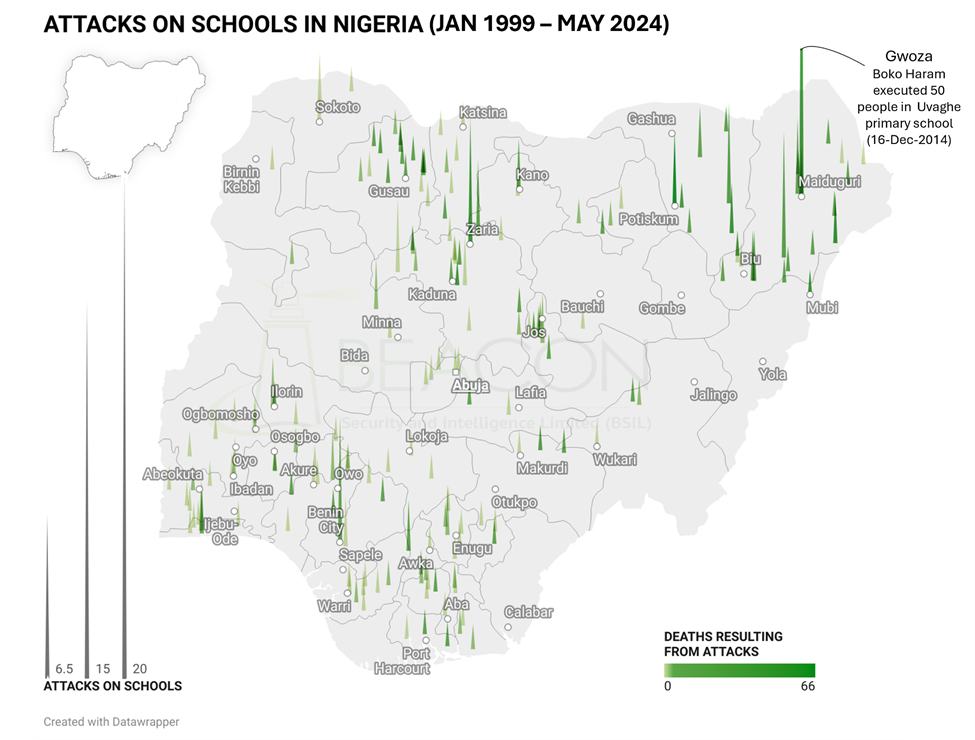
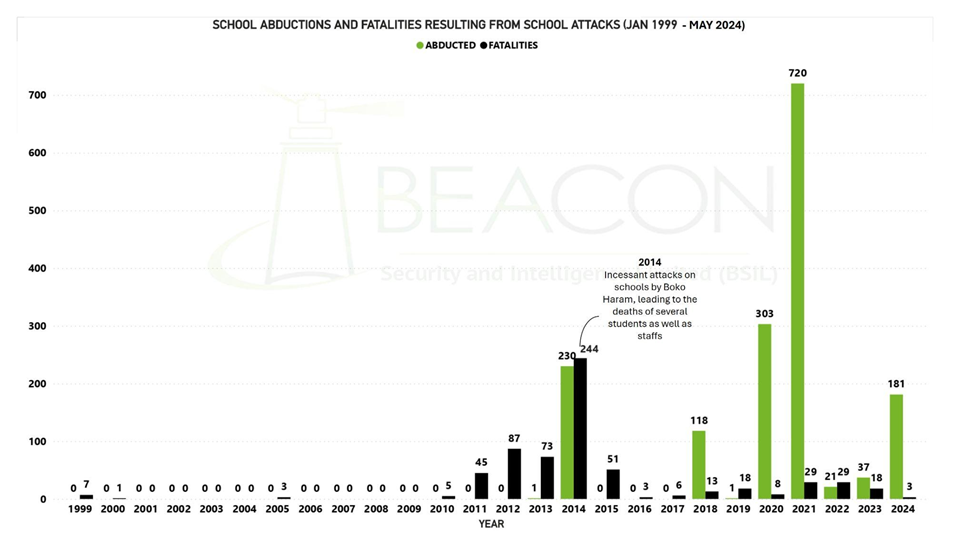
Nigeria is not new to the menace of mass abduction, especially those targeting educational institutions. The unfathomable incidents of mass abduction of female secondary school students in Chibok, Borno State, and Dapchi, Adamawa State, in Northeast Nigeria in 2014 and 2015, respectively, are occurrences that are still fresh in our minds. This is despite Nigeria introducing at least three major instruments (the Safe Schools Initiative, the Safe Schools Declaration and the National Policy on Safe, Secure and Violence-Free Schools) plus substantial loans from the World Bank under different interventions, including the Adolescent Girls Initiative for Learning and Empowerment (AGILE), some of which have been in existence for over a decade.
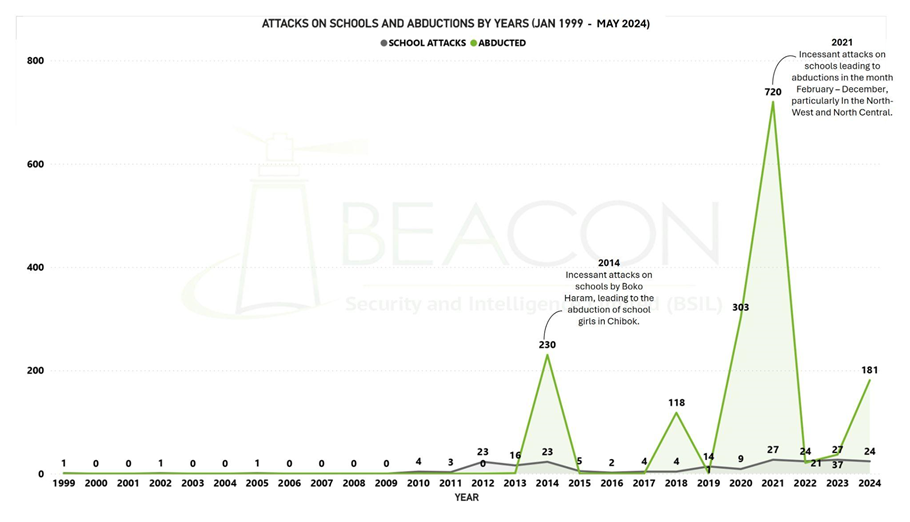
Attacks on schools in Nigeria over the past 25 years have been a significant and recurring issue and have led to abductions, violence, and varying consequences. Already, Nigeria’s indices in education bear some alarming trends. Of the total number of children and youth (ages 6 to 18) excluded from education, out-of-school children (OOSC) worldwide number approximately 272 million (based on data from UNESCO and UNICEF updated in June 2025), and 18.3 – 20 million are in Nigeria. This means Nigeria hosts about 20%, the highest (or 2nd/3rd after India and Pakistan), depending on the specific age range of OOSC in the world. It also means that one in every five of the world’s OOSC is estimated to be Nigerian.
Mass abductions are typically the domain of two sadly now converging categories of threat actors: ideologically driven non-state armed groups affiliated with the global Jihadist franchises, Al Qaeda and Islamic State, including the Jama’atu Ahlis-Sunna Lidda’Awati Wal-Jihad, Islamic State West Africa Province (ISWAP), Jama’atu Ansarul Muslimina Fi Biladis Sudan or Ansaru, Lakurawa, Mahmudawas and DarulSalam, amongst several others; and well-armed organised criminal gangs (generally referred to as bandits). For terror groups, their primary motivation is political, religious, or ideological dominance; assertion of power over the state; recruitment; and funding through ransom. While for the bandits, the primary motivation is predominantly financial – kidnapping for ransom (K4R) as a commercialised, low-risk, high-reward enterprise. The two groups prioritise psychological shock, high-value media exposure, and often, substantial economic gain through ransom.
“We must also proactively identify and designate kidnap-for-ransom groups as financial threats and apply counter-terrorism financing tools (asset freezing, banking restrictions) to cripple their business model.”
The operational success of these groups is tied directly to their ability to retreat into forested or mountainous parts that are largely ungoverned. These include
● Dense forests and remote terrain: Locations like the forests of Zamfara, Katsina, and Kaduna in Nigeria, or vast, sparsely populated border regions in the Sahel, provide natural cover, make rescue operations difficult, and complicate surveillance.
● Cross-border areas: Proximity to international borders allows actors to easily cross into neighbouring states, frustrating the pursuit and jurisdictional authority of security forces.
● Politically unstable/conflict zones: Areas where state authority has collapsed or is severely contested (e.g., the Lake Chad region) serve as operational bases and training grounds.
The methodology employed by these actors is refined for efficiency and maximum terror. It often follows a calculated, multi-stage process:
Intelligence gathering and surveillance: The operation begins with meticulous reconnaissance. Informants (local residents, compromised staff, or former students) are crucial. They provide inside knowledge on:
1. School/facility layout, guard routines, and vulnerable access points.
2. The size, type, and movement of potential targets.
3. Escape routes and viable hideouts.
Invasion and Overpowering: Abductions are typically executed during vulnerable hours (late night or early morning). The actors employ brute force, speed, and fear tactics to overwhelm minimal security.
4. They arrive in large gangs (20-50+), often on motorcycles or pickup trucks.
5. Heavy gunfire and explosives are used not only for effect but also to instill immediate, paralysing terror in victims and witnesses.
6. The objective is not a fight but rapid control.
Extraction and transit: Victims are quickly herded, often force-marched or loaded onto waiting vehicles, and taken to remote, difficult-to-access hideouts. This phase is designed to create a large distance between the incident site and the abductees before a state security response can be mounted.
Ransom negotiation and communication: Once secured, the criminal cell’s “task force” or negotiation team takes over.
7. They use GSM phones to contact family or intermediaries and encrypted communication channels to talk amongst themselves.
8. Negotiations are protracted and emotionally manipulative, designed to exploit the desperation of victims’ families and communities.
9. For ideological groups, the ransom is primarily funding; for bandits, it is the sole revenue stream. The payment itself often involves complex, untraceable cash drops.
Countering the threat of mass abduction in Nigeria requires a strategic shift from the current reactive and crisis management approach to a proactive, layered security and intelligence dominance mechanism. This mechanism should commence with a strengthened intelligence fusion element driven by the whole spectrum of modern intelligence sourcing. For this, Nigeria’s security enterprise should extend a handshake to the Federal Ministry of Communications, Innovation, and Digital Economy (FMCIDE) and several private firms that have strong credentials in OSINT as a prerequisite for better tapping the cyberspace for intelligence. As an example, BSIL solutions include a mapping of the threat actors, their typologies and a web of affiliations.
It is also critical to ensure systemic information sharing by establishing secure, cross-jurisdictional platforms for real-time information sharing between local law enforcement, military, and intelligence agencies on kidnap trends, cell movements, and ransom demands. Additionally, we must invest in HUMINT networks by re-energising and protecting local intelligence networks. The ‘insider threat’ and local informants are the primary weaknesses of the criminal groups; leveraging local community leaders, vigilantes, and trusted sources can provide crucial early warnings. We must also strengthen the work being done by the Nigerian Financial
Intelligence Unit in financial intelligence by aggressively tracking and interdicting the flow of ransom money. We must also proactively identify and designate kidnap-for-ransom groups as financial threats and apply counter-terrorism financing tools (asset freezing, banking restrictions) to cripple their business model.
The next step is for us to achieve deterrence through hardening these soft targets and promoting resilience. To do this, we must implement minimal, cost-effective physical security measures at high-risk soft targets (e.g., schools, worship centres, hospitals, hotels, etc.). This includes perimeter fencing, limited entry/exit points, panic buttons connected to the nearest law enforcement posts, and rapid communication systems that are backed by reliable and effective response capabilities. We must also train our communities and staff by facilitating a better understanding of various distress incidents, including terror attacks such as active shooters, bombings and complex attacks, etc. This will include “Run, Hide, Call/Fight” or “Alert, Evacuate, Shelter” protocols for all soft-target personnel. Security awareness must become a core part of the culture. We should also leverage technology and deploy CCTV with analytic capabilities and rapidly deployable Unmanned Aircraft Systems (UAS/drones) for surveillance and real-time tracking during an incident and for pre-emptive patrol of identified threat corridors. In educational institutions, the roadmap for this is contained in the three major instruments for safe schools in Nigeria.
To achieve the above, we must ensure strategic policy and governance of the public security practice. The first step is to end the cycle of impunity that has now been institutionalised in the national security enterprise. One major way to achieve this is by ensuring a clear, consistent policy against paying ransom. President Bola Ahmed Tinubu, in an op-ed in Newsweek published on April 15, 2024, was clear about his administration’s stance on no payment of ransom. Two years plus down the road, a back-channel scheme involving several players in the government is a major forbearer of the ransom economy. While difficult and controversial, the no-ransom policy and paying sustain the business model. We call on President Tinubu to break down this scheme and charge the actors in court. We must take immediate and decisive measures to end this nefarious scheme.
We must also target the criminal havens by launching joint, sustained, multi-agency operations to degrade the capability of actors in their identified safe havens, disrupting their command, control, and logistics. For this to be successful, we require regional cooperation given the transnational nature of the threats. We must forge stronger, actionable agreements with neighbouring countries for intelligence exchange, coordinated border patrol, and cross-border pursuit of criminal elements.
By understanding the financial logic and operational blueprint of mass abductors and implementing a holistic strategy that fuses intelligence, physical hardening, and decisive governance, states can transition from being victims of this terror to being effective counter-threat adversaries.
Kabir Adamu is the Managing Director of Beacon Security and Intelligence Limited.

Join BusinessDay whatsapp Channel, to stay up to date
Open In Whatsapp