1. Cultural Ritual or Submissive Act? The ‘Wrapper Debate’ Grips Nigeria
A seemingly local gesture of respect has ignited a national conversation about culture, power, and political accountability in Nigeria. The act of a young entrepreneur laying her fine clothing on the ground for a governor’s daughter has forced a reckoning with how citizens honour—and how officials receive—public reverence.
The Incident. An ecstatic Blessing Emma Gabriel Akpan spread her finest wrappers on the ground to welcome Helen Eno-Obareki, daughter of Akwa Ibom State Governor Umo Eno and coordinator of the state’s First Lady’s office, during a visit to her restaurant.
The Backlash and Apology. A notable Facebook influencer—also an FMCG manufacturer from Akwa Ibom—initially led the criticism. However, a powerful pushback from her own followers was so intense that she revisited her stance and issued a public apology to the young entrepreneur.
The Context. Helen Eno-Obareki has been coordinating the First Lady’s office following the death of Governor Umo Eno’s wife, Pastor Patience Eno. While some media outlets initially described her as the state’s First Lady, the governor later clarified that she serves strictly as the office coordinator.
Three Camps, One Debate
Online reactions have coalesced into three distinct positions:
– Critics: Excessive Adulation. This camp argues that laying wrappers on the floor reflects personality worship rather than respect. They contend that public officials and their families should discourage displays that suggest royalty or unquestioning reverence. Furthermore, they question why ordinary citizens—many facing acute economic hardship—should engage in such symbolic acts.
– Defenders: Cultural Expression: Supporters counter that in many communities across southern Nigeria, especially during traditional ceremonies, women spread wrappers or cloths to honour respected guests. They argue the act is voluntary and should be viewed within its cultural context, not through a purely political lens. To them, it signifies esteem, hospitality, and celebration—not subservience.
– The Middle Position: Optics Matter. A third group accepts the cultural roots of the practice but maintains that proximity to public office fundamentally changes its meaning. Their concern is not the tradition itself, but how it appears when performed for individuals closely associated with political power. They argue leaders must be sensitive to public perception and avoid ceremonies that can be interpreted as glorifying officeholders.
The Core Takeaway. At its heart, the debate is less about wrappers and more about the fraught intersection of culture, power, public symbolism, and expectations of democratic leadership. What one group honours as a legitimate cultural tradition, another condemns as an inappropriate display of deference to political authority.
2. Nigeria’s Social Media Landscape: Facebook Leads Traffic, WhatsApp Rules Reach
Which platform truly dominates Nigeria’s digital space? The answer depends entirely on the metric. The latest data reveals a two-tiered hierarchy: one king of daily communication, and another sovereign of total traffic.
Ranking by Estimated Audience Size (Nigeria, 2025–2026)
1. WhatsApp – ~51 million users; the most widely used platform for everyday communication.
2. Facebook – ~39–48 million users; the largest broad-based audience across age groups.
3. TikTok– ~37 million users and growing rapidly, especially among younger Nigerians.
4. YouTube – ~27 million users; expanding as a hub for education, entertainment, and creator monetisation.
5. LinkedIn– ~13 million users.
6. Instagram – ~10 million users.
7. Snapchat – ~9–20 million users (varies by measurement source).
8. X – Smaller by user numbers (influential but not top-tier for reach), yet remains disproportionately powerful for politics, media, and public affairs.
Ranking by Social Media Traffic Share (Nigeria, May 2026)
According to StatCounter’s latest traffic-share data:
Rank Platform Share
1. Facebook 73.37%
2. X 9.76%
3. YouTube 7.65%
4. Instagram 6.54%
5. Pinterest 1.55%
6. LinkedIn 0.61%
Key Trend. Facebook’s 73% traffic share—driven by video content, news consumption, and community engagement—far exceeds its user base ranking, indicating deeper and more frequent engagement per user. WhatsApp, by contrast, commands massive reach but generates less trackable web traffic due to its private, encrypted nature.
Facebook: An Economic and Political Powerhouse
– Market Position: 51.2 million users (43.2% penetration) as of 2025, making Nigeria Africa’s second-largest Facebook market after Egypt.
– Age & Gender: Largest group is 25–34 years; majority male (57.3%).
– Economic Impact: 14 million Nigerian SMEs used Meta’s platforms in 2025, contributing an estimated $2 billion to the national GDP.
-News Consumption: 65% of Nigerians use Facebook to consume news.
– Access: Optimised for low-end smartphones and limited data plans.
Strategic Implications for PR and Political Communication
For mass reach and influence in Nigeria, the most strategic platforms in order are:
1. WhatsApp (unmatched reach, private distribution)
2. Facebook (traffic dominance, news aggregation, community building)
3. TikTok (fastest-growing, youth engagement)
4. X (agenda-setting, elite and media influence)
5. YouTube (long-form content, monetisation, education)
3. Disinformation Watch: Deepfakes, False Narratives, and Real-World Harm (Since 5 June 2026)
The ten-day period from June 1–10, 2026, has witnessed a significant escalation in disinformation across Nigeria. A notable shift is the increased use of generative AI to produce highly convincing deepfakes targeting top officials, alongside persistent political and health-related falsehoods.
Summary of Recent Disinformation (June 1–10, 2026)
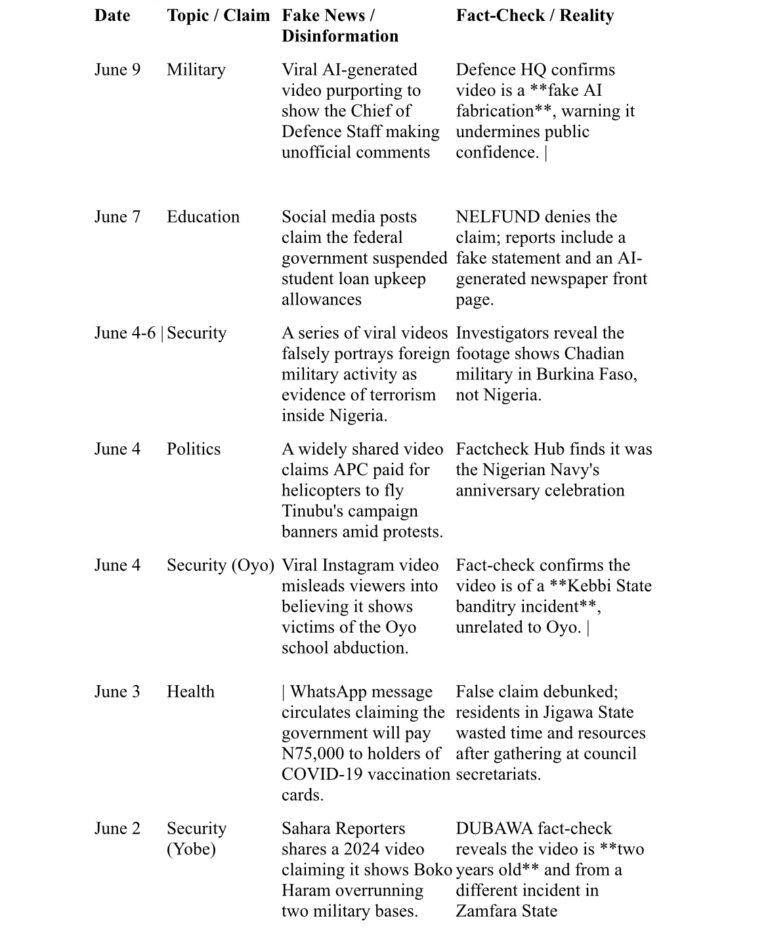
The Rise of AI-Generated Deepfakes
A key trend is the weaponisation of generative AI to create deepfake content targeting high-profile officials:
– Targeting the President: An AI-generated audio clip mimicking President Bola Tinubu’s voice, containing controversial political statements, went viral. Police have since arrested one suspect, Ifechukwu Dennis, in Benin City in connection with the forgery.
– Undermining Military Leadership: Defence Headquarters debunked an AI-manipulated video appearing to show the Chief of Defence Staff, confirming it was fabricated and warning that such content erodes public confidence in the armed forces.
Election Disinformation Intensifies
With the Osun State governorship election scheduled for 15 August 2026, and the 2027 general elections approaching, political disinformation is accelerating:
– False Election Results: The Nigeria Democratic Congress (NDC) dismissed fake primary election results circulating on social media, affirming that only the party’s National Executive Council can announce official outcomes.
– INEC Warning: The Independent National Electoral Commission (INEC) has warned that misinformation and disinformation pose a “significant threat” to credible elections and has called on journalists to help combat fake news.
– Presidential Caution: The Presidency has warned of “desperate political actors” using deepfake technology and disinformation campaigns to inflame religious sentiments and discredit the administration ahead of polls.
Health-Related Falsehoods
– Fake COVID-19 Grant: A false rumour about a N75,000 payment for vaccinated individuals caused significant disruption in Jigawa State. Hundreds travelled up to 15 kilometres to the Gumel Local Government secretariat, only to be turned away.
– Vaccine Myths Persist: A study published in the African Journal of Online Information assessed persistent COVID-19 vaccine hesitancy fuelled by misinformation among residents of Ijebu-Ode, Ogun State.
– Fake NYSC Cases: The National Youth Service Corps (NYSC) denied social media reports claiming corps members had tested positive for COVID-19 in orientation camps in Lagos, Kano, and the Federal Capital Territory.
Real-World Consequences
The spread of false information has tangible harms:
– Public Panic: A fake security alert led to the temporary closure of several schools in parts of the FCT and Nasarawa State, causing widespread panic among parents.
– Wasted Resources: The false N75,000 grant rumour led residents to travel long distances, wasting time and scarce resources for a non-existent programme.
Official Response and Arrests
Security agencies are taking a more aggressive stance:
– Arrests Made: In addition to the arrest in the fake presidential audio case, police in Ogun State arrested Johnson Elleh for creating and circulating a false kidnapping video for online engagement.
– Official Warnings: The Defence Headquarters has specifically warned social media influencers against sharing fake military-related content, stating that the “quest for online visibility… must not come at the expense of truth.” The Nigerian Police Force has repeatedly stressed that those found spreading misinformation will be investigated and prosecuted.
-Takeaway for Citizens: These events underscore an urgent need: always verify information from official sources before sharing. In an era of deepfakes and coordinated disinformation, the first share is often the most dangerous.

Join BusinessDay whatsapp Channel, to stay up to date
Open In Whatsapp