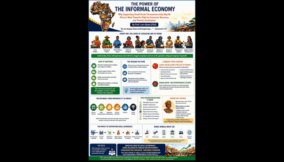
Three years in, Africa’s flagship trade agreement still cannot move value across the Lake Chad Basin. The market that has actually grown is the informal one.
By the time you finish reading this paragraph, a trader in Maiduguri will have settled a debt in Kousséri without a single Naira leaving Borno State.
No SWIFT instruction. No correspondent bank. No AfCFTA paperwork. A phone call to a hawaladar, a corresponding instruction at the other end, and an offset against a future shipment of grain or electronics, and the transaction is closed. The Central Bank of Nigeria will never see it. Cameroon’s BEAC will never see it. The continental free trade area, whose third anniversary we are quietly approaching, will never see it either.
This is not a curiosity. It is the dominant settlement layer for trade in the Lake Chad Basin. And the longer the AfCFTA refuses to address the monetary and political plumbing of cross-border commerce, the more it strengthens the very system it was supposed to make obsolete.
The AfCFTA was designed to lower tariffs and harmonise rules of origin. It was not designed to fix the fact that a cement trader in Kano cannot send Naira directly to a supplier in N’Djamena. As of May 2026, the CBN still routes nearly all formal cross-border payments through the US dollar, meaning a Naira-to-CFA transfer becomes a Naira-to-dollar-to-CFA transfer, with the spread eaten twice. The May 1, 2026 circular tightening international remittances, which mandates Naira payouts and stricter traceability, has narrowed the corridor further, not widened it. The Pan-African Payment and Settlement System, PAPSS, was designed to solve exactly this. Still, in the first half of 2025, Nigerian settlements on PAPSS fell 53 per cent to N5.6 billion across just 3,246 transactions. SME awareness of PAPSS in early 2025 sat below 20 per cent.
So the trader who needs to move value from Borno to Kousséri does the rational thing. She uses hawala.
Hawala predates the AfCFTA by at least eleven centuries. It is not the Lake Chad Basin’s invention alone. It’s called ‘Hundi’ in India and Pakistan, ‘Fei-ch’ien’ in southern China, ‘Padala’ in the Philippines, ‘Xawilaad’ in Somalia and the ‘Black Market Peso Exchange’ in Colombia and Mexico. It is what people use when the formal system is too slow, too expensive, too far away, or too unreliable. The mechanism is the same in every language: money does not move, value does. A hawaladar in one city accepts cash. A hawaladar in another city pays it out. The two settle their books later through trade offsets, net cash, or simply by waiting for the next round of business to balance the ledger. Settlement is collateralised by social capital. A hawaladar who fails to pay does not lose money; he loses his name, his family’s standing, and his ability to do business in any market that knows him. In the Sahel, that protocol is more expensive to break than a bank’s reserve requirement.
In Borno State, where only about 13 per cent of households use formal banks and where insurgent attacks have closed branches that have not reopened, this is not a parallel system. It is the system. Nigeria has 84 official border control posts and an estimated 1,499 unauthorised routes between them. The hawala network was built for that geography. SWIFT was not.
To call the hawala “informal” is to misread it. It is informal only in relation to the state. To the people using it, it is highly formal: there are rules, ledgers, exchange rates, and reputational consequences. What the West calls a clearing house, the Lake Chad Basin calls a hawaladar. The ledger is on a phone instead of a server. The settlement happens in a truckload of goods instead of a reserve account at the central bank. The function is identical, however.
The criminal-exploitation argument is the one most often deployed to justify ignoring the system. Boko Haram has used hawaladar anonymity to move fuel-smuggling proceeds, buy vehicles, and launder livestock raids. That is true, and it is serious. But it is a regulatory gap, not a structural condemnation. The South Asian hundi network moves trade settlement for some of the world’s largest exporters. The Chinese ‘fei-chien’ network has financed diaspora commerce for centuries. Calling hawala a terror-finance instrument is like calling the Naira a fraud instrument because 419 letters exist. Perhaps our focus ought to be on regulation and not complete abolition.
The AfCFTA’s silence on monetary integration is being filled, necessarily and rationally, by a system the AfCFTA cannot see. And the silence is not uniform. Compare the Nigeria-Chad trade with the Nigeria-Niger route. It appears Nigeria and Chad are in a strategic honeymoon. In April 2026, President Tinubu and President Déby met to fast-track trade along the Maiduguri-Gamboru-Ngala axis; PAPSS has been piloted between the two countries, and the Multinational Joint Task Force protects the corridor. Niger, having exited ECOWAS in 2025 and pivoted into the Alliance of Sahel States, has imposed a 0.5 per cent “Economic Independence Levy” on goods coming from ECOWAS countries. To make things worse, banking corridors between Lagos and Niamey are clogged. Subsequently, and unsurprisingly, security checks at Jibia and Illela now function as non-tariff barriers. Both relationships sit under the same AfCFTA framework. The framework decides nothing to resolve the grassroots barriers to trade.
What hawala is doing is filling a vacuum that policy has not closed. The honest response is not to criminalise it but to integrate it. A registry of hawaladars, agreed upon jointly by the CBN, BEAC, and BCEAO, with KYC obligations proportional to volume, would convert social-capital settlement into something the state can audit without dismantling. Direct Naira-to-CFA convertibility, which the CBN has the technical capacity to permit and the political reluctance to deliver, would remove the price wedge that makes informality rational. A retail-grade PAPSS, embedded in the bank apps that traders already use, would do more for AfCFTA implementation than another rules-of-origin workshop in Addis Ababa. The e-currency, now targeted for a 2027 rollout, will only matter if these rails exist beneath it.
None of this is novel. The recommendations sit in publicly available reports from the OECD, Afreximbank, and the CBN itself. What is missing is the political calculus to act on them. As an operator sourcing across the Nigeria-Cameroon border, I will say this plainly: the cost of the current arrangement is not borne by the state. It is borne by the women-owned MSMEs that the AfCFTA Country Business Index keeps flagging as disproportionately disadvantaged. It is borne by the trader in Maiduguri who pays a hawaladar five per cent because the bank cannot help her at any price.
The AfCFTA will not fail because tariffs were too high. It will fail quietly because the rails of payment, the rails of trust, and the rails of border management were left to whoever was already running them. In the Lake Chad Basin, that means the hawaladar. If continental trade policy cannot meet him at the market, it should not be surprised when the market continues without it.
Cobi-Jane Akinrele is the founder of Aké Collective, working with over 1,000 smallholder farmers in Nigeria’s highland states (Plateau, Bauchi, and Taraba) to build traceable, EUDR-compliant supply chains for soy, coffee, and fonio. Born in the UK with Nigerian roots, she studied at Cambridge and holds a master’s in African Studies. She writes about supply chains, compliance, and the realities of building food systems from the inside in her newsletter, Highland Lens.

Join BusinessDay whatsapp Channel, to stay up to date
Open In Whatsapp