

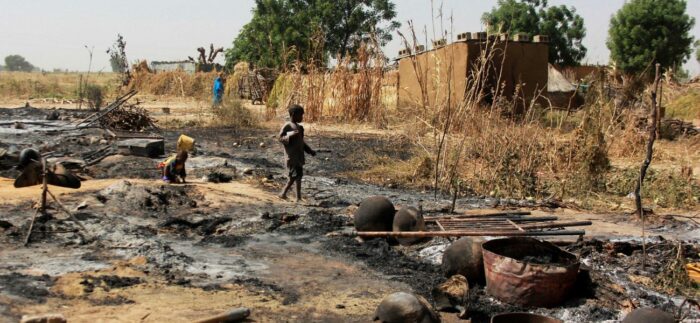
There is something deeply unsettling about how insecurity has been normalised in Nigeria, not just by the persistence of violence, but by the predictability of our leaders’ responses. Each time tragedy strikes, whether in Borno, Plateau, Benue, Zamfara, or Kebbi, the script is already written. The president dispatches a message or visits, the vice president follows, governors arrive with entourages, and political figures line up to ‘commiserate.’ Cameras flash, statements are read, promises are recycled. Then they leave until the next massacre.
At this point, Nigerians are no longer shocked by the violence but they are exhausted by the routine that follows it.
Take the recent condolence visits by Vice President Kashim Shettima to Borno State. Within days of one visit, he returned again for essentially the same reason – to mourn fresh victims of the same unresolved crisis. That repetition is not just tragic but symbolic of a broken system where leadership has become reactive rather than preventive, ceremonial rather than strategic.
Across Nigeria’s troubled regions, this cycle has played out countless times. In the North-East, insurgency has lingered for over a decade. In the North-West, banditry has evolved into a brutal economy of kidnapping and extortion. In the Middle Belt, especially in Plateau and Benue, communal violence has stretched across four decades, claiming thousands of lives. Yet, despite the longevity and scale of these crises, the most consistent government response remains condolence visits.
It raises a painful question. Have our leaders unconsciously redefined governance as the management of grief rather than the prevention of tragedy?
The cost of this failure is staggering, as every attack leaves behind grieving families, displaced communities, and a nation increasingly desensitised to bloodshed. Entire villages have been wiped out, farmers abandon their lands, worsening food insecurity, and children grow up in camps instead of classrooms. Meanwhile, security personnel (underfunded, overstretched, and often outgunned) are sent repeatedly into harm’s way, becoming sacrificial lambs in a war that lacks clear, decisive leadership.
Yet, after each incident, the same speeches are delivered. “We condemn this attack.” “The perpetrators will be brought to justice.” “This will not happen again.” Nigerians have heard these lines so often that they now sound like echoes from a hollow chamber of governance.
The truth many citizens have come to accept, rightly or wrongly, is that Nigeria’s insecurity crisis is not just a failure of capacity, but of will. There is a growing belief that these problems persist because they are politically convenient for some within the system. Whether through negligence, complicity, or sheer indifference, the political class has failed to demonstrate the urgency required to decisively confront these threats.
Just consider this, if insecurity were treated with the same seriousness as elections, would it still persist at this scale? Nigerian politicians have shown time and again that they can mobilise enormous resources, coordinate complex operations, and deploy vast networks when their political survival is at stake. Why then does that same level of urgency disappear when citizens’ lives are on the line?
Instead, what we see is a performative cycle of leadership. Helicopters land in devastated communities, convoys roll through grieving towns, and officials dressed in solemn attire offer condolences. But beyond what is seen and said, little changes. No bold reforms, no transparent accountability, no sustained, measurable strategy that Nigerians can track and trust.
This is not to say condolence visits are entirely without value. In moments of grief, empathy matters and leadership requires presence. But empathy without action becomes hypocrisy. When visits become substitutes for solutions, they lose their meaning and begin to feel like political theatre.
What Nigerians are demanding is not the absence of sympathy, but the presence of seriousness. Seriousness means investing in intelligence-driven security operations, not just deploying troops after attacks occur. It means addressing the root causes of conflict (land disputes, poverty, ethnic tensions, and governance failures) rather than merely responding to their symptoms. It means equipping security agencies with the tools, training, and morale needed to succeed. Above all, it means holding leaders accountable when they fail to protect lives.
There must also be transparency, as Nigerians deserve to know what specific steps are being taken after each incident. Not vague assurances, but concrete actions with timelines and measurable outcomes. How many arrests were made? What intelligence gaps were identified? What preventive measures are now in place?
Without such accountability, condolence visits risk becoming annual rituals, grim anniversaries of leadership failure.
The tragedy is not just that Nigerians are dying; it is that their deaths are becoming predictable. And in that predictability lies a dangerous erosion of public trust. When citizens begin to expect violence as inevitable and leadership as performative, the very foundation of the state is weakened.
Nigeria can choose to continue down this path of reactive governance, where leaders arrive after the fact to mourn what could have been prevented. Or it can choose a different path, one of proactive, courageous, and accountable leadership that prioritises the sanctity of human life above all else.
Nigerians are tired, not just of the killings, but of the choreography that follows them. They are tired of leaders who show up with condolences instead of solutions, with speeches instead of strategies, with promises instead of protection.
The time has come to move from mourning to action, because a nation that is constantly visited in grief is a nation that is being governed in failure.

Join BusinessDay whatsapp Channel, to stay up to date
Open In Whatsapp


