

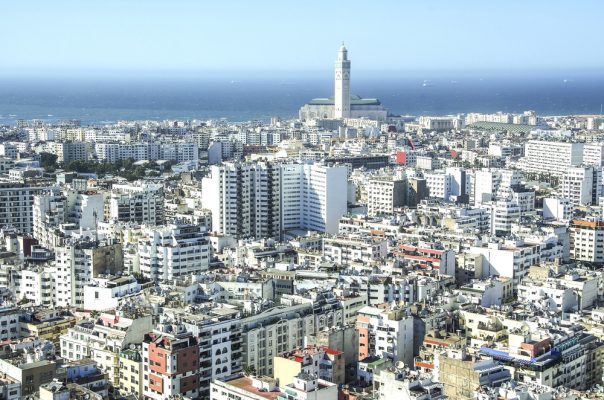
The pitch is overwhelmingly compelling for investors lured by Morocco’s luminous new ports, expansive renewable-energy projects, automotive industry, and preparations to co-host the 2030 FIFA World Cup, and its role as a stable gateway to Africa. It is therefore a little wonder that the favourite talking point among deal-makers in the corridors of CassaBlanca Finance City is that Morocco is Africa’s most sophisticated investment destination.
Also, one is not surprised with the recent announcement that Standard & Poor’s had upgraded the Kingdom’s sovereign debt to investment grade. Rather than pose a surprise, the upgrade reflects the dividends of an economy firing on multiple cylinders. With real Gross Domestic Product (GDP) growth forecast to race above 4.0 percent this year on the back of a remarkable post-drought agricultural recovery, a record-breaking tourism boom, and the unyielding expansion of high-value manufacturing clusters around Tangier and Casablanca, Morrocco offers a stable, pro-business monarchy and a modernising economy.
However, figures from a study by the Organisation for Economic Cooperation and Development (OECD) indicate that investors who scratch beneath this gleaming surface of macroeconomic resilience would surely unveil the more complicated truth of an embedded microeconomic paradox bordering on legal, regulatory, and contract enforcement issues. The monarchy is politically stable and economically active.
On the other hand, it is enormously institutionally unreliable, particularly when contracts are signed and disputes arise. Clearly, this is a type of environment where deep structural dualism creates friction for independent investors. As a result, investors, analysts, and other stakeholders are already analysing whether the impending legislative elections in September 2026 can fundamentally recast the nature of sovereign and regulatory risks.
The macro-friction of the law
Contract enforcement is still a grinding process Moroccan courts. Granted that the Monarchy has established dedicated commercial tribunals with genuine technical competence, the operational throughput of these courts is hugely hindered by out-of-date procedural requirements and an over-reliance on physical documentation. A routine commercial dispute can easily suffer neglect for two to three years before reaching a final, enforceable judgment.
For foreign investors, they frequently find that respite lies beyond obtaining a favorable court ruling, because the actual execution of judgements against well-connected local counterparties requires unending patience and bureaucratic endurance, often punctuated by endless appeals on minor technicalities. This legal drag is worsened by an ubiquitous ethos of inter-corporate arrears.
Late payments have evolved from an occassional cash-flow irritation into a structural feature of the Moroccan market. Despite legislative attempts to impose statutory penalties on overdue balances, state-owned enterprises (SOEs) and major local conglomerates routinely stretch payment timelines well beyond 120 days, effectively forcing smaller suppliers and foreign contractors to provide interest-free credit terms under the implicit threat of contract non-renewal.
An avalanche of graft and opacity
Morocco is halfway in the ladder of Transparency International’s Corruption Perceptions Index, ranking 91st out of 182 countries and scoring 39 out of 100. It is therefore neither in crisis nor among institutional leaders, but in an institutional middle ground. So, the challenge is not that there is no law. Instead, Morocco has layered regulation with some frustrating repetition. There is the 2022 Investment Charter, a reformed Commercial Code, bilateral investment treaties with dozens of partners, and active membership of the International Center for Settlement of Investment Disputes (ICSID). Rather, the challenge is in enforcement. Then there is the creeping suspicion, documented by business surveys, that only the well-connected can get enforcement.
In the same vein, companies have reported that favourable court decisions are often secured with bribes and irregular payments, while nearly 75 percent of households say that the judiciary does not have independence. The formal protections embedded in Morocco’s legal code, including freedom of contract, good-faith obligations, judicial review of administrative decisions, are largely theoretical in practice. But for a foreign investor in a dispute with a state-linked enterprise or a regionally powerful interest, the courts have historically been an uncertain arena. Critics argue that despite constitutional reforms that nominally strengthened judicial independence following the Arab Spring, the concentration of economic and political power has not fundamentally changed.
Electoral currents and the social squeeze
There is a profound collision between the challenging legal and regulatory environment and the pivotal political moment, the 2026 general election. The campaign has been remarkably miserly on detailed economic policy. Parties are apparently unwilling to engage with the hard choices ahead. Yet the choice the electorate makes will have a profound impact on the risk profile for investors.
The election is not expected to challenge the bedrock of the monarchy’s authority. While this guarantees some level of political stability, it could produce a fragmented parliament with the potential to hinder any quick or fundamental reform. The next government will inherit a daunting set of pressures. Youth unemployment is stuck at 22 percent. The cost of living has spiked, fuelling social discontent and protest movements that signal a legitimacy gap between the state and its citizens. At the other end, Morocco’s ambitious infrastructure projects like the US$1 billion Nador West Med LNG terminal have faced unexpected suspensions, exposing the gap between grand strategy and execution.
Investors’ core risks
For investors, the pre-election period carries its own risks on various fronts, among which is the intensification of domestic tax enforcement. Companies must anticipate that the tax apparatus will operate with unprecedented zeal as it seeks to extract the revenue needed to underwrite pre-election social spending.
Next is the regulatory evolution of the green transition that was driven largely by the urgent necessity to preserve smooth access to the European market ahead of the full implementation of the EU’s Carbon Border Adjustment Mechanism (CBAM). In line with this, Morocco has established a specialized Climate Unit within the Ministry of Economy and Finance, has successfully integrated climate targets into national budgetary planning and greened public procurement. But this means that ESG compliance requirements will escalate, stricter environmental permitting requirements will become stringent for investors.
The layers of investors discomfort are compounded by elite capture of public contracting. Morocco’s procurement sector is fraught with patronage that distorts market competition through the influence of a connected elite. For instance, Prime Minister Akhannouch’s company was reported to have secured a government desalination contract as recently as December 2023. This reinforces perceptions of impunity at the top. Implementation gaps remain despite the OECD’s Anti-Corruption and Integrity Outlook 2026 identifying Morocco as a country with formal anti-corruption frameworks.
Agenda for the incoming government
The agenda is actionable for any coalition that takes power in October. The incoming regime must establish a dedicated commercial court and set with international-standard timelines. It must also codify arbitral award enforcement through legislation, prosecute anti-corruption cases that visibly reach the elite, and genuinely reform the civil-service to disrupt the informal networks that route contracts to connected parties.
For a system where much authority comes from the palace instead of the parliament, one understands that none of these is easy. Nonetheless, the gap between statute enactment and practice must close. Else, Morocco’s ambitions of co-hosting the World Cup as well as becoming the green hydrogen hub and African financial centre will remain hostage to its legal infrastructure.
The bottom line
Several investors continue to bet on Morocco, for the most part, on the assumption that the monarchy will continue to commit to modernisation and be willing to sacrifice cronyist interests for the demands of international capital. That bet has paid off in several instances. However, sustainable bets are premised on institutional trust.
As Morocco’s elections approach, it should be a moment to begin closing that gap. Will the incoming government have both the mandate and the will to do so, or will it just add another layer of well-crafted legislation to an architecture that already has more foundations than floors?

Join BusinessDay whatsapp Channel, to stay up to date
Open In Whatsapp


