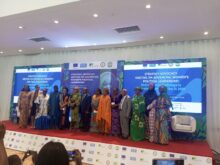
This year’s International Women’s Day celebration had an interesting theme: ‘Pledge for Parity’. The theme addressed essentially the need for commitments both in private and public life to take action(s) that will help bring about gender equality.
Gender discrimination has always occupied societal consciousness and discourse. Remarkably, very little real progress has been made in the quest for gender parity in many parts of the world, particularly in Africa. The biblical story of the daughters of Zelophehad speaks clearly to gender prejudice and the struggle for parity. God had to intervene by directing Moses to tell the Israelites that “If a man dies and has no son, then you shall transfer his inheritance to his daughter.”(Numbers 27: 8). The World Economic Forum agreed that there was a “glacial pace of progress” in the quest for parity and projected it will take another 117 years, more than a century from now, for there to be parity.
The United Nations affirmation that “equality between women and men is a matter of human rights and a condition for social justice and is also a necessary and fundamental prerequisite for equality, development and peace” notwithstanding, in many societies today, the place of women is still largely undefined. They are considered the appendages of the men and therefore discriminated against through unfair cultural, socio-economic, political as well as legal practices.
In many parts of Africa, for instance, women’s right to landed property is restricted. Female genital mutilation and child marriage are still rife in Nigeria. Violence against women and trafficking women for sex work continue to be a growing concern worldwide. In parts of the Middle East, honour killings, where women considered to have engaged in fornication or adultery are murdered by their own family members, are still being practiced.
Interestingly, women who gathered recently at the 2016 Stanbic IBTC Blue Women Network event in Lagos to commemorate the International Women’s Day started off with sober self reflection; they indicted women themselves for slowing down the pace. They argued that women are largely to blame for the inequality in society and then called for a total shift in mindset, which should be devoid of stereotype, for gender equality to be attained.
The two guest speakers at the Stanbic IBTC event, a female pilot, Captain Mercy Odushola Eghonghon, and Member, Lagos State House of Assembly representing Mushin I constituency, Honourable Adefunmilayo Tejuoso, agreed that gender inequality is often the product of the constraints and limitations women unconsciously place on themselves, either in public or private life.
According to them, for gender equality to be achieved, parents, particularly mothers, have a critical role to play in the nurturing and education of the girl-child in a way to remove stereotypes and help build self-belief, courage, self-esteem and drive. These, they say, are essential ingredients needed for the girl-child to compete on equal terms with her male counterparts.
They argued that parents have the duty to raise their children in ‘genderless’ homes. Using their personal experiences to buttress the point, the two speakers said they have been successful in male-dominated professions largely due to their upbringing in ‘genderless’ homes, where there were no differentiation between the male and female children as everyone was treated equally. “Growing up, my father would call me to assist him with the repair or servicing of the family electric generator; he would show me how to change the oil, refuel, etc, while my brother regularly assisted our mum in the kitchen,” Eghonghon said.
Chimamanda Ngozi Adichie, the Nigerian author and motivational speaker, shares this sentiment. In a speech on feminism for TEDxEuston in 2013, Adichie said women are their own worst enemies. According to her, women often feel insecure and are ‘apologetic’ for their femininity. Even on something as basic as appearance, women tend to be hesitant and defer to men. “The sad truth of the matter is that when it comes to appearance, we start off with men as the standard, as the norm. Many of us think that the less feminine a woman appears, the more likely she is to be taken seriously,” Chimamanda said.
She believes there is double standard in the way society raises children and called for a change. “We do a great disservice to boys in how we raise them. And then we do a much greater disservice to girls, because we raise them to cater to the fragile egos of males. We teach girls to shrink themselves, to make themselves smaller.”
It was essentially the same message espoused in Lean In, a controversial book by Sheryl Sandberg, the chief operating officer of Facebook. Sheryl believes women are too docile and stagnated and her book is a call to action. “We lower our own expectations of what we can achieve,” she said of women. The way forward, according to Sheryl, would be to “combine niceness with insistence.”
Indeed, women must take the lead to ensure equality is achieved and they must be insistent on concrete commitments to change. However, we would be skirting the truth to believe women alone are guilty for the inequality and are solely responsible for change. While that may be true on the social level, at the policy and governance levels, men have a larger part to play. In Nigeria, for instance, male chauvinism continues to manifest even in statutes and policies. Even in public institutions, there are discriminatory rules. For instance, Rule 122 of the Police Regulations placed all manner of restrictions on women. A married woman is not allowed to enlist in the police; a freshly enlisted single policewoman must spend two (2) years in service before marrying. And she must first apply for permission to marry and be cleared to do so before proceeding. She must submit the particulars of the fiancé, who is then investigated. So, if for personal reason(s) the superior officer does not like the fiancé, the marriage can be scuttled.
Interestingly, even supposedly democratic societies, where equal opportunity for all is enshrined in their rule books, gender parity is still largely unattainable. In its 238 years of nationhood, the United States, which prides itself as the leading democratic light, cannot boast of a female president. In employment, data from the United States Census Bureau and the country’s Bureau of Labor Statistics show that there is a wide disparity in earnings among male and female workers, who are both in full-time, year-round employment. Women in similar positions as men have been shown to earn at least 18percent less than their male counterparts. According to information provided by the American Association of University Women (AAUW), “In 2014, women working full time in the United States typically were paid just 79 percent of what men [on the same level] were paid, a gap of 21 percent.” In Saudi Arabia, women are not allowed to drive.
In the past decades, women have continued to be vocal as they sought parity with men. These efforts have brought about a number of interesting developments. The Convention on the Elimination of All Forms of Discrimination against Women (CEDAW), the Beijing Platform for Action and a number of UN Resolutions are some of the offshoot of the agitation for parity. Many will point to these achievements to buttress the fact that women are on the way to attaining parity with men.
In truth, much of the imbalance is not so much a lack of opportunity or a gender balanced policy but the failure of women to test the waters either through timidity, passiveness or ignorance. Women like Stanbic IBTC’s Sola David-Borha, Chimamanda, Sheryl, Margaret Thatcher and Hilary Clinton that have dared to challenge the norm with courage and resilience in politics, business, academia or other spheres of influence have recorded remarkable achievements, which further validates Sheryl’s call for insistence.
Zebulon Agomuo


Join BusinessDay whatsapp Channel, to stay up to date
Open In Whatsapp