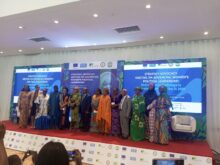
The Zinnia Hall, Eko Ekpo Centre of the prestigious Eko Hotel and Suites in the ever-busy Victoria Island area of Lagos, was filled to the brim Friday morning. The gathering was for an event tagged ‘Breakfast Seminar in honour of Richard (Dick) Kramer at 80’.
Speakers were some of the best brains drawn from the private and public sectors, who also possess intimidating résumés. Speaker after speaker spoke, with a thread running through their submissions, that Nigeria, whose economy towers above those of other countries in Africa by virtue of the recent Gross Domestic Product (GDP) rebasing, is in the real sense lagging behind its peers in terms of tangible development.
The august gathering comprising intellectuals of diverse race and colour, were unequivocal in pointing out some of the faulty steps that had left the country in a sorry state over the years.
Setting the ball rolling, Pascal Dozie, founder of the very flourishing Diamond Bank plc and a very close ally of Kramer, said it was a day to celebrate the results of Kramer’s efforts to develop others.
Dozie, a man who has seen it all in Nigeria and has created for himself an enviable position on the list of great achievers in the country, said though Dick Kramer was not naturally born a Nigerian, he was more Nigerian than most Nigerians, and has positively impacted on the country in more ways than one.
On the capability of the keynote speaker to do justice to the topic, Dozie said: “He has the knowledge of how to ‘debottle’ the bottlenecks that hinder economic development” in Nigeria.
Princeton Lyman, the keynote speaker, is not a visitor to Nigeria either. He was the United States’ ambassador to Nigeria (1986-1989), and he flew into the country to present the speech, free of charge.
Nigeria in the eyes of Lyman
Speaking on the topic: ‘Nigeria: A Nation Poised for Greatness’, Princeton Lyman, began by asking if Nigeria was really poised for greatness.
According to him, “I spent a lot of time thinking about that title. So many problems have plagued Nigeria over the years, so many opportunities gained and then squandered. So many proclamations of a new beginning, only to see them fade into oblivion. To see its international reputation tarnished by charges of corruption, ethnic and religious violence, political upheaval, and most recently by the rampages of the horrific Boko Haram.
“Is Nigeria reality ‘poised for greatness,’ or for more turmoil and disappointment? I chose the title because Nigeria is so poised. But whether it realises this opportunity is still uncertain. Nigeria could remain forever poised, but its potential greatness never realised.
“Let me say a few words about the world around us and how it impacts Nigeria’s future. Our world is changing rapidly and nowhere more than in economic opportunities and challenges. The technological revolution, in communications, manufacturing, agriculture, health, and transportation is upending older modes of operation. It is changing historic sources of comparative advantage.
“India now is a leader in IT, China in manufacturing and the leading importer of natural resources, Bangladesh is a leader in textiles production, South Korea is a leader in shipbuilding and electronics. The energy sector is changing worldwide with far-reaching implications for Nigeria.
“Oil production in sub-Saharan Africa is on the path to doubling by 2020. But as more of the production comes from offshore sources, higher costs will reduce the return per barrel by half. This will require painful adjustments in contractual relations to attract sufficient investment.
“With steadily lower revenue, diversification of the economy will become ever more urgent. On the positive side, genetically modified organisms and other advances could make Africa a principal source of agricultural supply for the world as well as overcoming deep-seated problems of hunger and malnutrition on the continent.”
Lyman further said: “Though I have been back many times since, it is exactly 25 years since I departed Nigeria as ambassador. When I was leaving someone asked what I saw for Nigeria’s future, 25 years hence. I will not try to recall all that I said, but I know it was quite optimistic. Looking back now, there have been some very significant accomplishments.”
However, he noted that one negative stands out from these figures. “Poverty in Nigeria is shockingly high, shockingly for a country with such rich human, natural, and economic resources. Poverty rates, people living on less than $1 a day, is estimated by the Nigerian government at 61 percent, more than 100 million people living on less than $1 a day.
“In the North it is even higher. Unemployment and underemployment are endemic and in some parts of the country reach 80 percent. The ramifications of poverty reach into every aspect of Nigerian society, its politics, economics, stability, and security. It is the greatest obstacle to greatness. And yet, this vast human resource, so underutilised, is a potential source for greatness,” he said.
The panelists’ verdicts
The panel of discussants were Ben Akabueze, commissioner for economic planning and budget, Lagos State; Udoma Udo Udoma, a senior partner and head of Udo Udoma and Belo-Osagie; Maryam Lemu, head or resource management and administration, and one of the directors of ProStart Consultants; Andrew Alli, CEO, Africa Finance Corporation, and Peter Bamkole, pioneer, Enterprise Development Centre (EDC) of the Pan-Atlantic University.
In his presentation, Akabueze observed that Nigeria, over the years, has suffered a deficit of good leadership and that the leadership failure “cuts across sectors, but is probably most prominent and impactful in the arena of political leadership.”
He noted that leadership failure was manifested in the level of corruption, illicit acquisition of power, lack of integrity, and lack of competence.
To achieve the desired leadership, the commissioner said there must be capacity building through formal training and mentorship programmes; religion and ethnicity must be de-emphasised as credentials for leadership; the laws and institutions to fight corruption need to be strengthened and rigorously enforced to check unregulated and unaccountable access to the public treasury, and that a national campaign to promote and enforce tax payment should be mounted.
Udoma Udo Udoma believes that “leadership matters but effectiveness depends on institutions.”
Citing instances of achievers who are today being remembered because of the institutions they built, Udoma said but for the outstanding success of a firm like Akintola William & Deloitte, the man, Akintola William would have been forgotten by now.
According to him, Kramer will be remembered by institutions like Arthur Anderson (KPMG), Capital Alliance, Pan-Atlantic University, the Nigerian Economic Summit (NESG) whose formation and nurturing he helped build.
He urged politicians to always ensure political positions are not available for the highest bidders. And that party primaries must reflect the aspirations of people. He urged the strengthening of institutions like the EFCC, Police, NAFDAC, political parties to ensure they are not tied to the apron string of some powerful individuals.
Maryam Lemu believes that the best investment must be on healthcare, social welfare, economic empowerment, policy making, security, law and justice. She strongly urged heavy investment on education of people.
“We need true social re-engineering, we need to celebrate heroes, we need to teach and give knowledge, and mentor, lay a solid foundation for the youth,” she said.
Andrew Alli, who spoke on ‘investment in physical infrastructure’, noted that no nation can be termed developed without infrastructural development. According to him, infrastructure “provides the means where people can operate optimally, and it reduces the cost of doing business.”
He listed some impediments to infrastructure development to include lack of political will, lack of adequate policy framework, lack of institutional framework and low execution capacity in government.
He said for there to be adequate infrastructure, there must be a change in government mindset, change in public attitude (willingness to pay), stable macro-economic environment, among others.
Speaking on ‘creating an enabling and supporting environment for entrepreneurial activities’, Peter Bamkole, noted that despite the privatisation of the power sector, electricity supply had not improved. He said no country achieves greatness without power “to power the nation”.
“I have no doubt in my mind that Nigeria is not lacking in entrepreneurship, what I think that is lacking is the enabling environment to make them perform well,” he said.
Zebulon Agomuo

Join BusinessDay whatsapp Channel, to stay up to date
Open In Whatsapp