It has come to be that any time the Niger Delta region coughs, the entire nation catches cold. This is because the entire global oil economy would shake violently too. Nigeria still relies on oil and gas from the region to fund its annual budget, now over N7 trillion. The 2017 budget is hinged on 2.2mbd oil flow, and serious disruption means bigger deficit and probable collapse of the budget.
Thus, when the 2016 suffered huge setback, some advisers urged the Muhammadu Buhari administration to consider dialogue instead of military actions alone. Buhari was said to have given his deputy, the professor and top cleric, Yemi Osinbajo, the nod to move to the volatile region for full consultations, after initial efforts by the ministers of Transportation and Petroleum.
Can the boys strike again?
Security experts opined that nothing has happened to make the militants unable to strike any time. They have never been disarmed despite several bogus amnesty rounds both at national and state levels. Instead, arms build-up in most parts of the country has continued, the oil region not left out. Illegal bunkering puts a lot money and thus arms in the hands of the boys, though this seems to have reduced in recent months.
The militants usually have arms dumps. When amnesty comes, they go to places such as Aba and purchase guns and hand over and qualify for huge rewards. They bury their arms and wait for the next turn. Also, there is what they call ‘community arms’. Most communities in the region fight inter-communal wars or prepare for one. The communities contribute funds to acquire large catches of arms to prosecute these wars. Most of the boys who become militants are usually veterans of these conflicts. When it is time for amnesty, they claim that the arms belong to the communities and could not be returned by individuals. This seems tricky.
There are enough idle boys to fight. There is also much hardship to fuel unrest. Most of the boys served one political lord or not, most of whom have been dislodged from power and are hunted and haunted for looting. So, flow of money from the political lords to the boys has reduced drastically.
So, nothing may have happened to make it impossible for the boys to strike again, except the accord reached between the FG and the elders and leaders of the oil region Pan Niger Delta Forum (PANDEF), led by the likes of Edwin Clark and Alfred Diete-Spiff. The accord is held by 16 strings dangling from the points of demand by the oil region on November 1, 2016.
Reason for provocation
Many however ask if any of the demands have been met. Most persons contacted in the region on this kept mute while the few that spoke said none had been met. The anger of the elders seemed to stem from the rejection of devolution of powers by the National Assembly last week. The agitators demand for true federalism and fiscal federalism. The hope of the oil region is that restructuring would hand to them the right to control their resources in a federal system where most civil and administrative functions would be handled by the states with larger revenue chunks. The hope was that much allocation would go to the states. The National Assembly seemed to deflate this hope, thus the stir.
Demands! How far?
Some of the demands have truly been fulfilled or at least attempted.
Amnesty: This was treated to the full in the 2017 budget. In 2016, only N20bn was allocated where it was N60Bn, according to the former officials of the scheme. This led to suspicion against the Buhari administration despite the fact that Amnesty scheme was scheduled for only five years by the Yar’Adua/Jonathan administration. The 2017 restored the full amount.
Military presence has reduced in the oil region and attacks and hunt of militants either reduced or stopped entirely. The army however increased surveillance against bunkering and outright burning of any vessel involved. This same points leads to addressing the fourth demand, plight of internally displaced persons (IDPs) in the region. The cessation or reduction in military raids led to corresponding reduction in refugees as fleeing villagers returned home. In parts of Rivers State, however, IDPs were caused by raging cult wars that sacked entire communities, not by military raids.
The Ogoni cleanup was launched in June 2016 and some of the institutions prescribed by the UNEP Report of 2011 have been set up. What is left is the actual cleaning plus a plan to accommodate other parts of the oil region also devastated by oil pollution. At the same time, the militants and natives are believed to be causing spills and massive pollution by other means (pipeline vandalism and bunkering plus illegal refining).
The Maritime University in Delta State has been restored, at least on paper, as fiercely demanded by PANDEF. The hunt for its major contractor, Tompolo, had mellowed down, too. By this, the oil region has two maritime universities; yet, master mariners are not being produced in Nigeria.
The FG (Osinbajo) has ordered for the relocation of oil companies to the oil region. The order seems to meet deaf ears as some others even attempted to leave the region. Also, major corporations such as NLNG and Dangote moved major investments such as dry dock and petrochemicals and refineries to Lagos. These angered the natives from where the raw materials, gas and crude oil, would be piped out.
The Niger Delta Development Commission (NDDC) has been owed since the inception and even when a Niger Delta son was president for six years. Buhari is said to have however since ordered the ministry of finance to work out the amount (believed to be about N1.7 trillion) with the NDDC and work out payment plan.
There are some demands that may require the National Assembly or a sovereign national conference such as fiscal federalism. Demands on economic development may have been hampered by recession and budget constraints but of a truth, there have been no special economic projects in the region so far.
Clark however threw more light in an exclusive interview with BDSUNDAY in Port Harcourt few days before the Aso Rock meeting. “There is so much injustice in the system. Sin they say, is a reproach to a nation but that righteousness exalts a nation. Take the case of Local Government Creation, which was an exclusive state matter. This is because if you want 20 LGAS, you create them and pay them and not when Kano state alone has 44 LGAs and do not produce nothing and yet demands money from the Federation account while Bayelsa and Rivers State put together, has just about 31 LGAS and yet produce the wealth of the nation. And yet put Jigawa’s 27 LGAs and Kano together, you know the different. Is this one nation?”
He went on: “Take another example in the NNPC, that exploits oil and its head quarters is in Abuja, instead of Port Harcourt or Warri. As of today, it has nine board members. President Buhari appointed six members from the North including the chief of staff. Only one member is from the South-South, and South West and non from the south East, which produces oil. Yet, the North does not produce even a drop of oil. Is that the country we need?”
He mentioned another point: “Now take the case of the Vice President who was elected with the President on the same ticket, and the President is ill and away for about 70 days. The Vice President was nice enough, followed the constitution and wrote the National Assembly, that he was going on vacation but certain people, who were not elected, are now making it difficult for him because they are not in power. Is this a country we need?”
It is also not clear whether the FG accepted all the demands in the first place. Issues of law and justice may sound vague, except the PANDEF leaders told the FG team what exactly they needed in such clauses. Injustice and break down of order seem to be a national malady.
Key regional critical infrastructure seems to remain critical. The East West Road remains the most critical but it was awarded by the past administration at N726Bn and ought to have been completed. There is a desire to have an energy corridor from Port Harcourt to Benin and a coastal road. Instead, the FG introduced a coastal rail line from Calabar to Lagos which seemed to receive subtle snub by lawmakers from the oil region, probably because it was being pushed by the wrong person or the wrong political party, according to an oil industry finance expert.
The Bakassi question may remain a question for long. The desire of the region is to recapture the ceded portion given to Cameroon but many argue that their son never launched a recapture war all the years he was president.
Attention seeking strategy:
Oil wells, appointments are said to be the real undertones in such situations. Two days earlier, a community in Rivers State protested against continued operation of an IOC in OML 25, demanding it be ceded to an indigenous operator that they named. The region had clamoured for allocation of oil wells, saying the north had dominated. Many had wondered how the region did not get enough all the years their son sat in Aso Rock, if oil well allocation was that easy.
Some analysts suggest that the threat last week was intended to recapture attention to the region. The region and the militants seemed to pale into insignificance in the wake of the Biafra agitation, Arewa quit notice and resurgence of Boko Haram.
The Niger Delta leaders had to speak out at a press conference addressed by the forum’s National Leader/Convener, Edwin Clark, in Abuja where they added that the killing of the power devolution bill had reduced the possibility of restructuring the country along fiscal federal lines that could eliminate the persistence of tension and strife that had be-devilled the country for a long time.
The forum said in the circumstances, it would have to insist that the federal government returned to the table with it to trash out the outstanding issues arising from the need to implement its 16-point demand for the development of the region.
Already, a militant group, the Niger Delta Revolutionary Crusaders (NDRC), has threatened to resume attacks on oil facilities on September 31, 2017. The group, in a statement Monday by its spokesman, Izon Ebi, also urged PANDEF to stop all talks with the federal government.
It added: “We have resolved that resource control, fiscal federalism and devolution of powers are the only panacea. Anything short of that will not be acceptable to NDRC and the 21st-century agitators of the Niger Delta.
“Our elders and distinguished personalities of PANDEF have tried in their advocacy. We realise that the balancing act of being elder statesmen and resource control advocates can be a very touchy act. That is why our goal is in consonance with the vision of Niger Delta’s emerging youth leaders in the clamour for resource control,” the group stated.
According to separate online media reports, Clark said: “I wish to urge the federal government to, as a matter of urgency, implement the pronouncements made by the Acting President during his fact-finding visits to the Niger Delta region, and to set up, without delay, the federal government dialogue team to engage PANDEF towards resolving the pending issues contained in the forum’s 16-point demands on behalf of the people of the Niger Delta region, by, or before, November 1, 2017 (one year anniversary of our meeting with His Excellency, President Muhammadu Buhari),”
He complained about the alienation of the people of the Niger Delta, citing appointments at the Nigerian National Petroleum Corporation (NNPC) and discrimination against indigenes of host communities in the area of indigenous oil and gas concessions.
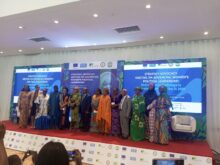
Flanked by several members of PANDEF, including King Alfred Diete-Spiff, Senator Stella Omu, Senator Henshaw and Mr. Kayode Ajulo, Clark stated that the demand for restructuring did not mean the people of the region did not believe in the corporate existence of Nigeria.
According to him, “You can therefore understand why some Northern elements are constantly opposed to any increase in the derivation formula of 13 percent under Section 162 of the 1999 Constitution (as amended) during the Political Reform Conference of 2005, and also the National Conference in 2014, where the Northern delegates vigorously opposed any increase in the derivation provision, and this was responsible for our staging a walk-out from the Conference.
“It is on record that, during the 2014 National Conference, prominent Northern delegates, again, opposed the increase of derivation revenue from 13 per cent to 25 percent. But the conference eventually recommended 18 percent derivation revenue for oil producing states, and also recommended five per cent for rebuilding the North-east that has been devastated by the insurgent activities.
“Some Northern delegates were opposed to it because Kano and Kaduna were not included.”
Opposition:
Militant group, Movement for the Emancipation of the Niger Delta (MEND) has however announced that it has dissociated itself from the Pan Niger Delta Forum (PANDEF), which it described as a hypocritical group.
MEND particularly dissociated itself from the PANDEV press conference of July 31, saying PANDEF “lacks the moral justification in giving an ultimatum to the Federal Government, and making demands they never made from Goodluck Jonathan when he was at the helm for 6 wasted years.”
“Instead of listening to the so-called Niger Delta activists and the compromised Ijaw Youth Council (IYC), who have miraculously regained the voices they lost when Jonathan was President,” alleged MEND in an emailed statement signed by its spokesperson, Jomo Gbomo.
It claimed that PANDEF ought to have used the forum and opportunity to commend the Federal Government for exposing alleged monumental looting of the nation’s commonwealth by some sons and daughters of the soil. In view of our irreconcilable differences, MEND hereby recalls its representatives in PANDEF for consultation with immediate effect.”
Intervention:
Two major interventions have taken place since the threat. The Deputy Senate President Ike Ekweremadu said the rejected bills proposing certain amendments to the 1999 Constitution could still be revisited, following further consultations and understanding of the issues.
He reiterated that devolution of more powers to the states from the exclusive list would accelerate infrastructure development.
Ekweremadu said these during a consultative meeting on South-east infrastructural development with a delegation of the Partnership to Engage, Reform, and Learn (PERL) and the United Kingdom’s Department for International Development (DfID) led by PERL’s Team Leader, Adiya Ode, in Abuja recently.
The second intervention is a meeting that just took place in Abuja between the PANDEF leaders and the Ag President, Osinbajo, most of Thursday night.
PANDEF withdraws threat?
Initial reports from the closed door meeting in Aso Rock with the Ag President indicated that PANDEF has withdrawn the threat. Speaking with journalists after the meeting, Minister of Petroelum, Ibe Kachikwu, said: “Several issues were discussed issues relating to University at Okerenkeko, issues related to development in Niger Delta generally, issues related to the amnesty program and how well it is working, issues related to NDDC operations in Niger Delta. It was very exhaustive; we looked at the 16 point agenda how far we have gone. Today was environment of peace, calm friendliness and mutual dialoguing of issues so that they will understand where we are coming from and some of the most pressing concerns that they have.”
He added; “Obviously PANDEF as a very responsible organisation always alerts us where there is an alarm bell that is going on. They did, in fact they placed their loyalty and their willingness to work with us to find solutions to the problems and the Acting President took notes of them. It wasn’t an ultimatum it was a warning for the needs of urgency. The alarm is that we need to hurry up with a lot of problems, people are frustrated, people are tired. People want to see positive action in all the problems. They probably think that we are not fast as we should be.”
Those at the meeting include: Edwin Clarke, Amayanabo of Brass, Alfred Diete-Spiff, Victor Attah, Don Etiebet, Timi Alaibe, Senator Bassey Ewa-Henshaw, Tony Uranta, Hosa Ogunbor, Godknows Igali amongst others.
BOX
The 16-point demand
1. The Presidential Amnesty Programme
2. Law and Justice Issues
3. The Effect of Increased Military Presence in the Niger Delta
4. Plight of Internally Displaced Persons (IDPs)
5. The Ogoni Clean-up and Environmental Remediation
6. The Maritime University Issue
7. Key Regional Critical Infrastructure
8. Security Surveillance and Protection of Oil and Gas Infrastructure
9. Relocation of Administrative and Operational Headquarters of IOCs
10. Power Supply
11. Economic Development and Empowerment
12. Inclusive Participation in Oil Industry and Ownership of Oil Blocs
13. Restructuring and Funding of the NDDC
14. Strengthening the Niger Delta Ministry
15. The Bakassi Question
16. Fiscal Federalism
Ignatius Chukwu

Join BusinessDay whatsapp Channel, to stay up to date
Open In Whatsapp