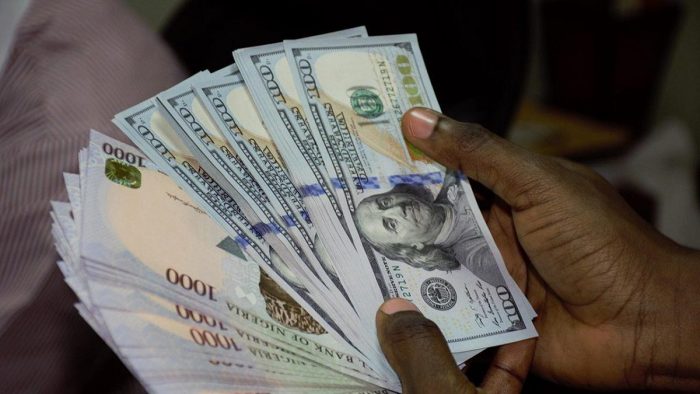
.Cites FX surplus, oil gains
Despite stabilising at N1,602.18 per dollar as of May 2, 2025, the naira should be trading below N1,000 based on current economic fundamentals, according to Tilewa Adebajo, CEO of CFG Advisory.
The naira steadied at N1,605 per dollar in the first trading day of May 2025 in the parallel market, while closing flat the same day at the Nigerian Foreign Exchange Market (NFEM).
In a statement entitled, ‘Shouldn’t the Naira Be Trading Below 1,000/$?,’ Adebajo said that a deeper and more transparent foreign exchange (FX) market, improved external reserves, and increased oil production support a stronger naira.
He noted that the spread between the parallel and official FX markets has narrowed significantly, from over 50 percent in 2022 to under 5 percent in 2025, thanks to the implementation of a Bloomberg-driven bid and offer platform that has enhanced transparency and price discovery.
The Central Bank of Nigeria (CBN) had, in December 2024, mandated all banks operating in the interbank FX market to adopt the Bloomberg BMatch system for FX trading.
“FX flows have increased. Since January 2024, FX inflows have consistently outpaced outflows,” Adebajo stated. “In 2025, average monthly FX turnovers have grown to US\$8.1 billion, compared to US\$5.5 billion in 2024.”
He also highlighted significant improvements in the country’s external buffers. Nigeria’s external reserves rose from $30 billion in March 2024 to $40 billion by September, and have since stabilised at around $38 billion in the first quarter (Q1) of 2025. The net reserve position, which had dropped to a low of $4 billion in 2023, rebounded to $23.1 billion by the end of 2024, a five-fold recovery.
“The new NNPC leadership has made reentry drilling a priority,” Adebajo added. “This common practice in mature oil fields helps to optimise production and reduce costs. According to the Nigerian Upstream Petroleum Regulatory Commission (NUPRC), rig count has risen from 18 to 38 in the past year, and is expected to hit 50 by year-end.”
He further emphasised the urgency of auditing and reconciling forward oil sales contracts, which could have major implications for FX inflows and fiscal transparency.
Commenting on trade dynamics, Adebajo noted that Nigeria’s imports in 2024 amounted to $43 billion. “Given the current FX market’s average monthly turnover, the market has the capacity to generate between $97 billion and $100 billion annually,” he said.
Subtracting the annual value of imports from market turnover, he explained, leaves around $40 billion–$50 billion available for invisible transactions and informal sector FX demands.
“So, given that the CBN has now cleared its FX backlog and currently accounts for just 2 percent of FX market turnover, where are the demand and supply exponents who still argue that dollar demand exceeds supply?” Adebajo asked.
“We need to reassess the FX market and recognise that it exists to support the economy, not as a profit centre. FX trading should be geared toward price discovery, not arbitrage,” he said.
He warned that speculation, distortion, and manipulation would continue to hinder market development and economic growth. “Transparent markets remove arbitrage opportunities, they shouldn’t facilitate them,” Adebajo added.

Join BusinessDay whatsapp Channel, to stay up to date
Open In Whatsapp