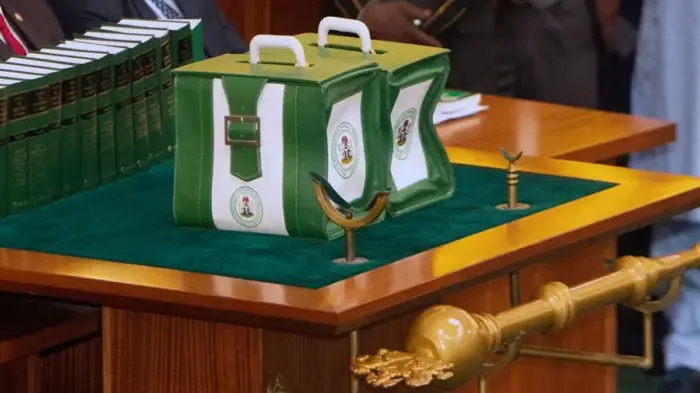
Nigeria’s annual budget approvals have increasingly become mere paper exercises, failing to deliver tangible economic development due to deeply entrenched opacity and untraceable fund releases, civic tech organisation, BudgIT has revealed.
The organisation, in its latest report: ‘2026 federal government approved budget analysis’, stated that the 2026 budget, with an expenditure of N68.32 trillion and revenue of N36.87 trillion, indicates how ambitious the government is.
It flagged the budget which it described as ‘ambitious’ and ‘unrealistic’, stating that it has been the long-standing, recurring norm in Nigeria over the years.
BudgIT also decried that over the years, revenue performance has remained weak in the nation’s budgeting system coupled with a fragile public trust in governance.
“Hence, effective budget execution requires not only the publication of allocations but also the timely disclosure of execution reports. In Nigeria, approved budgets do not necessarily translate into performance, as fund releases are opaque and untraceable.”
The organisation emphasised that the executive arm of government must prioritize credible macroeconomic assumptions, strict implementation discipline, and policy consistency to enhance budget effectiveness.
Read also: Edo Police signal progress in rescue of woman abducted at Benin Market
“A major challenge in Nigeria’s budgeting system is over-optimistic revenue projections, particularly oil revenues, which expose the budget to fiscal risks. Therefore, political appointees should ensure that revenue forecasts are
evidence-based and conservative to reduce mid-year distortions. When putting budget documents together, there is a need to focus on completing existing projects, which translates into limiting the introduction of new projects.
“The executive must also enforce zero tolerance for extra-budgetary spending and off-book expenditures, for example, the Lagos to Calabar coastal highway that does not exist in the budget in total allocations, which have historically weakened fiscal credibility.”
Noting the capital allocation in the 2026 fiscal year budget at N32.28 trillion, from an initial proposed figure of N23.21 trillion, BudgIT said that while higher capital spending is often presented as evidence of a development-oriented budget, the central question is whether the spending is sufficiently strategic, disciplined, and tied to measurable economic outcomes or merely reflects inflated and recurrent capital line items that offer limited economic returns.
Read also: Luxury stock surge propels SA’s Rupert past Nigeria’s Rabiu on billionaire list
It stated that given current fiscal constraints, the government should adopt a ‘Big Push’ approach to capital spending concentrating limited resources on a few strategically selected sectors capable of driving broad-based economic transformation.
The organisation stressed that rather than dispersing funds across numerous low-impact projects, priority should be given to critical areas such as infrastructure, education, and healthcare, where coordinated and substantial investment can unlock productivity, stimulate growth, and improve human capital outcomes.
“Equally important is ensuring that such expenditures are credible, backed by rigorous planning, realistic costing, and clear implementation frameworks.
“Considering the country’s historical challenges with budget implementation, project duplication, and weak
monitoring, it is important to interrogate whether the proposed allocations are tied to productivity-enhancing investments capable of improving growth and service delivery.
“Also, given the political economy context and proximity to the next electoral cycle, there are concerns that the budget may bear characteristics of a politically motivated, pre-election spending framework designed to maximize short term visibility rather than long-term national value,” it stated.
On the issue of debt service, the BudgIT decried that the increasing burden of debt servicing has continued to deepen the country’s fiscal fragility. It noted that in recent years, debt servicing costs have risen sharply, and largely due to exchange rate volatility, the devaluation of the naira and more acquired loans.
It stated that the pace of debt growth has outstripped revenue growth, causing debt service to absorb over 50 percent of revenues in the fiscal year.
BudgIT argued that while borrowing is not the problem, unproductive application of debt is the problem. “Persistent borrowing to finance budget deficits, rather than for productive investments, deepens fiscal vulnerability and exposes the country to exchange rate shocks,” it added.

Join BusinessDay whatsapp Channel, to stay up to date
Open In Whatsapp