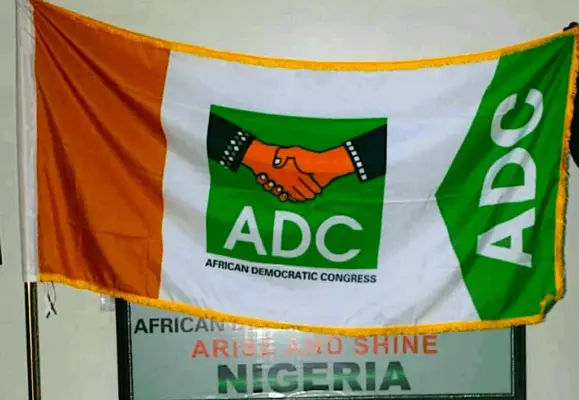
On Wednesday, the Independent National Electoral Commission (INEC) announced its decision to recognise either the David Marks-led faction or Rafiu Bala’s leadership of the African Democratic Congress (ADC).
The Commission’s decision to step back from the leadership dispute within the ADC has added a new layer of uncertainty for the party at a critical moment in the 2027 election cycle.
With deadlines for party primaries and submissions of membership registers fast approaching, INEC’s move to “maintain the status quo ante bellum” effectively freezes the ADC’s internal structure, leaving the party in a procedural limbo that could have far-reaching consequences.
Read also: We would.rather defect to ADC than APC – PDP govs, others
A party without a recognised leadership
At the heart of the crisis is a dispute between factions loyal to David Mark and Nafiu Bala Gombe over who legitimately leads the party.
In 2025, an opposition coalition adopted the ADC as its platform to challenge the All Progressives Congress (APC) in the 2027 elections. Ralph Nwosu, former national chairman, subsequently handed over the party structure to David Mark and Rauf Aregbesola, who became interim national chairman and secretary following the resignation of the party’s National Working Committee.
However, Gombe, the vice-national chairman, challenged the arrangement, insisting he should assume leadership. He filed a suit at the Federal High Court on September 2, 2025, seeking to stop Mark’s group from acting as party leaders. Although Mark appealed an interim order in the case, the Court of Appeal dismissed the appeal on March 12, 2026.
Citing the ongoing litigation, the Independent National Electoral Commission (INEC) said it would maintain the status quo as it existed before the suit was filed.
INEC’s resolution goes beyond neutrality. By declining to recognise either faction, refusing to process correspondence, and suspending monitoring of party activities, the commission has effectively shut the door on any official ADC engagements until the courts resolve the matter.
More significantly, the commission has opted to remove the names of the current National Working Committee led by Mark from its portal, in compliance with the Court of Appeal’s directive to preserve the “status quo ante bellum.”
This creates a vacuum. Without recognised leadership, the ADC may struggle to perform core statutory functions required under the Electoral Act.
Read also: ADC rejects INEC’s interpretation of Appeal Court ruling
Implications for primaries and candidate nomination
The timing of INEC’s decision is critical. Political parties are required to submit their membership registers by May 10, 2026, ahead of primaries starting in a few weeks, and only registered members are eligible to participate.
However, INEC has made it clear it will not “receive any further communication or deal with any of the parties or groups pertaining to the affairs of the party” until the Federal High Court delivers judgment.
Here are some of the implications of the INEC’s decision
Paralysis of party activities
Without INEC recognition or monitoring, any congresses, conventions, or primaries conducted by either faction risk being deemed invalid. This could ultimately disqualify ADC candidates if the process is successfully challenged.
Under the Electoral Act 2026, Section 84(1) requires the Independent National Electoral Commission (INEC) to monitor political party primaries. It mandates that parties must nominate candidates through primaries conducted in the presence of the commission to ensure compliance with the law.
Read also: When Nigeria’s economic expansion fails its people
Section 88(3) further provides sanctions for non-compliance, empowering INEC to exclude a party’s candidate from an election if the party fails to meet statutory requirements for conducting primaries, including the requirement for INEC monitoring.
Risk of missing statutory deadlines
If the leadership dispute lingers in court, the ADC may be unable to submit a valid membership register or conduct primaries within the legally prescribed timeframe as required by Section 77(4) of the Electoral Act, 2026. According to the INEC timetable, party primaries must be concluded by the end of May 2026.
Exposure to post-election litigation
Even if one faction proceeds unilaterally, candidates emerging from such processes could face disqualification suits, weakening the party’s electoral prospects.
INEC’s position is anchored in the Court of Appeal’s order directing parties to maintain the status quo and avoid actions that could “foist a fait accompli” on the court.
Read also: Nigerian states return to borrowing despite FAAC windfall
By refusing to recognise Bala Gombe as acting chairman and equally declining to validate the Mark-led structure, the commission is attempting to avoid contempt while preserving institutional neutrality.
However, this strict adherence to judicial restraint has operational consequences. In effect, INEC has prioritised legal compliance over administrative continuity, leaving the ADC to navigate the electoral calendar without institutional backing.
Political consequences for the opposition coalition
The ADC’s internal crisis comes at a delicate time. The party had been adopted as a platform by opposition figures seeking to challenge the ruling party in 2027.
The involvement of high-profile figures like Atiku Abubakar, Peter Obi, Nasir El-Rufai, and others had raised expectations that the ADC could evolve into a formidable coalition vehicle.
INEC’s decision now complicates that trajectory. A prolonged leadership vacuum could weaken confidence among coalition partners, delay strategic planning for primaries, and trigger defections to more stable platforms.
In Nigeria’s fluid political environment, uncertainty often translates to loss of momentum.
Ultimately, the ADC’s fate in the 2027 elections may hinge less on political strategy and more on judicial timelines.
If the Federal High Court delivers a swift ruling, the party may still have time to regularise its processes. But if the case drags, the ADC risks being structurally excluded from key stages of the electoral process.

Join BusinessDay whatsapp Channel, to stay up to date
Open In Whatsapp