Julius Maada Bio, Chairman of the Authority of Heads of State and Government of the Economic Community of West African States (ECOWAS), has challenged the regional bloc to move beyond lofty declarations and ensure that its policies translate into tangible improvements in the lives of more than 450 million West Africans.
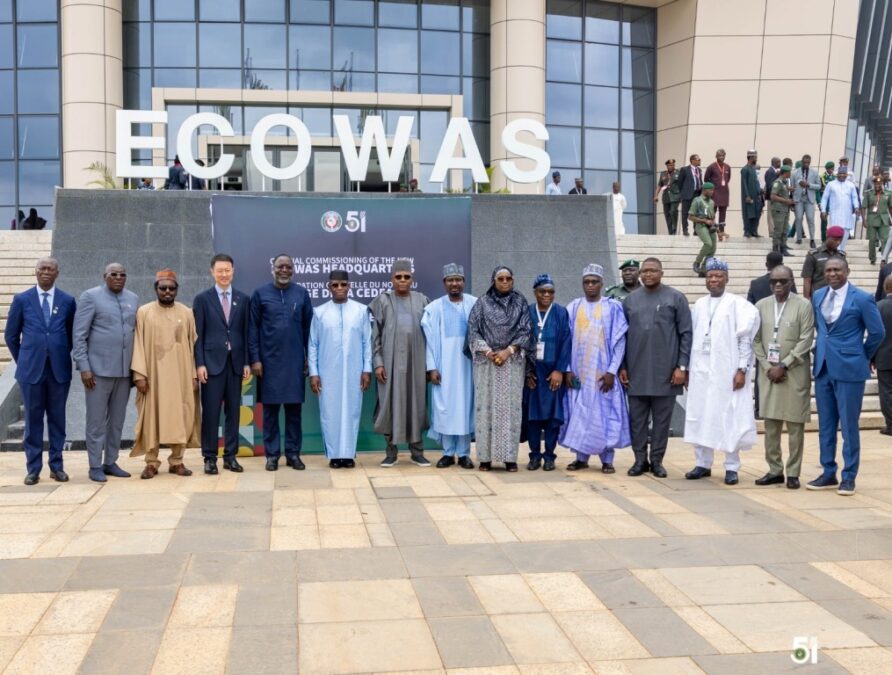
Speaking on Thursday during the commissioning of the new ECOWAS Commission headquarters in Abuja, Bio said the newly inaugurated edifice represents far more than an architectural accomplishment.
He described it as a lasting symbol of the region’s shared vision, collective responsibility and unwavering commitment to regional integration, peace and prosperity.
According to him, the true measure of the institution will not be the grandeur of its headquarters but its ability to deliver meaningful change for the people it serves.
“This headquarters is the permanent home of our shared vision, collective ambition and enduring commitment to regional integration and prosperity. What matters is not how it was built, but how faithfully it advances the aspirations of the people of West Africa,” he said.
The Sierra Leonean President stressed that citizens across the region are no longer interested in promises but in concrete outcomes that improve livelihoods through expanded trade, employment opportunities, enhanced security and greater inclusion of young people and women.
He noted that West Africans expect borders that facilitate commerce rather than obstruct it, governments that uphold democratic principles and regional institutions capable of responding effectively to emerging security, political and economic challenges.
Bio paid tribute to Nigeria and President Bola Tinubu for the country’s unwavering support for ECOWAS since the organisation’s establishment in 1975.
He described Nigeria as the backbone of regional integration, citing its consistent financial contributions, diplomatic leadership and political commitment to the growth and stability of the sub-region.
The ECOWAS Chairman also expressed appreciation to the government of the People’s Republic of China for financing the construction of the new headquarters, describing the project as a demonstration of strong international cooperation founded on mutual respect and partnership.
Reflecting on ECOWAS’ achievements over the past five decades, Bio highlighted the bloc’s successes in promoting the free movement of persons, conducting peace support operations, mediating political crises and defending constitutional governance across member states.
However, he warned that the region is now confronted with increasingly complex threats, including terrorism, violent extremism, political instability, climate change, economic uncertainty and the disruptive effects of rapid technological advancement.
The Sierra Leonean leader expressed concern over the resurgence of unconstitutional changes of government in parts of West Africa, insisting that ECOWAS remains committed to defending democratic governance while encouraging dialogue and peaceful political transitions.
“Our response has been guided by principle, not expedience. The people of West Africa deserve governments they freely choose, governments that are accountable and committed to serving them,” he stated.
Bio also called on member states to intensify efforts towards achieving the objectives of the ECOWAS Vision 2050 by deepening regional integration, encouraging innovation, attracting investment and creating economic opportunities for the region’s youthful population.
He observed that more than 60 per cent of West Africa’s population comprises young people, making youth empowerment central to the region’s long-term development agenda.
He equally advocated greater inclusion of women in economic development, peacebuilding and democratic governance, describing them as indispensable partners in shaping West Africa’s future.
Bio urged officials of the ECOWAS Commission to ensure that every decision taken within the new headquarters reflects integrity, professionalism, transparency and accountability.
“Public trust is never inherited. It is earned every day through integrity, accountability, transparency and excellence. Let every office inspire excellence, every meeting produce solutions and every decision strengthen the confidence of the people we serve,” he said.
Representing Tinubu at the event, Kashim Shettima, Vice President described the new headquarters as a powerful symbol of renewal, resilience and hope for West Africa.
He said the inauguration represents not only the opening of a landmark facility but also the renewal of ECOWAS’ commitment to regional integration, solidarity and shared prosperity.
Shettima commended the Chinese government for financing the project and praised the ECOWAS Commission, contractors and all stakeholders involved in delivering the headquarters.
While acknowledging the bloc’s achievements in peacebuilding, democratic governance, economic cooperation and the free movement of people and goods, he noted that terrorism, food insecurity, climate change, public health emergencies and economic vulnerabilities continue to threaten regional progress.
The Vice President urged member states to transform West Africa from a consumption-driven market into a production-based regional economy through accelerated industrialisation, stronger regional value chains and expanded investment opportunities for young people.
“Our integration must increasingly be driven by what we produce rather than by what we consume. A community that consumes what it does not produce will forever depend on the goodwill of others,” Shettima said.
He added that the newly commissioned headquarters should serve as a centre for dialogue, innovation and collective action where leaders formulate policies capable of advancing peace, unity, economic prosperity and the welfare of the people of West Africa.

Join BusinessDay whatsapp Channel, to stay up to date
Open In Whatsapp