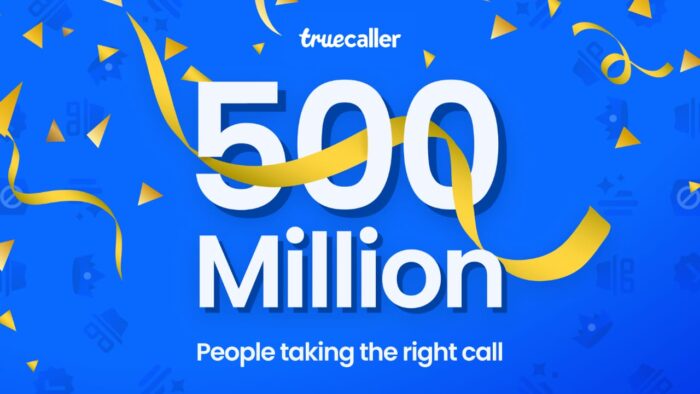
Truecaller has crossed 500 million users globally.
The Stockholm-headquartered company, listed on Nasdaq Stockholm, now sits at the centre of a quiet but profound shift in how people interact over the phone. What was once a basic utility, answering a call, has become a calculated decision, increasingly mediated by technology.
Truecaller’s latest figures underline this transformation. The platform added over 50 million users in 2025 alone, pushing its global base past the 500 million mark, with more than 150 million users now outside its largest market, India. It has also crossed 4 million paying subscribers, turning what began as a simple caller ID tool into a scalable subscription-driven business.
The rise of the “trust layer”
In theory, telecommunications networks were designed to be neutral pipes, tools for seamless human connection. In practice, they have become increasingly polluted by spam, fraud, and unsolicited outreach.
Truecaller’s own data reflects the scale of the problem. The platform identified 68 billion spam and fraud calls in 2025 alone. That figure does not just highlight the company’s reach; it exposes the magnitude of the threat embedded within modern communication systems.
As a result, apps like Truecaller are no longer optional add-ons. They are becoming a new layer of infrastructure—a “trust layer”—sitting between users and the networks they rely on.
Rishit Jhunjhunwala, the company’s CEO, acknowledged as much, noting that the milestone reflects “the scale of need” for tools that help users navigate spam and scams. His comment points to a broader reality: digital communication is no longer self-authenticating. It requires verification.
From feature to infrastructure
Truecaller’s evolution mirrors that shift. What began as a caller identification feature has expanded into a full-fledged communication utility, helping users screen calls, detect fraud, and manage messaging safely.
With over one billion downloads globally, the platform is now embedded in the daily habits of hundreds of millions of users. It operates less like an app and more like a background system, quietly shaping who gets through and who does not.
That transformation has significant economic implications.
First, it creates a new category of digital services built around trust and verification. Second, it opens up monetisation pathways beyond advertising, particularly through subscriptions. The company’s 4 million paying users suggest that consumers are increasingly willing to pay for safety, not just connectivity.
A lean model, outsized reach
Perhaps more striking is how Truecaller has achieved this scale. Despite serving half a billion users, the company operates with a workforce of roughly 470 employees.
That ratio—massive global reach powered by a relatively small team—underscores the efficiency of platform-based business models. It also highlights the increasing role of data, algorithms, and network effects in building digital utilities.
The more users Truecaller has, the better it becomes at identifying unknown numbers and flagging suspicious activity. In turn, that improved accuracy attracts even more users, reinforcing a powerful feedback loop.
What it means for emerging markets
While Truecaller’s growth is global, its relevance is particularly acute in emerging markets like Nigeria, where spam calls, fraud attempts, and informal communication channels are widespread.
In such environments, the absence of strong identity verification systems makes users more vulnerable. As a result, third-party platforms often step in to fill the gap—effectively becoming private-sector solutions to what is, at its core, a public infrastructure problem.
Users are choosing convenience and immediate protection, even if it comes from outside the traditional telecom framework.
The road to a billion
Truecaller has set its sights on reaching one billion users, a target that would place it among the most widely used digital platforms globally.
Whether it achieves that milestone will depend less on marketing and more on the persistence of the problem it is trying to solve.
If spam and fraud continue to proliferate, demand for trust layers will only deepen. In that sense, Truecaller’s growth is not just a story of innovation—it is a reflection of systemic weakness in global communication systems.
Crossing 500 million users, then, is not just a corporate milestone. It is a reminder that in today’s digital economy, trust is no longer built into the system. It is something users must actively install.

Join BusinessDay whatsapp Channel, to stay up to date
Open In Whatsapp