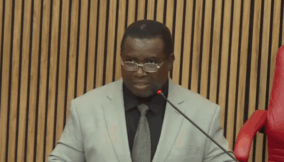
Olusegun Adesokan, Executive Secretary of the Joint Revenue Board (JRB), has said the tax reforms introduced by President Bola Tinubu are designed to reduce the tax burden on low-income Nigerians while broadening the country’s revenue base through improved compliance and technology.
Adesokan spoke on Thursday at the 2026 BusinessDay Tax Conference themed “Navigating the New Tax Regime: What It Means for Your Wallet,” where policymakers, tax experts and business leaders gathered to examine the implications of the government’s ongoing tax reforms.
According to him, the reforms seek to simplify Nigeria’s tax system, promote fairness and transparency, and ensure that taxation no longer discourages investment or productivity.
“I would like to begin by congratulating Nigerians on the reforms and also correcting whatever misinformation is out there.
“Taxation sometimes appears abstract because of the technical language used, but the goal of these reforms is to make the system easier for citizens and businesses to understand”, Adesokan said.
Adesokan explained that one of the core objectives of the reforms is to consolidate Nigeria’s fragmented tax laws into a more unified and accessible framework.
Read also: Nigeria’s new tax regime: Income tracking powers of tax authorities and data protection concerns
Previously, taxation in Nigeria was governed by several different laws, including the Personal Income Tax Act, the Company Income Tax Act, capital gains legislation and value-added tax provisions.
Under the new structure, many of these provisions have been integrated into a single framework known as the Nigeria Tax Act, which contains different chapters addressing specific tax categories.
“This new arrangement allows anyone to go through one law and understand the various tax obligations,” he said.
The framework includes sections on personal income taxation, corporate taxation, value-added tax, petroleum profits tax, and capital gains tax, now referred to as “targeting gains.”
Adesokan said the reforms are guided by a philosophy articulated by Tinubu, which seeks to shift the focus of taxation away from individuals’ livelihoods toward profits and wealth creation.
He explained that the government intends to stop “taxing poverty” and instead create a balanced system that benefits government, businesses and citizens alike.
“The idea is to create a win-win situation. A win for government in terms of revenue, a win for companies in terms of growth and investment, and a win for citizens through a fair and transparent system”, he said.
Read also: New tax law critical to spur investment, shield low-income earners — Uwaleke
He added that the reforms include measures designed to protect investments, support job creation and strengthen the operating environment for businesses.
Another pillar of the reforms is the increased deployment of technology in tax administration.
According to Adesokan, digitising tax processes will reduce human interference, limit corruption and close revenue leakages across federal and state tax systems.
“When technology is deployed, it reduces the propensity for compromise. It blocks leakages and ultimately increases tax revenues”, he said.
He stressed that improved transparency would also enable citizens to hold governments accountable for how tax revenues are utilised.
Adesokan said one of the most significant outcomes of the reforms is that the majority of Nigerian workers will pay less tax or none at all.
He noted that about 90 percent of income earners in the country, particularly those earning around N12 million annually or less, would either see lower tax deductions or be exempt entirely.
“For most Nigerians, if they check their take-home pay under the new system, they will see an increase because they are paying less tax,” he said.
He explained that lower tax deductions would leave households with more disposable income, enabling them to spend more and support economic activity.
The reforms also introduce stricter compliance requirements, particularly regarding record-keeping for employees and businesses.
Adesokan also said employers are required to file annual tax returns for their employees by January 31 each year, detailing the taxes deducted and remitted in the previous year.
“Employees themselves must also file individual tax returns, typically by March 31.
“Filing returns allows tax authorities to verify income declarations and determine whether taxpayers are eligible for refunds or reliefs.
“Keeping records is extremely important. Many people have taxes deducted from dividends, interest from fixed deposits, or withholding taxes from other income streams. These records can help them claim refunds where they have paid excess tax”, he said.
Adesokan highlighted several deductions that are exempt from taxation under the new framework.
These include contributions to pension schemes, payments into the National Housing Fund, contributions to the Nigeria Social Insurance Trust Fund and interest payments on mortgages.
He said such exemptions encourage savings and long-term financial planning while increasing citizens’ disposable income.
“These deductions are not taxed, which means taxpayers have more money left after fulfilling their obligations,” he said.
Adesokan also disclosed that new presumptive tax regulations have been introduced to bring more participants in the informal sector into the tax net while protecting very small businesses.
He said individuals operating micro-businesses with an annual turnover below N12 million would be exempt from taxation.
However, businesses above that threshold would pay a simplified tax calculated as a small percentage of turnover. The presumptive tax regime, he explained, is aimed at formalising economic activity in Nigeria’s vast informal sector, which accounts for a significant portion of employment.
Adesokan warned that the reforms also outlaw cash tax collections and illegal roadblocks used by non-state actors to extort money from businesses and transport operators.
He said the JRB plans to collaborate with security agencies to enforce compliance and dismantle such practices.
“If any tax officer approaches you for cash collection, you should know that it is illegal,” he said.
The board is also working with authorities to establish a national task force to address illegal tax enforcement activities across the country.
Adesokan said the reforms extend beyond federal taxation and include efforts to harmonise taxes across states.
He revealed that several states have already adopted a Model Taxes and Levies Act designed to streamline subnational tax collections and eliminate multiple taxation. According to him, the law also criminalises illegal tax collection and establishes clearer rules governing levies imposed by state and local governments.
Read also: Tax reforms will improve lives, lift low-income earners – Shettima
“Fourteen states have already passed the legislation, while about sixteen others are currently considering it in their state assemblies.
“When fully implemented nationwide, the framework will standardise taxes across all 36 states and the Federal Capital Territory, making it easier for businesses to operate across state boundaries”, Adesokan noted.
Adesokan further emphasised that the reforms do not introduce new taxes but rather seek to increase revenue by expanding the number of taxpayers and improving compliance.
“The government is not introducing new taxes. What we are doing is bringing more people into the tax net and using technology to ensure transparency”, he said.
He added that improved compliance would enable the government to generate more revenue needed for infrastructure development and public services.
“At the end of the day, taxation is a collective responsibility. Citizens must pay their taxes, and governments must also be accountable for how those resources are used,” Adesokan said.

Join BusinessDay whatsapp Channel, to stay up to date
Open In Whatsapp