…Says state police bill, product of national consensus, not politics
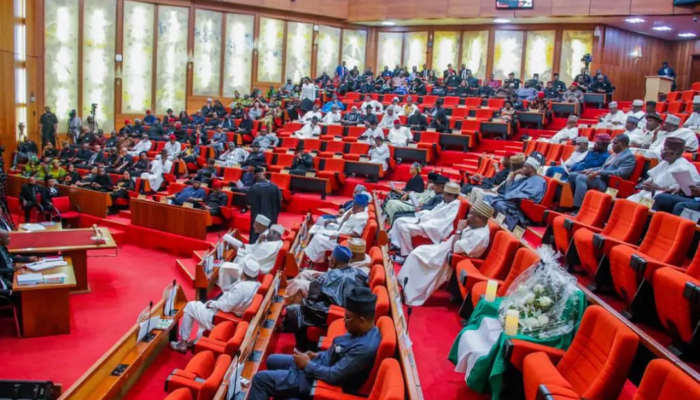
The Senate has defended the passage of the Constitution of the Federal Republic of Nigeria (Alteration) (State Police) Bill, 2026, insisting that the proposal emerged from extensive nationwide consultations and enjoyed overwhelming legislative support rather than political considerations.
The red chamber’s response comes days after the passage of the Constitution of the Federal Republic of Nigeria (Alteration) (State Police) Bill, 2026, which has generated mixed reactions across the country.
While several opposition figures have endorsed the concept of state police, they have questioned the timing of the reform and warned of the potential for abuse by state governors.
The African Democratic Congress (ADC), for instance, backed the establishment of state police but cautioned against what it described as a rushed implementation, warning that introducing the new policing structure without adequate safeguards could expose it to political manipulation, particularly ahead of the 2027 general elections.
Similarly, Peter Obi argued that although State Police is necessary, its implementation should be deferred until after the next general election.
Responding to criticisms that have trailed the passage of the bill, Opeyemi Bamidele, the Leader of the Senate, said the establishment of State Police was “purely a child of necessity and not of political expediency” and reflected broad national consensus.
In a statement issued on Sunday by his Directorate of Media and Public Affairs, Bamidele disclosed that 84 of the 109 senators voted in support of the bill during its clause-by-clause consideration, representing 77.06 per cent approval in the upper chamber.
“Even though the APC is the majority, there are members of opposition parties – PDP, ADC, NDC and Labour Party – that exercised their discretion in favour of the Bill, mainly in the national interest and not on parochial basis.
“In the Senate, for instance, 84 out of 109 members voted clause by clause in support of the Bill. This accounted for 77.06% approval at the Senate alone,” he said.
He argued that the proposal sould not be delayed because of political calculations in view of the country’s worsening security challenges.
“The legislative initiative is purely a child of necessity and not of political expediency as well as a product of national consensus and not of cynicism,” Bamidele said.
He added that the proposal to establish State Police “is one of urgent public importance, which could not and should not take a back seat because of anyone’s political aspirations in the light of stark realities currently facing the country.”
According to him, the move to create State Police did not begin recently but originated from memoranda submitted during the ongoing constitutional amendment process.
He explained that the proposal underwent rigorous scrutiny because of its sensitivity, including consultations with the Executive, the Nigeria Governors’ Forum, the Conference of Speakers of State Legislatures and the leadership of the Nigeria Police.
Bamidele said the National Assembly also conducted public hearings across the six geopolitical zones in July 2025, where participants overwhelmingly endorsed the proposal.
“The state police proposal was part of memoranda submitted to the Senate Ad-hoc Committee on the Review of the 1999 Constitution,” he said, noting that the memorandum “had been subjected to rigorous process and multi-tiered consultation across the federation due to its sensitive nature.”
He added, “At each level of our consultation, nearly all stakeholders embraced the State Police Bill in the light of stark realities we are facing today.”
The Senate Leader said the Nigeria Police made significant contributions to the drafting of the bill, particularly on accountability and oversight mechanisms designed to prevent abuse of State Police by political actors.
He noted that the Police’s endorsement underscored the national importance of the proposal.
“The resolve of the Nigeria Police to support the Bill obviously highlights its strategic national significance to deal with insecurity at local and state levels,” he said.
Bamidele further maintained that security should rise above partisan politics.
“Globally, security is a collective public good that benefits citizenry across ethnic, political and religious divides. Political actors elsewhere always throw off their togas of partisanship and parochialism to support initiatives that will boost and reinforce national security,” he said.
He urged opposition parties to contribute ideas that would strengthen peace and national stability rather than oppose reforms for political reasons.
“At this challenging time, opposition parties and leaders should come forward with ideas that would deepen the peace and stability of the federation.
“Even when they disagree on some grounds, they are under obligations to provide credible and useful ideas that can make our nation better and greater. Unfortunately, they have not passed this critical test of opposition democracy,” Bamidele added.

Join BusinessDay whatsapp Channel, to stay up to date
Open In Whatsapp