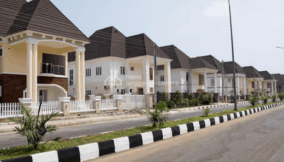
Sakeholders in Nigeria’s real estate sector have raised concerns that Nigeria’s persistent housing deficit will remain an insurmountable crisis unless the country shifts from fragmented, short-term interventions toward a unified framework that aligns policy, private capital, and regulatory governance.
Speaking at the ‘Abuja Real Estate’ conference, organised by BusinessDay Media Limited on Thursday, industry stakeholders argued that years of isolated interventions, ranging from ad-hoc mortgage schemes to sporadic government housing projects, have failed to deliver scalable impact due to a lack of institutional trust and synergy.
Delivering his address at the conference, Bature Mohammed, president of the Nigerian Institute of Estate Surveyors and Valuers (NIESV), explained that the major challenge bedeviling Nigeria’s real estate sector is centered around building a trusted ecosystem in which policy, finance, governance, and professional expertise converge to produce measurable outcomes.
He explained that to unlock large-scale domestic and international investment, Nigeria must strengthen its enforceable property rights, transparent land administration, and reliable property and market data, among other critical fundamentals.
“The emphasis must not merely be on policy formulation, but on policy implementation. Across Nigeria, we have no shortage of policies. We have development plans, housing policies, urban renewal initiatives, infrastructure master plans, mortgage reform proposals, and land administration guidelines. Yet the gap between policy and tangible projects remains significant.
“Policies do not build houses, policies do not construct roads, policies do not create industrial parks, policies do not deliver affordable housing—but people do, institutions do, professionals do, investors do.
“The challenge before us, therefore, is to build a trusted ecosystem in which policy, finance, governance, and professional expertise converge to produce measurable outcomes,” he said.
Speaking on mobilizing capital for investments, Mohammed stated that Nigeria possesses significant pools of capital, including pension funds, insurance funds, sovereign investment funds, and private equity.
Mohammed stressed that the challenge is not necessarily the availability of funds, but creating investment-grade projects. He explained that institutional investors require projects that are properly planned, professionally valued, legally secure, financially viable, and transparently governed.
“If Nigeria is to unlock trillions of Naira in long-term investment, professional real estate advisory services must become an integral part of project development from conception to completion.
“No nation can achieve sustainable real estate development while operating an inefficient land administration system. Lengthy title registration processes, fragmented land records, overlapping institutional responsibilities, and uncertainty in property ownership discourage investment.
“Government at all levels must prioritise digital land registries, faster processing of titles, Geographic Information Systems (GIS), transparent consent procedures, efficient dispute resolution mechanisms, and improved access to cadastral information. A modern land administration system reduces investment risk and significantly improves the ease of doing business,” he added.
Expanding on financial solutions, Mujahid Usman, a financial analyst at the Ministry of Finance Incorporated Real Estate Investment Fund (MREIF), noted the urgent need for strong public-private partnerships to tackle Nigeria’s housing deficit, which is estimated at 20 million units. He emphasized that the fundamental crisis stems from affordability and financial access.
Usman explained that to address these affordability concerns, the government is focusing on structuring true mortgages aimed at lowering long-term financing costs for citizens.
“And the mortgage penetration is still less than 1 percent, whereas other countries are having up to 20, 30, or even up to 50 percent in terms of penetration to GDP. So this says a lot, because that means that most of the people do not have capacity in terms of paying for these houses.
“And typically, the nature of the contract that is happening now is that developers are asking for huge sums of money within a short period of time that they call mortgages, but they are really not mortgages. They put heavy financial burden on people, and it’s just not the way to go. It’s not done like that anywhere.
“A World Bank study showed that over 70 percent of household income goes into housing. If over 70 percent of what you earn is going towards your housing, how are people meant to thrive?” Usman said.
Highlighting interventions by MREIF, Usman noted that the fund currently provides mortgages at a 9.75 percent interest rate with a 20-year tenure and a 10 percent down payment requirement per individual.
“And this mortgage is open to all Nigerians, whether you work for government, whether you’re in the private sector, or whether you’re in the diaspora. You can access the mortgage, provided your income can satisfy the loan amount,” he said.
Usman further outlined MREIF’s secondary mandate: offering cash-backed offtake guarantees as credit enhancement instruments to compensate for current constraints in direct construction financing.
“Because right now we do not have the capital to go directly into construction finance, we provide developers with credit enhancement instruments in the form of offtake guarantees that they can use to access construction loans at different banks or financial institutions.
“What the guarantee says is that, provided you build your houses up to 75 percent completion and you have not sold those houses, we will uptake those units from you. That means we will buy those houses and enable buyers to access mortgages on them,” he added, revealing that MREIF has originated over 2,000 mortgages in its first year of operation.

Join BusinessDay whatsapp Channel, to stay up to date
Open In Whatsapp