…As lawmakers defer to ICPC, experts warn Parliament risks ceding core constitutional responsibilities
The Senate’s decision to shelve its own investigation into the controversial N1.3 billion budgetary allocation to the purported Presidential Foreign Intervention Promotion Council (PFIPC) has raised fresh questions on its constitutional oversight function.
The red chamber on Wednesday declined to adopt a motion seeking a comprehensive probe into how the PFIPC, an organisation publicly disowned by the Presidency as “fake,” “fictitious” and unauthorised, found its way into the 2026 Appropriation Act with a budgetary allocation of N1,302,978,784.
Instead, the Senate resolved to await the outcome of an investigation already ordered by President Bola Tinubu and being conducted by the Independent Corrupt Practices and Other Related Offences Commission (ICPC).
The decision has reignited concerns over the integrity of Nigeria’s budget process, amid recurring allegations of budget insertions, padding and weak legislative scrutiny.
The controversy erupted after the Presidential Foreign Intervention Promotion Council surfaced in the 2026 Appropriation Act with more than N1.3 billion in allocations despite senior Presidency officials distancing the Federal Government from the body and describing it as unauthorised.
The allocation comprised N802.98 million for personnel costs, N200 million for overheads and N300 million for capital expenditure, appropriations typically reserved for a fully operational government agency.
Following public outrage, President Tinubu directed the ICPC to investigate how the entity found its way into the national budget and identify those responsible.
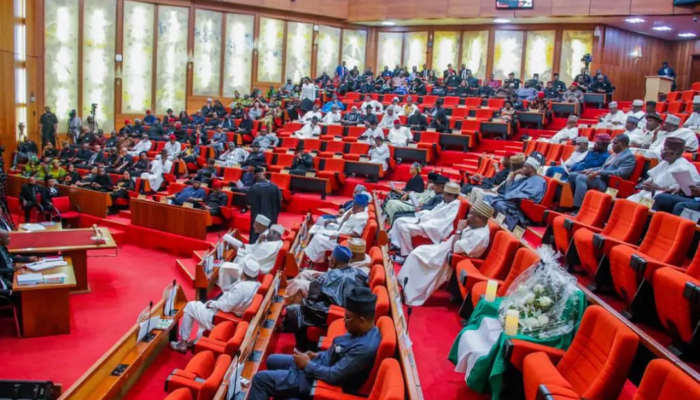
Barely 24 hours after the President’s directive, the issue came to the fore on the floor of the Senate Chamber.
The argument was advanced by Suleiman Kawu (Kano South), who sponsored an urgent motion under Orders 9 and 9(c) of the Senate Standing Rules.
Rather than focusing on whether the PFIPC should exist, Kawu said his concern was the integrity of the appropriation process itself.
He pointed out that it was a dent on the image of the National Assembly and its budgetary process.
“The issues raised directly affect the integrity of the Senate, the credibility of the National Assembly and the effective exercise of our constitutional oversight and appropriation responsibilities,” he told lawmakers.
He warned that allowing a purportedly non-existent agency to receive public funds undermined confidence in Parliament and Nigeria’s fiscal governance.
“The inclusion of a purportedly non-existent or unauthorised entity in the national budget undermines the credibility of the appropriation process, exposes weaknesses in institutional budgetary scrutiny, erodes public confidence in the National Assembly, and subjects the Federal Government to avoidable domestic and international criticism regarding transparency, accountability and fiscal governance,” Kawu said.
His motion sought to empower the Senate Committees on Ethics and Appropriations to establish how the budget line was introduced, identify the ministries, agencies or public officials involved and determine whether any funds had already been released.
The motion, however, was ruled out after a voice vote favouring the Nays.
Deputy Senate President Barau Jibrin, who presided over plenary, ruled that the chamber should await the ICPC investigation before taking any action.
“Senator Kawu, you have tabled your motion and the Senate has noted it, but since the issue is being critically investigated by ICPC as directed by President Tinubu, the Senate will await the report of ICPC before taking any action on the controversial issue,” Barau ruled.
Although his motion was effectively blocked, Kawu maintained that Parliament still had an obligation to investigate how the controversial allocation entered the budget.
“My concern is not the creation of the agency,” he told journalists after plenary.
“My concern is that the power of appropriation lies in the National Assembly. Therefore, we exercised that power by approving the inclusion of that agency in our budget.
“I just want to be sure who is responsible for facilitating the inclusion.”
He argued that the source of the budget provision remained the central question.
“If it is from the National Assembly, we can understand. If it is from the Budget Office to the Villa to the National Assembly, we can understand. They must tell us where the budget emanated from.”
While welcoming the President’s directive to the ICPC, the senator insisted the legislature could and should conduct its own inquiry alongside the executive investigation.
Constitutional experts argue that the Senate’s oversight responsibility is fundamentally different from the ICPC’s criminal investigative mandate.
Under Sections 88 and 89 of the Constitution, the National Assembly has powers to investigate public institutions to expose corruption, inefficiency and waste, and to make laws that strengthen governance.
Those powers exist independently of criminal investigations.
Historically, legislative probes have run simultaneously with investigations by the ICPC, EFCC and the police without constitutional conflict.
For Ifeanyi Odili, National President of the Campaign for Democracy, the Senate missed an opportunity to reinforce accountability.
“The reason is simple: the Senate and the ICPC have different mandates, and both are needed for real accountability,” he said.
“The ICPC, as an executive agency, is focused on criminal investigation and possible prosecution.
“ The Senate’s role under the constitution is oversight. It is to examine how public funds were appropriated, whether due process was followed in the budget, where the loopholes are, and what reforms can prevent a repeat.”
Odili warned that allowing only the executive to investigate the matter sends the wrong signal.
“If the Senate waits for the executive to investigate itself, it cedes that constitutional duty and creates the impression that the executive is marking its own script.
“That does not strengthen accountability; it weakens it.”
According to him, both investigations could have proceeded without undermining one another.
“A parallel Senate investigation does not undermine the ICPC.
“It complements it. The Senate can hold public hearings, summon MDAs and expose process failures while the ICPC focuses on criminal liability.”
He also argued that the Senate’s decision risks deepening public scepticism about the budget process.
“The more responsible approach would have been to respect the ICPC’s mandate while also conducting legislative oversight. Whether deliberate or not, the outcome looks like avoidance.”
Christian Okeke, a Political scientist at Nnamdi Azikiwe University, described the Senate’s decision as constitutionally indefensible.
“It is constitutionally wrong for the Senate to have decided to wait for another body to conduct an investigation into an issue that it has interest in,” he said.
According to him, the latest decision reflects a broader institutional pattern.
“The action of the Senate reveals an entrenched tradition of institutional negligence.”
Okeke argued that Parliament squandered an opportunity to restore confidence in Nigeria’s appropriation process.
“The Senate’s decision was a disservice to taxpayers whose hard-earned money was appropriated for a purported agency now enmeshed in controversy.”
He added that allowing the executive to investigate itself raises serious questions about transparency.
“It is a sad day that the Senate pushed away its core oversight responsibility to another arm, despite possessing every necessary instrument to unravel the truth and ensure that someone is held accountable.”

Join BusinessDay whatsapp Channel, to stay up to date
Open In Whatsapp